Hardness on the Mohs scale: 5 – 5.5
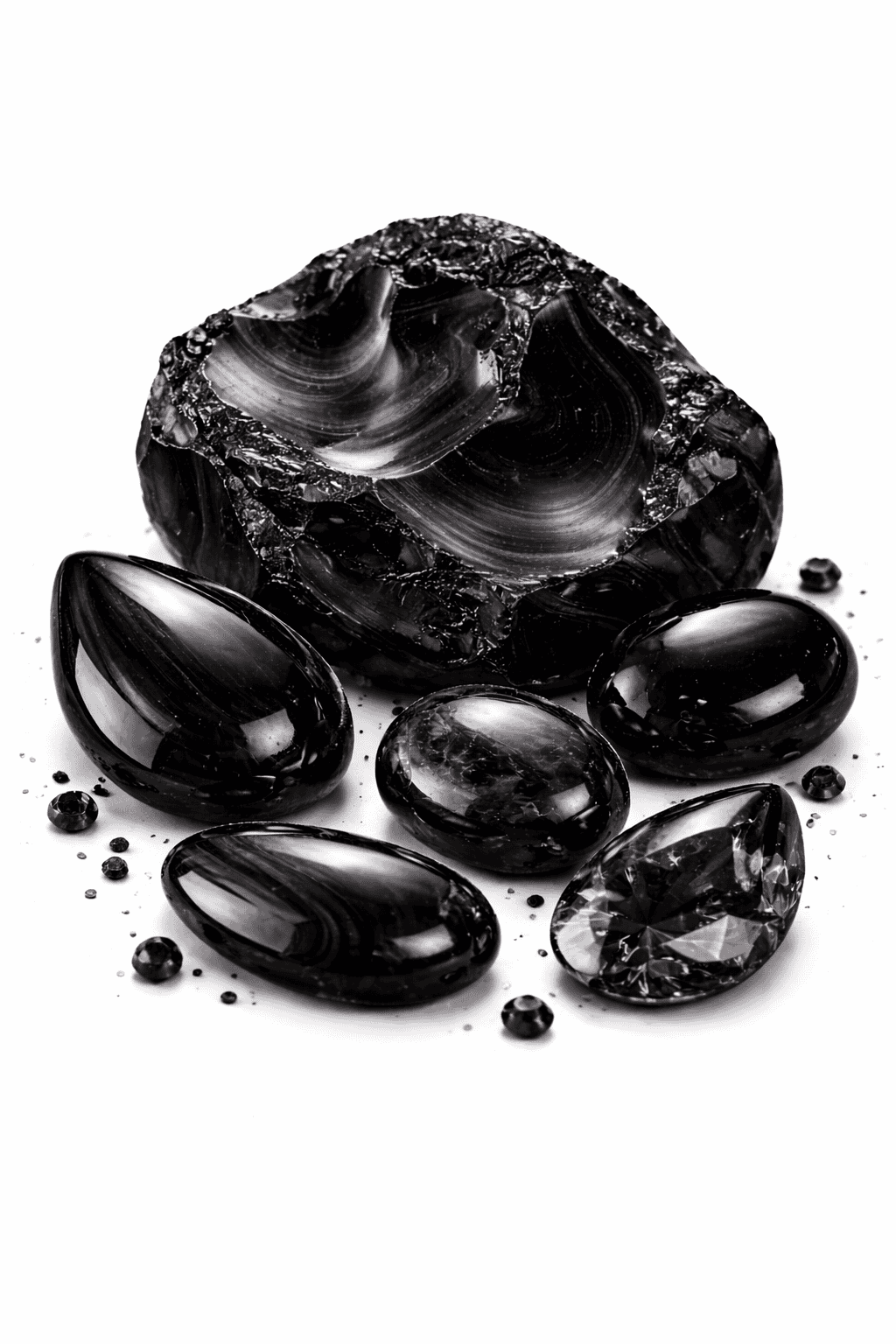
Obsidian is one of the most mysterious and fascinating volcanic stones created by nature deep within the Earth's fiery core. It forms when molten lava cools rapidly, producing a unique natural material with a glass-like texture and deep, intense color.
Often referred to as natural volcanic glass, obsidian has an amorphous structure rather than a traditional crystalline form. This distinctive structure gives the stone its remarkable appearance—rich black tones, a mirror-like shine, and subtle color variations.
Today, obsidian jewelry holds a special place in the world of fine accessories. This semi-precious stone is valued not only for its elegant beauty but also for its symbolic and energetic significance.
The history of obsidian stretches back thousands of years. Ancient civilizations believed the stone possessed powerful properties and used it in both everyday objects and ceremonial artifacts.
Obsidian was first described by the ancient Greek philosopher and naturalist Theophrastus, who lived in the 4th–3rd centuries BC. Archaeological discoveries, however, reveal that obsidian was already widely used during the Stone Age to produce knives, tools, and spearheads due to its incredibly sharp edges.
The name obsidian comes from an ancient Roman legend. According to tradition, the stone was first brought to Rome by a warrior named Obsius, and the mineral was later named in his honor.
Throughout history, obsidian has been surrounded by fascinating myths and legends.
Caucasian mythology
In some traditions, obsidian was believed to be fragments of the devil’s claws, due to its dark color and sharp edges resembling volcanic fire.
The Apache legend
In North America, a famous legend states that obsidian stones are the tears of ancient Apache warriors that hardened in volcanic lava. These stones are still known today as “Apache Tears.”
European tradition
In Hungary, obsidian was sometimes referred to as “lux sapphire” because its brilliant shine resembled precious gemstones.
Obsidian appears in several fascinating natural varieties.
A deep black stone with white crystal inclusions that resemble snowflakes.
A rare type displaying shimmering layers of red, green, blue, and golden hues when exposed to light.
A black variety with rounded patterns formed due to high magnetite content.
Obsidian is primarily found in volcanically active regions.
Major deposits exist in:
South America — Mexico, Peru, Ecuador
Japan — especially the island of Hokkaido
New Zealand, Iceland, and Kenya
The United States — particularly Nevada, Arizona, and California
Russia — including the Kamchatka Peninsula
In Georgia, obsidian has been known since ancient times and was poetically referred to as a “fragment of the sky.” A notable deposit is located near Paravani Lake, where unique black stones with reddish inclusions can be found.
Obsidian has been used for centuries in a wide range of applications.
Jewelry
Obsidian is widely used to create elegant rings, necklaces, bracelets, and earrings. Its deep color pairs beautifully with silver settings.
Interior decoration
Bowls, sculptures, and decorative objects crafted from obsidian bring a natural and luxurious aesthetic to interiors.
Spiritual practices
Polished obsidian spheres are often used in meditation, energy work, and spiritual rituals.
Industry
Obsidian can also be processed to produce perlite, a material used for thermal insulation in construction.
In many cultures, obsidian is considered a powerful protective stone.
It is believed to:
Shield against negative energy
Strengthen intuition
Reveal inner strength
Support determination and personal transformation
Obsidian is often associated with the following zodiac signs:
Capricorn
Aquarius
Scorpio
Aries
Leo
Gemini
It is less commonly recommended for Cancer and Virgo.
Proper care is essential to preserve the beauty and brilliance of obsidian jewelry.
Storage
Because obsidian is relatively soft compared to many gemstones, it should be stored separately in a jewelry box or a soft pouch to prevent scratches.
Temperature
Avoid prolonged exposure to direct sunlight or sudden temperature changes.
Chemical exposure
Keep obsidian away from perfumes, chlorine, household cleaning products, and cosmetics, as these substances may damage the surface.
Cleaning
To clean obsidian jewelry:
Use warm water
Add a mild soap solution
Gently wipe with a soft cloth
After cleaning, rinse with clean water and allow the stone to air dry naturally on a soft fabric.
Energetic cleansing
In spiritual practices, obsidian is sometimes cleansed under running water or left under moonlight to refresh its energy.
Obsidian is far more than just a stone. It is a symbol of volcanic power, natural beauty, and timeless elegance.
Its deep color, fascinating history, and mystical aura make obsidian jewelry a unique addition to any collection. Whether worn as a stylish accessory or kept as a meaningful talisman, obsidian remains one of nature’s most captivating treasures.
 511 40 73 13
 info@silveria.ge


 Eng
Eng