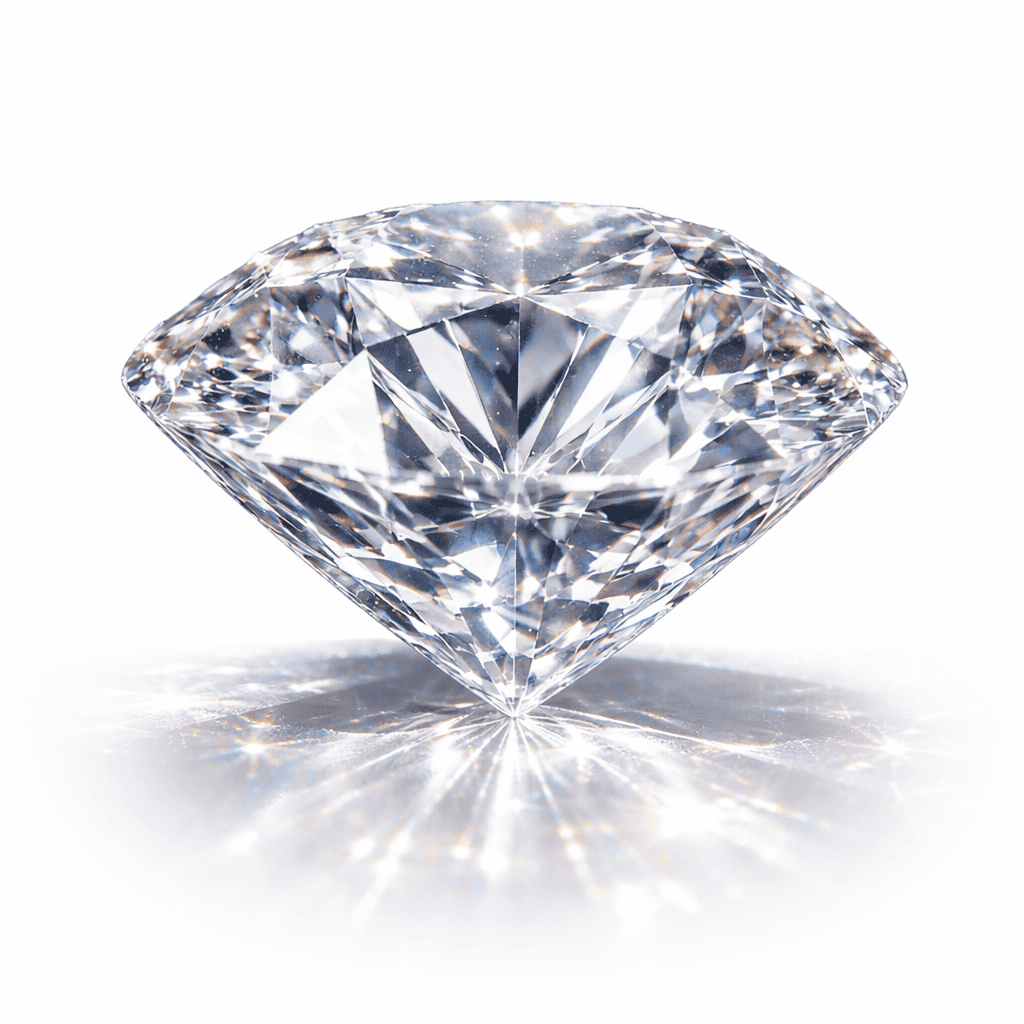
When visiting a jewelry store, a person is greeted by dazzling rings, earrings, and precious stones. However, very few know how to distinguish a store-displayed fianit from a diamond. Often, this secret is revealed by the price: fianit is much more affordable than a diamond.
Do you think fianit was created solely for jewelry? Not at all. The artificial diamond imitation, also known as fianit, was first synthesized in 1930, but its use in jewelry officially began only in 1976.
Cubic zirconia was initially used not for jewelry, but for industrial purposes, as a substitute for precious stones. It was used in construction equipment, the space industry, thermal shields for rockets, and high-precision optical devices.
However, the aesthetic appeal of this crystal quickly attracted the attention of jewelers. As a result, its usage expanded, and cubic zirconia became refined for jewelry and elegant accessories.
In 1968, Soviet scientists attempted to create an especially thin laser beam in laboratory conditions. During the process of growing various artificial stones, some specimens were considered “defective” and were used as souvenirs. However, when these crystals reached jewelers, their processing resulted in extraordinary brilliance that amazed the public. Only a very small number of people could distinguish the artificial diamond imitation from a natural diamond. The main difference was in hardness: a diamond leaves a mark where cubic zirconia cannot.
At the Physics Institute (FIAN), this unusual crystal was grown for the first time, and it was here that the name “fianit” originated. This name became memorable in the jewelry world, and the technology soon spread worldwide.
Cubic zirconia is produced through the synthesis of zirconium dioxide at very high temperatures, using melting and crystallization processes. Afterward, the material undergoes processing, including purification, shaping, and final cutting. The resulting crystal can be made transparent or colored, while cutting enhances its shape and brilliance.
Cubic zirconia is used to create all types of jewelry. Its hardness allows for the production of complex, multi-faceted forms, fully revealing the crystal’s potential.
The production of cubic zirconia is far more environmentally friendly than the extraction of natural diamonds. Mining precious stones is often associated with risks, illegal practices, and violations of labor rights. In contrast, cubic zirconia is obtained legally, under ethical conditions, and does not require unsafe labor, making it an attractive product for modern consumers.
Fianit is no longer considered just an artificial stone—it enjoys wide popularity even among those who prefer natural gemstones. You can find fianit jewelry in both gold and silver displays.
Cubic zirconia can be enhanced with various chemical additives, creating a wide range of colors:
Blue – resembles sapphire, achieved with the addition of yttrium or nickel.
Pink – resembles morganite or pink tourmaline, achieved with manganese or cerium.
Yellow – resembles citrine, yellow topaz, or cognac diamonds.
Purple – resembles amethyst or purple topaz.
In terms of hardness, fianit reaches 8.5 on the Mohs scale, which is very close to diamond hardness (10).
Since ancient times, jewelry sellers have attempted to sell other transparent stones, including glass or zirconia, as diamonds. Visually, fianit can easily confuse and mislead buyers into thinking it is a diamond.
Important distinctions:
Fianit / Cubic Zirconia = zirconium dioxide crystal (artificial diamond imitation)
Diamond = carbon (natural or lab-grown)
Natural diamonds are so transparent that they are almost invisible on X-rays, leaving the image very dark. The same effect occurs under ultraviolet light.
This helps clearly differentiate fianit from diamonds, despite visual similarities.
Fianit crystals belong to the highest cubic crystal system. Their crystal lattice has uniform facets arranged at right angles. These specimens are easy to process, allowing for perfectly shaped jewelry.
Despite being made from zirconium dioxide, the crystals obtained are thermally stable. Their melting temperature exceeds 2500°C, and they are completely dielectric up to 300°C.
Proper care of cubic zirconia jewelry is important because:
It can be damaged and potentially harm other jewelry pieces.
It does not tolerate prolonged exposure to sunlight or heat.
Unlike diamonds, it may lose its color and brilliance over time.
Fianit jewelry should be stored separately, especially away from emeralds.
 511 40 73 13
 info@silveria.ge


 Eng
Eng