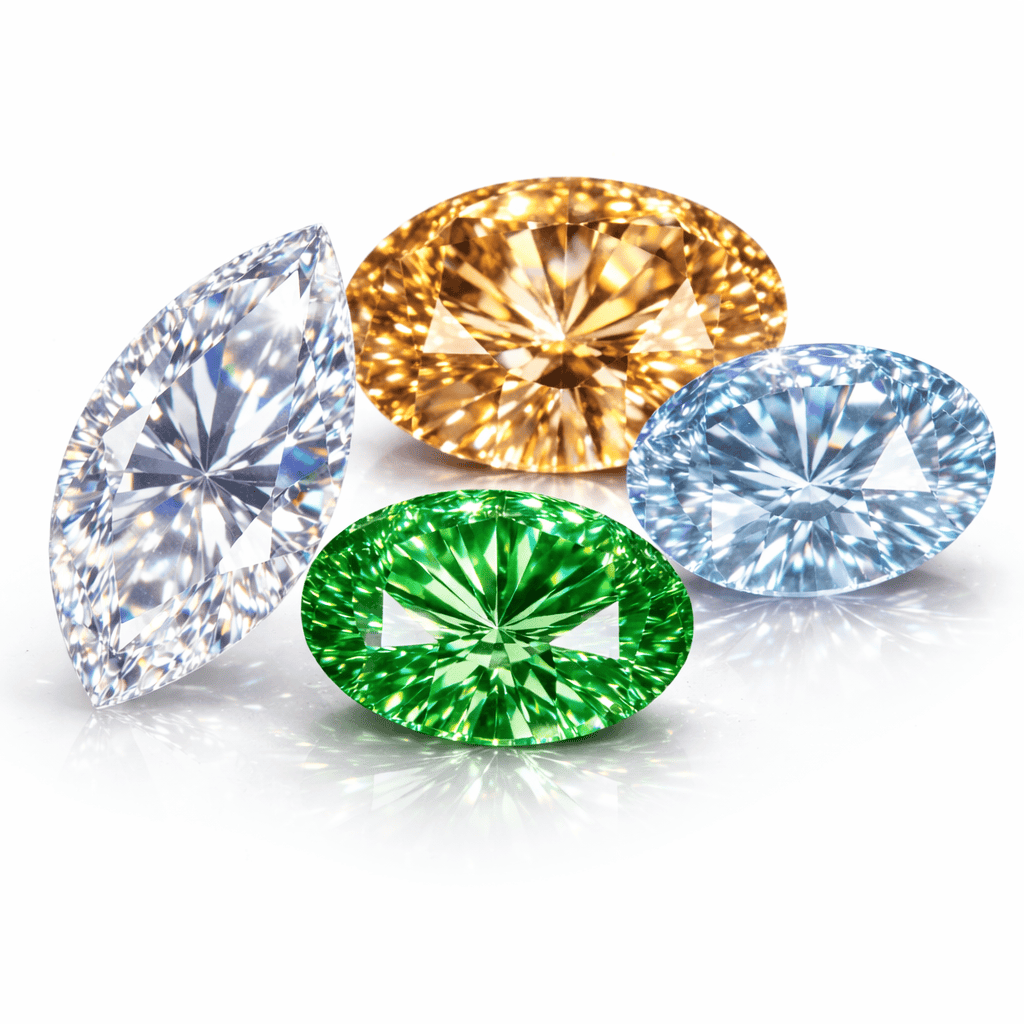
What is a precious stone?
A precious stone is characterized by sparkling brilliance, lasting beauty, durability, and reliability. These are the qualities we use to evaluate gemstones. The emperor of the jewelry world is the diamond. However, today a new precious stone has entered the market, one that has truly changed the jewelry industry — moissanite.
Moissanite is sometimes called “Forever Brilliant,” meaning “perpetually sparkling.” Its brilliance is not the only thing that makes it special — other diamond simulants, such as cubic zirconia and cubic zircon, also have sparkle. What sets moissanite apart are its unique properties, which allow it to fairly compete with diamonds.
Moissanite — a precious stone from stardust
Moissanite was formed in clouds of stardust and was first brought to Earth by a meteorite.
Advantages:
Unlike other simulants, moissanite not only rivals but in some cases exceeds diamonds in jewelry and physical properties.
Refractive index: Diamonds have 2.42, while moissanite has 2.97. This means moissanite bends light 25% more effectively, making it a brighter gemstone.
Dispersion: Moissanite — 0.104, diamond — 0.044. This makes the “fire” or sparkle more intense.
Brilliance: Moissanite — 20.4%, diamond — 17.2%.
Hardness: Moissanite — 9.25, diamond — 10.
Its hardness is higher than sapphire (9.0) and far exceeds simulants like cubic zirconia or cubic zircon (7.5–8).
Lab-created moissanite is nearly flawless, free of inclusions and impurities, which gives it a purity far above that of natural diamonds.
History of moissanite
Why didn’t moissanite replace diamonds earlier?
The answer is that moissanite is extremely rare on Earth. It is truly a “sky stone” — historically found only in ancient meteorites. Many of these did not even originate in our system. Natural formation on Earth or the Sun is impossible under normal conditions; it can only occur near giant stars or during massive cosmic events.
The first moissanite was discovered in 1893 in Diablo Canyon, Arizona, by geologist Ferdinand Henri Moissan. He initially believed he had found new diamonds, but later realized the crystals were made of silicon carbide.
In 1905, the mineral was named “moissanite” in honor of the geologist, and in 1906, Moissan received the Nobel Prize. Natural moissanite is extremely rare; today, only lab-created specimens are available, with the first commercial batch appearing in 1998.
Attempts to produce large quantities of moissanite in earlier decades repeatedly failed because the technology was too demanding. Only in 1982 was the process developed, and by 1998, it became possible to create large, colorless, gem-quality crystals in sufficient quantities for industrial use. That is why moissanite can be called the 21st-century gemstone.
Jewelry with moissanite
Perfect light performance, transparency, brilliance, and a durable structure create truly exceptional jewelry.
Compared to diamonds, moissanite sparkles even more, especially in white gold or platinum. Even experienced jewelers — and some diamond detectors — may find it difficult to distinguish moissanite from a diamond.
Cost:
Lab-created moissanite jewelry is nearly ten times more affordable than diamonds, allowing you to choose large, high-carat stones without overspending.
The most famous moissanite collection was launched by the Duchess of York, Sarah Ferguson, for K&G Creations. She named the collection “The Duchess’ Creation,” making it accessible to any woman.
Classification:
Diamonds are evaluated using the 4C scale (cut, clarity, color, carat), while moissanite is primarily assessed by color.
Premium moissanite stones are nearly colorless, corresponding to G–H on the diamond color scale.
Super-premium stones fall within the D–F range.
Moissanite is a 21st-century gemstone — lab-created, high-quality, and far superior to common diamond simulants.
 511 40 73 13
 info@silveria.ge


 Eng
Eng