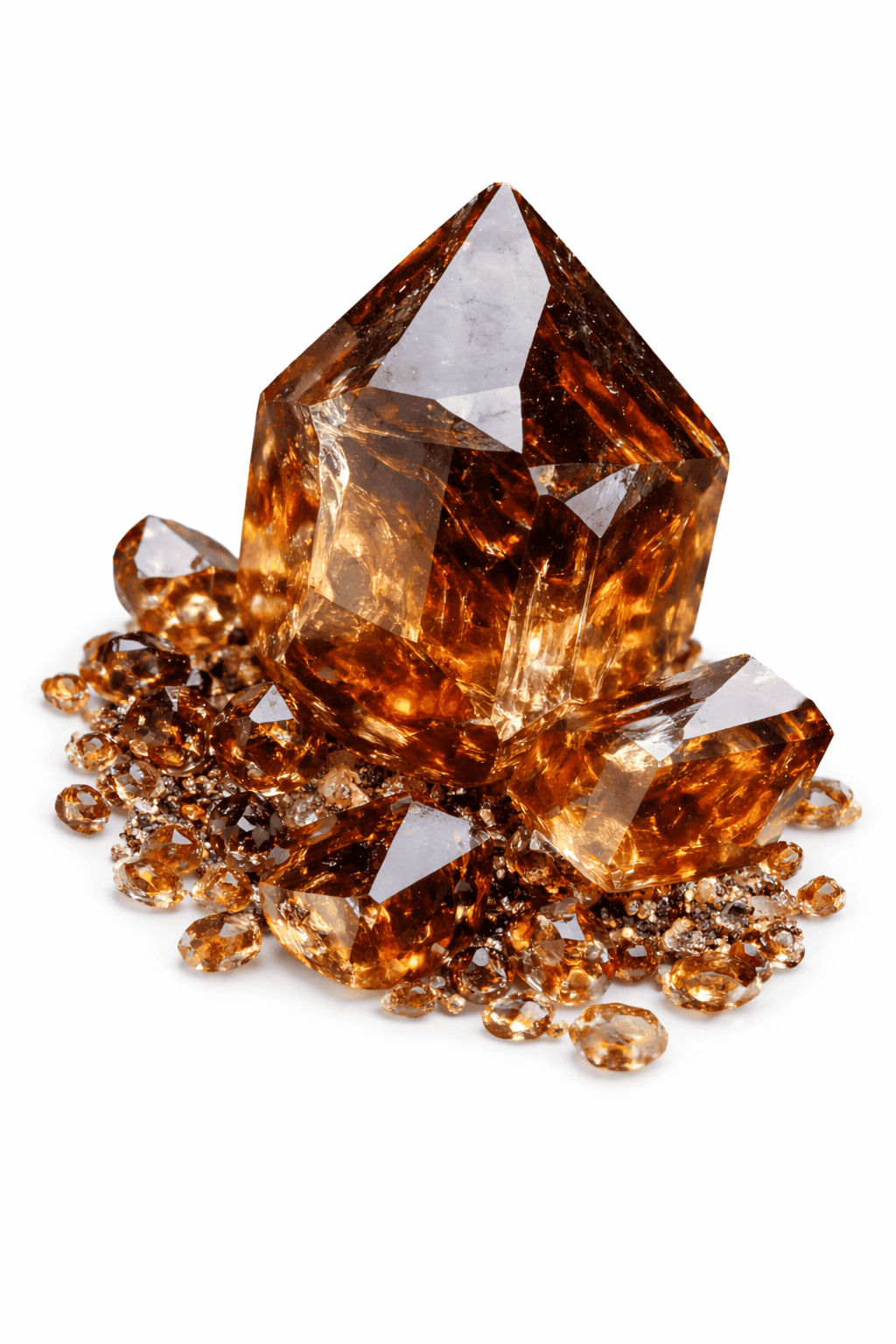
Zircon is one of the oldest gemstones on Earth. Its age depends on its origin and location. The oldest zircon mineral discovered in Australia is more than 4 billion years old.
The gemstone zircon stands out for its unique physical properties, remarkable colors, and strong brilliance. Despite this, for a long time it did not occupy the place among precious stones that it truly deserves.
One of the main reasons for the underappreciation of this mineral has been human misunderstanding. Zircon has a wide range of colors, and for this reason in ancient times it was often confused with other precious stones such as ruby, topaz, citrine, or sapphire.
Transparent zircon was often considered a variety of diamond.
With the development of science, specialists managed to create cubic zirconia, an artificial imitation of diamond. Over time this artificial stone was often referred to as zirconium, because in English the names zircon and zirconium sound very similar.
Although zirconium (cubic zirconia) differs significantly from natural zircon, the similarity of the names has caused many people to consider them the same stone. As a result, the true value of natural zircon has been underestimated.
The relatively wide distribution of zircon deposits has also influenced its price.
Zircon deposits are found in many countries, including:
• Australia
• Russia
• Thailand
• Korea
• Brazil
• Norway
• Cambodia
• Tanzania
• Vietnam
• Nigeria
• Sri Lanka
• Madagascar
These countries contain the largest resources of the mineral, although zircon is also mined in other regions of the world.
The physical and, according to traditional beliefs, magical properties of zircon often depend on its variety. Several main types are distinguished based on their color and deposit location.
Transparent stones known as Matara diamonds are mined in the southern part of the island of Sri Lanka.
A stone called Malacon has a light pinkish-brown color and is mainly found in Norway.
Zircon can have a wide range of shades. The main colors include:
• Yellow
• Yellow-brown
• Yellow-green
• Pink and red
• Blue
• Colorless
Yellow zircon may have several shades, including golden, smoky yellow, and corn yellow. Such stones are collectively called jargon.
Jargon deposits are found in Australia, Sri Lanka, Madagascar, and Southeast Asia. High-quality gemstones mined in these countries are widely used in jewelry.
Red zircon is called jacinth or hyacinth. These stones are mined in Russia, Vietnam, Thailand, and other countries around the world.
Their colors may include:
• Red
• Orange
• Reddish-brown
• Pinkish
The name “hyacinth” is connected with a mythological story according to which the blood of a young man named Hyacinth turned into a mineral of the same color. For this reason the stone is sometimes called the stone of sorrow and melancholy.
Blue zircon is known as starlite. This color is often obtained through heat treatment. High-quality blue zircon may reach a price of up to $500 per carat.
Interestingly, zircon can also change color. For example, malacon, which is originally a brown stone, often turns blue after strong heating and becomes starlite.
The rarest and most expensive varieties are considered to be colorless and black zircon.
Green zircons are used less frequently in jewelry because some specimens may contain small amounts of radioactive elements. For this reason, darker green zircons are often kept only in specialized museums under strict safety regulations.
Zircon is distinguished by exceptional brilliance and light dispersion. It shows strong iridescence, producing rainbow-like flashes, and it can concentrate light rays in a single point.
Because of this, transparent zircon can sometimes be mistaken for a real diamond, while colored zircons may resemble naturally colored diamonds.
Natural zircon is a mineral with the chemical formula ZrSiO₄. It belongs to the group of island silicates and contains silicon.
Cubic zirconia (CZ), on the other hand, is a laboratory-created synthetic stone with the chemical formula ZrO₂.
Although both stones contain the element zirconium, there are important differences:
• Zircon is a natural mineral
• Cubic zirconia is a man-made stone
• Zircon has stronger natural brilliance and “fire”
• Cubic zirconia is much cheaper and often used as a diamond imitation
Many people attribute certain healing properties to zircon. It is believed that its unique crystal structure, resembling a double pyramid, gives it special energetic qualities.
According to traditional beliefs:
• Blue zircon reduces depression and helps normalize sleep
• Yellow zircon positively affects the endocrine system
• Red zircon supports digestive system function
• Brown zircon was traditionally used against colds
It is also believed that zircon helps improve metabolism and strengthen the body after serious illness or surgery.
Since ancient times zircon has been popular among magicians and mystics. Many magical properties have been attributed to it.
It was believed that zircon could:
• reveal lies and deception
• protect against evil intentions
• strengthen intuition
• develop intellect and mental abilities
• increase self-confidence
According to some traditions, zircon especially benefits people who are honest and sincere.
In astrology, zircon is considered particularly favorable for:
• Sagittarius
• Aquarius
• Taurus
It is believed that this stone enhances their intuition, energy, and confidence.
Some astrological beliefs suggest that Cancer and Pisces should wear zircon less often, as it may intensify their emotional sensitivity.
Zircon is widely used in jewelry. Due to its strong brilliance, it is often used as:
• a diamond imitation
• an alternative to sapphire
• a substitute for ruby or spinel
Nevertheless, many jewelers believe that zircon is an undervalued gemstone, because its optical qualities sometimes come close to those of a diamond.
Rare and high-quality zircons also attract the attention of collectors and investors, as their value may increase significantly in the future.
Although zircon is a relatively durable mineral, it still requires proper care in order to maintain its brilliance and beauty for a long time. Improper care may cause clouding, scratches, or a loss of shine.
Zircon has a fairly strong structure, but it may still be damaged by strong impacts. Therefore it is recommended to:
• remove jewelry during physical work
• avoid strong impacts and pressure
• store it separately from harder gemstones to prevent scratches
Zircon is sensitive to certain chemicals. Therefore the stone should not come into contact with:
• household chemicals
• perfumes
• nail polish and cosmetic products
• chlorine
Such substances may damage the surface of the stone or reduce its natural brilliance.
The best method for cleaning zircon jewelry is a gentle approach.
Recommended cleaning materials:
• warm water
• mild soap
• a soft brush or cloth
After cleaning, the stone should be rinsed thoroughly with clean water and dried with a soft cloth.
Zircon jewelry should preferably be stored:
• in a separate jewelry box
• in a soft pouch or cloth
• in a dry and cool place
This helps prevent scratches and protects the stone from environmental effects.
Over time any gemstone may accumulate dirt or lose some of its shine. In such cases it is recommended to have the jewelry professionally cleaned by a jeweler, who can restore its original brilliance using specialized tools and techniques.
 511 40 73 13
 info@silveria.ge


 Eng
Eng