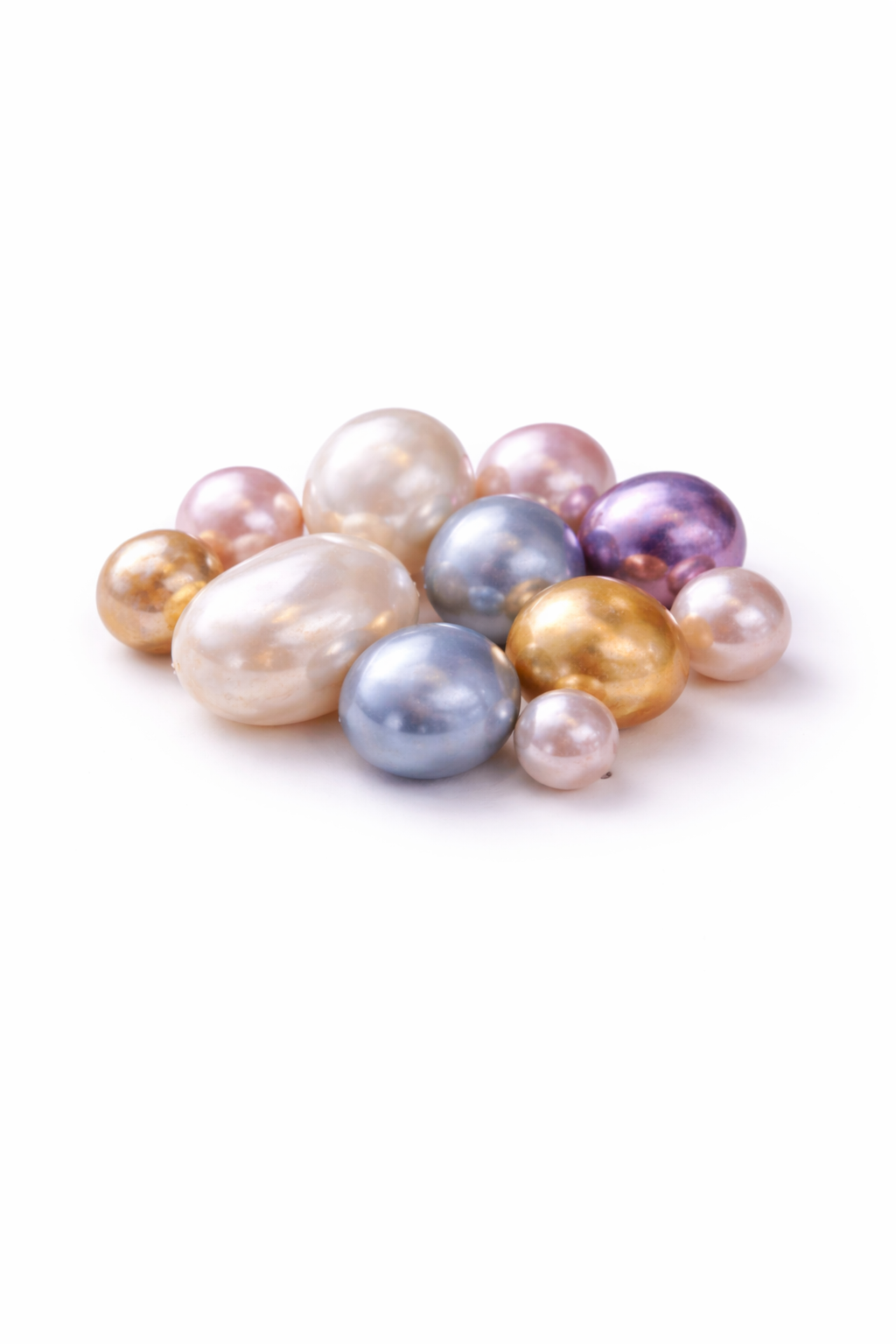
A pearl is a mineraloid — a biogenic, solid formation of rounded or irregular shape, formed inside the shells of marine and freshwater mollusks. According to modern mineralogical nomenclature approved by the International Mineralogical Association (IMA), pearls are not classified as minerals, although they contain the mineral aragonite in their composition.
Pearls are valued as gemstones and are widely used in jewelry design, as well as in decorative and cultural applications.
The name “pearl” is derived from the word perna, referring to a species of bivalve mollusk. In classical Latin, pearls were known as margarita, a term borrowed from Ancient Greek and likely originating from the Proto-Iranian root (mŕ̥ga-ahri-ita-), meaning “pearl” or “shining object.”
Pearls are formed in both marine and freshwater mollusks. In theory, almost all mollusks can produce pearls; however, in practice, commercially valuable pearls are primarily formed in bivalve mollusks that produce nacre.
Pearl formation is a defensive reaction of the mollusk. When a foreign object enters the space between the shell and the mantle, or penetrates the mantle itself, the mollusk begins to coat it with layers of nacre, eventually forming a pearl.
A single mollusk may contain several dozen pearls. For example, Black Sea mussels can contain over 100 pearls, although in such cases they are typically very small (often less than 2.5 mm in diameter).
Since pearls are not single crystals, they do not have a strictly defined shape. They can range from perfectly spherical to completely irregular (“baroque”). Their shape largely depends on their position within the shell.
Information about pearls dates back to ancient times. They are mentioned in ancient Indian Vedas and have been found in archaeological discoveries in Persia. Their use dates back at least to the 2nd century BC.
One of the oldest known pearl jewelry pieces — a necklace — was discovered in Susa (modern-day Iran) and is now preserved in the Louvre. A bronze statue of Aphrodite (5th century BC), housed in the Boston Museum, is also adorned with pearl jewelry.
Until the late Middle Ages, pearls were considered among the most valuable gemstones. Historical sources state that Queen Cleopatra possessed two of the largest known pearls of her time. Another famous pearl, “La Peregrina,” once belonged to Elizabeth Taylor.
Saltwater pearls are primarily harvested in the Red Sea, the Persian Gulf, as well as along the coasts of Sri Lanka and Japan, where they are traditionally collected by “Ama” divers.
Freshwater pearls are found in Germany, Russia, China, and North America.
Cultured pearls are created through human intervention by introducing an irritant into the mollusk, mimicking the natural process.
There are several production methods:
Nucleated and non-nucleated
Saltwater and freshwater
On January 27, 1896, Japanese innovator Kokichi Mikimoto patented the method of producing nucleated pearls, laying the foundation for the modern pearl industry.
Early imitation pearls were made of glass. In the 15th–16th centuries, “Roman pearls” appeared — glass beads filled with paraffin.
Later, “pearl essence” (guanine), derived from fish scales, was used to give beads a pearlescent shine. Glass beads were coated with this essence, baked, and the process was repeated multiple times.
Modern imitation pearls may be made of plastic or glass and can be distinguished by their weight, surface texture, and microscopic details.
A major breakthrough in artificial pearl production occurred in 1890, when German engineer Eduard Hugo Heusch developed a production technology. Later, this industry expanded on the Spanish island of Majorca.
A core (made of glass, crystal, or shell) is repeatedly coated with a special solution and dried. This process may be repeated up to 40 times, resulting in a perfectly shaped and highly durable pearl.
Materials used include:
Pearl powder
Nacre
Fish scales
Aragonite
Binding agents
The primary difference lies in their origin. While artificial pearls may closely resemble natural ones in composition, their formation is fully controlled by humans.
High-quality artificial pearls are known for their flawless surface and durability, but they lack the symbolic and energetic significance attributed to natural pearls.
Pearls are classified using a grading system from A to D, with “+” variations, and are evaluated based on:
Color — white, pink, blue, golden, black, etc.
Luster — the higher the shine, the greater the value
Nacre thickness
Shape — perfectly round pearls are the most valuable
Surface quality
Size — typically 6–8 mm, with larger pearls being rarer and more valuable
For centuries, pearls have symbolized purity, femininity, and lunar energy. Across different cultures, they have been associated with healing, protection, and mystical properties.
They appear in both Western and Eastern art and have often been regarded as symbols of power and wisdom.
Pearls were believed to be gifts from the gods, who descended from the heavens and left their beauty in the ocean waves.
Mythical sea creatures called Jiaoren were said to produce pearls through their tears.
When Aphrodite emerged from the sea, the drops of water from her hair turned into pearls.
Since ancient times, pearls have been regarded not only as precious ornaments but also as powerful energetic talismans. Astrologically, they are associated with the water element, feminine energy, and lunar cycles.
Although pearls aesthetically suit almost everyone, astrologers recommend wearing them according to one’s zodiac sign.
Cancer
Enhances intuition, emotional balance, and attracts desired outcomes.
Aquarius
Acts as protection against negativity, reduces aggression, and stabilizes emotions.
Pisces
Promotes inner peace, reduces isolation, and supports emotional harmony.
Gemini
Helps control impulsiveness and improves focus.
Sagittarius
White or light gray pearls enhance positivity and support personal growth.
Note: Dark pearls may create unnecessary obstacles for Sagittarius.
Scorpio
Effect depends on emotional state; less effective during depressive periods.
Capricorn
Supports love, relationships, and career growth by balancing inner energy.
Taurus & Libra
Neutral effect; can be worn freely without significant influence.
Aries
May cause emotional imbalance and reduce energy.
Virgo
Supports career growth but may cause emotional overload if worn constantly.
Leo
Due to the clash between fire (Leo) and water (pearls), they may reduce natural confidence and energy.
Pearls are among the most delicate gemstones and require special care to maintain their beauty and luster.
Wear pearls last, after applying makeup and perfume
Avoid contact with:
perfumes
hairsprays
cosmetics
Store separately in a soft cloth or jewelry box
Avoid contact with other jewelry to prevent scratches
Do not keep in overly dry environments — pearls need natural moisture
Clean with a soft, slightly damp cloth
Avoid:
chemicals
ultrasonic cleaners
Pearls are often referred to as “living gems” because:
they react to their environment
their luster may change over time
Interesting fact:
Regular wear helps maintain the natural shine of pearls, as they interact positively with the skin’s natural moisture.
 511 40 73 13
 info@silveria.ge


 Eng
Eng