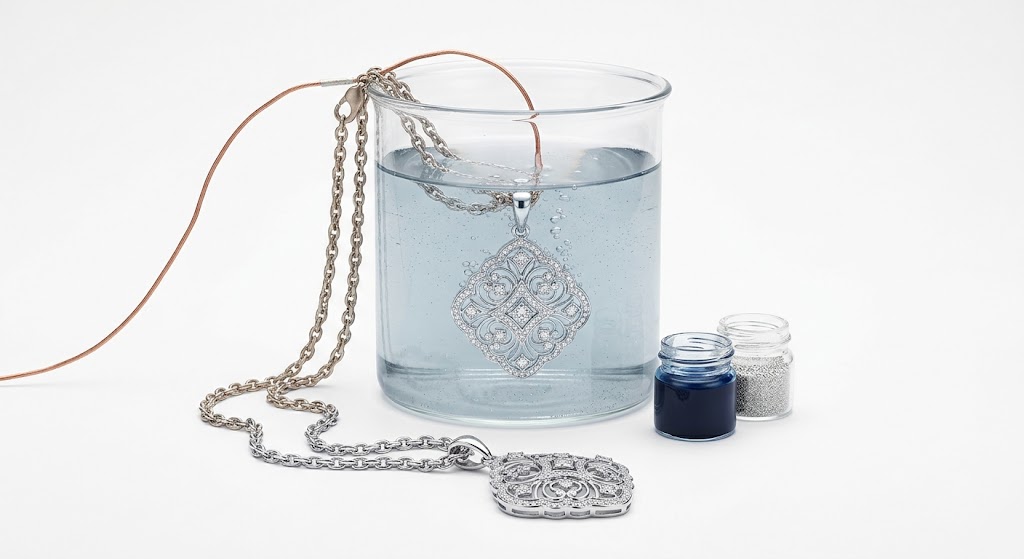
If you have ever purchased a new piece of white gold or silver jewelry, chances are high that you were not looking directly at those metals, but rather at rhodium. In the jewelry industry, rhodium plating is the magic wand that grants a piece an exclusive, "mirror-like" brilliance and protection.
Let's explore what rhodium plating is, why it is so important, and what every customer should know through the eyes of a master jeweler.
Rhodium is an extraordinarily rare and valuable member of the Platinum Group Metals (PGM). It was discovered in 1803 by the English chemist William Hyde Wollaston.
Historical Background: The use of rhodium as a protective and decorative plating in jewelry making began in the 1930s.
The Reason: Artisans were searching for a way to prevent silver from tarnishing (oxidizing) and to give white gold a flawless, cool white hue (since natural white gold has a slightly yellowish-grey tint).
Rhodium plating is not simple "painting." It is a high-tech, electroplating (galvanic) process.
Preparation and Cleaning: The piece undergoes ultrasonic cleaning, full polishing, and degreasing. Even a tiny particle of dust will disrupt the process.
Galvanic Bath: The jewelry is submerged in a specialized liquid solution (electrolyte) containing rhodium salts.
Electro-plating: A continuous electric current is passed through the bath. Under the force of the electric current, positively charged rhodium ions bind to the surface of the jewelry.
The Result: An ultra-thin layer is formed (approximately 0.1 to 0.5 microns thick).
Pros:
Flawless Aesthetic: Grants an unmatched, luminous white finish with a mirror-like shine.
Tarnish Protection: Rhodium-plated silver never turns black and does not react with air.
Hypoallergenic: If a white gold alloy contains nickel (which frequently triggers skin allergies), rhodium creates a protective barrier between the skin and the metal.
Scratch Resistance: Rhodium is extremely dense, shielding the piece from minor everyday scratches.
Cons:
Temporary: The rhodium layer is not permanent and wears off over time.
Re-plating Maintenance: The jewelry periodically requires re-application of the finish.
Sizing Challenges: If you resize a ring, the rhodium coating burns off during soldering and must be completely re-plated.
The lifespan of the rhodium layer depends entirely on how frequently you wear the piece:
Rings: Lasts 1 to 2 years (due to constant contact with surfaces and skin).
Earrings and Pendants: Can last 3 to 5 years or even longer.
Cost: The price depends on the size of the piece and the jeweler's labor. Because raw rhodium is extremely costly, the service is not cheap, yet it remains completely accessible (rhodium plating combined with polishing is a standard service at most bench jewelry workshops).
If your white gold ring takes on a slightly yellowish tint after 2 years, don't assume you were scammed! This is an entirely natural process—it simply means the thin rhodium layer has worn down. Take the piece to a jeweler for a polish and re-plating, and your jewelry will look just as brilliant as the day you bought it from the display case.
 511 40 73 13
 info@silveria.ge


 Eng
Eng