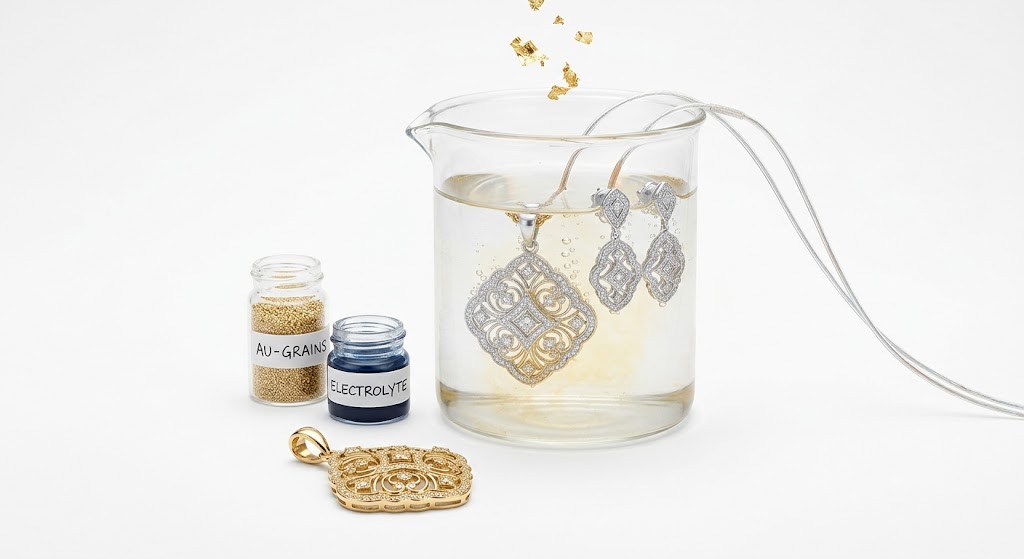
In the jewelry world, gold plating is a technique that allows a piece to achieve the look, brilliance, and luxurious aesthetic of solid gold. It is the perfect choice for those who desire the beauty of gold at a much more accessible price point.
Let's explore what gold plating is, how it works technically, and what every customer should know through the eyes of a master jeweler.
Gold plating involves applying an ultra-thin layer of pure gold onto the surface of a base metal (most commonly high-grade sterling silver).
Historical Background: Methods of gilding metals were used in ancient Egypt and China (by adhering gold leaf). However, modern electroplated gold plating was introduced in the 1840s in England.
The Reason: Artisans wanted to create pieces that were visually identical to solid gold while remaining significantly lighter and more affordable.
Just like rhodium plating, gold plating is a galvanic (electroplating) process:
Preparation: The piece (e.g., a 925 sterling silver ring) undergoes deep ultrasonic cleaning and full polishing. Not a trace of oil or dust can remain on the surface.
Gold Bath: The item is submerged in a specialized solution (electrolyte) containing suspended gold ions.
Electro-plating: As a direct electric current passes through the bath, positively charged gold ions attach evenly to the surface of the jewelry.
Thickness Control: The thickness of the layer typically ranges from 0.5 to 2.5 microns.
Pros:
Authentic Gold Appearance: Grants a 100% genuine gold color, shine, and aesthetic.
Affordability: Provides a luxurious look at a fraction of the price of solid gold.
Precious Base: When plated over sterling silver (Gold Vermeil), you still own a piece made of precious metal.
Versatility: Allows for various shades, including classic yellow gold and rose gold finishes.
Cons:
Temporary Finish: The thin gold layer gradually wears off, exposing the metal underneath.
Requires Care: Sensitive to water, perfumes, chemicals, and physical friction.
Maintenance: Periodically requires re-plating by a jeweler.
The lifespan of gold plating depends heavily on wear frequency and plating thickness:
Rings (Daily Wear): Lasts 6 months to 1.5 years due to direct skin contact and friction.
Earrings and Pendants: Can last 2 to 4 years as they experience minimal contact.
Master's Care Tips:
Remove gold-plated pieces before showering, swimming, or working out.
Avoid direct contact with perfumes, lotions, and hand sanitizers.
Store separately in a soft pouch to prevent surface scratches.
If your gold-plated silver jewelry begins to fade after a year or two, showing the silver beneath, don't worry! This is a completely natural process. Bring the piece to a bench jeweler for a quick polish and re-plating—it will instantly regain its rich, original brilliance just like the day you bought it.
 511 40 73 13
 info@silveria.ge


 Eng
Eng