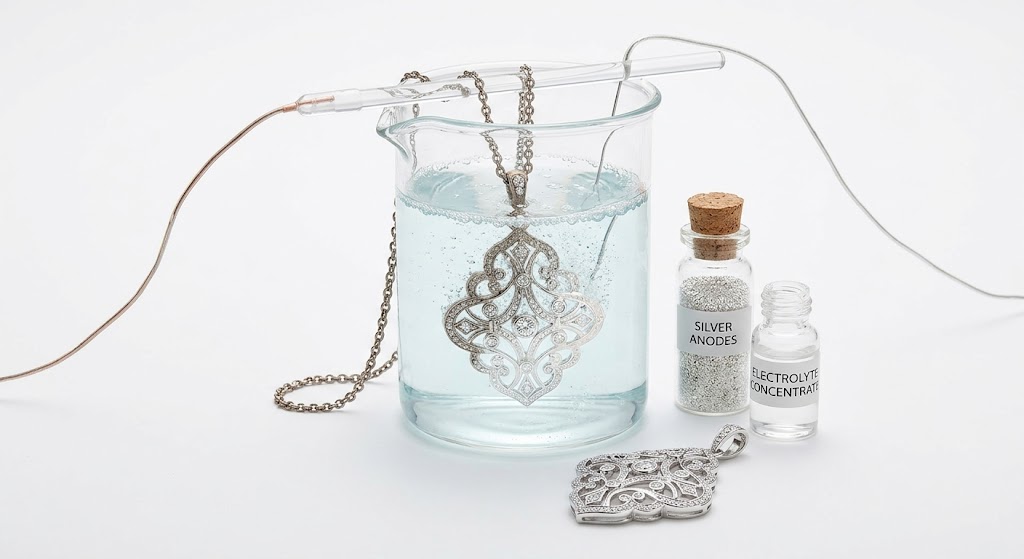
In the world of fine jewelry and decorative arts, silver plating is a technique that allows a piece to achieve the unmatched, vibrant brilliance and pure white tone of solid silver. It is the perfect solution for those who desire the noble aesthetic of white precious metal at a significantly more accessible price point.
Let's explore what silver plating is, how it works technically, and what every customer should know through the eyes of a master jeweler.
Silver plating involves applying an ultra-thin layer of fine, .999 pure silver onto the surface of a base metal (such as copper, brass, or nickel silver).
Historical Background: Before the 19th century, mechanical techniques like Sheffield Plate were used (fusing thin sheets of silver onto copper). However, modern electroplated silver plating was patented in 1840 in England by the Elkington brothers.
The Reason: Artisans aimed to create tableware, candelabras, and jewelry that were visually identical to solid sterling silver while making them affordable for the broader public.
Just like gold and rhodium plating, silver plating is a galvanic (electroplating) process:
Preparation and Chemical Cleaning: The piece undergoes deep polishing, ultrasonic cleaning, and degreasing. Even the smallest spot of oil will prevent the silver layer from adhering evenly.
Silver Bath: The item is submerged in a specialized liquid solution (electrolyte) containing silver salts and ions.
Electro-plating: As a direct electric current passes through the bath, positively charged silver ions bond evenly to the surface of the item.
Layer Thickness: Plating thickness typically ranges from 0.5 to 10+ microns (tableware receives a much thicker layer than fashion jewelry).
Pros:
Authentic Silver Appearance: Grants a 100% genuine, noble silver color and mirror shine.
High Affordability: Provides a luxurious look at a fraction of the cost of solid sterling silver.
Ideal for Decor and Tableware: Allows large objects (candelabras, trays, flatware) to carry a opulent, high-end look.
Easy Restoration: Worn plating can easily be re-applied by a bench jeweler.
Cons:
Tarnishing (Oxidation): Because the outer layer is pure silver, it reacts naturally with sulfur in the air and turns dark over time (requires cleaning).
Wearable Finish: Under heavy friction (such as daily-wear rings), the thin layer will eventually wear down.
Sensitivity to Chemicals: Vulnerable to acids, perfumes, and harsh household detergents.
The lifespan of silver plating depends on wear frequency and plating thickness:
Jewelry: Lasts 1 to 3 years (depending on skin contact and daily friction).
Decorative Items & Tableware: Can last for decades with proper care and maintenance.
Master's Care Tips:
Tarnished? Clean with a soft, specialized silver polishing cloth or mild soapy water.
Keep away from harsh chemicals, perfumes, and chlorinated pool water.
Store in a dry, airtight pouch to slow down natural oxidation.
If your silver-plated piece (or heirloom) darkens over time, never scrub it with abrasive powders or harsh sponges—you will scratch right through the thin layer of silver! Use only specialized, soft silver-cleaning solutions or microfiber cloths. If the plating eventually wears off entirely, bring it to a jeweler: a fresh electroplating bath will instantly restore its original, luminous glow.
 511 40 73 13
 info@silveria.ge


 Eng
Eng