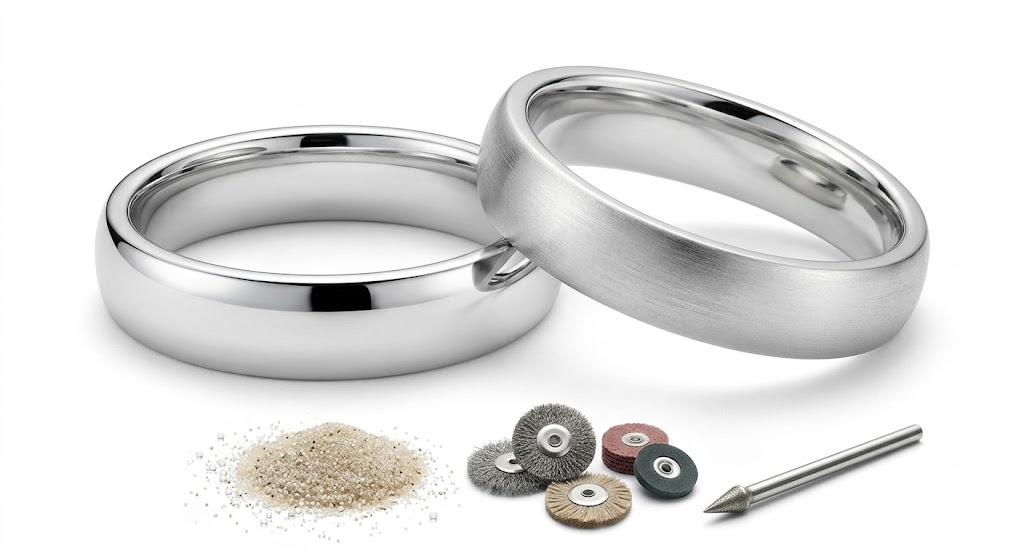
In fine jewelry craft, a Matte or Satin Finish offers a refined and modern alternative to traditional mirror-polished surfaces. It provides jewelry with a soft, velvety luster, accentuates geometric architecture, and has become extraordinarily popular for wedding bands and minimalist designs.
Let's explore what satin finishing is, the technical methods used to achieve various textures, and what every customer should know through the eyes of a master jeweler.
A matte appearance is achieved by microscopically texturing the polished surface of a precious metal (gold, silver, platinum), disrupting direct light reflection and replacing mirror shine with a silky sheen.
Historical Background: While rustic matte textures were historically achieved through hammering, modern refined satin finishing surged in popularity during the mid-20th century alongside modernist and architectural jewelry design.
The Reason: Artisans realized that high-gloss surfaces often reflect the surrounding environment, obscuring the piece's structural silhouette. A matte finish redirects focus entirely to the metal's natural color and form.
Jewelers employ several key techniques to produce distinct matte surfaces:
Satin Finish: The metal is treated with specialized abrasive wire brushes or sanding pads, creating ultra-fine, parallel grain lines that mimic the look of raw silk.
Sandblasting: The piece is bombarded at high pressure with fine silica sand or microscopic glass beads, producing a uniform, deep, and granular matte texture.
Diamond / Ice Finish: Using a diamond-tipped engraving tool, micro-incisions are cut into the metal. This yields a crisp, crystalline texture that sparkles subtly under direct light.
Pros:
Modern Aesthetic: Gives the piece an understated, sophisticated, and contemporary appeal.
Resists Fingerprints: Unlike mirror-polished items, matte surfaces do not show oils or smudges easily.
Highlights Gemstones: Diamonds and colored gemstones stand out with significantly higher contrast against a non-reflective matte backdrop.
Cons:
Polishes Over Time: Due to daily friction with skin, clothing, and objects, a matte surface will naturally burnish and become smoother over time.
Vulnerable to Deep Scratches: A deep scratch on a matte surface is more noticeable and requires professional re-texturing.
The longevity of a matte finish depends on the item type and daily wear:
Daily Wedding Bands: Retains its pristine texture for 6 months to 1.5 years before naturally developing a semi-polished patina.
Earrings and Pendants: Can maintain its original matte finish for many years.
Master's Care Tips:
Clean using warm soapy water and a soft-bristled brush.
Avoid using jeweler’s polishing cloths, as their built-in compounds will smooth out the matte texture.
Store separately in a soft pouch to prevent friction against polished items.
If your matte wedding ring starts to look shiny or uneven after a year of wear, don't worry! This is the natural lifecycle of textured metal. Bring the ring to a bench jeweler—using a satinizing wheel or sandblaster, the artisan can restore that soft, silky matte finish in less than 10 minutes.
 511 40 73 13
 info@silveria.ge


 Eng
Eng