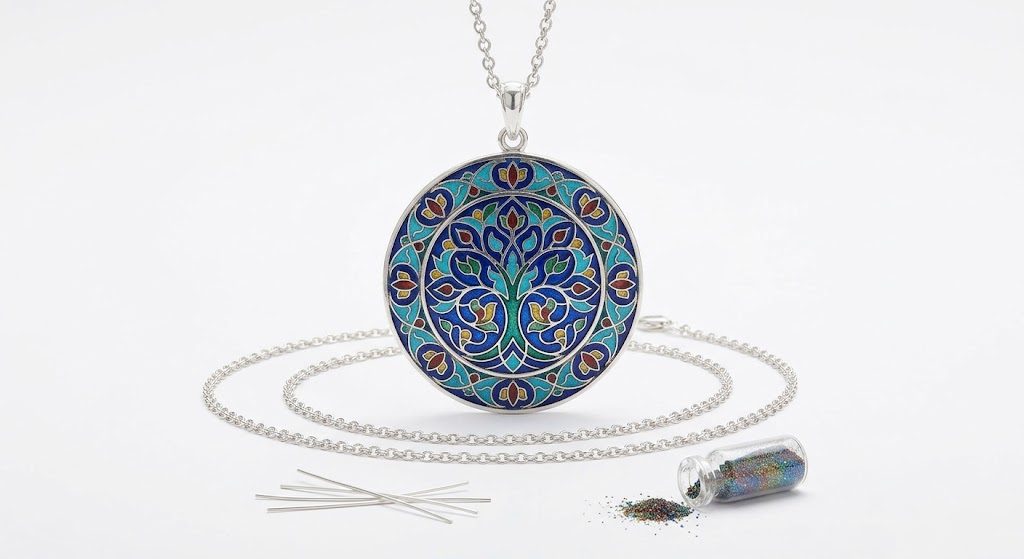
In fine jewelry craft, Enamelling stands as one of the most complex, vibrant, and enchanting techniques. It is not mere paint—it is the high-temperature fusion of glass powder with precious metal, retaining its brilliant colors for centuries. Notably, Georgian Cloisonné enamel (Minankari) is celebrated globally as a masterwork of cultural heritage.
Let's explore what enamelling is, how it functions technically, and what every customer should know through the eyes of a master jeweler.
Jewelry enamel is a powdered glass composition (silica mixed with mineral oxide pigments) that is fired in a kiln at high temperatures (750°C to 850°C / 1382°F to 1562°F), fusing permanently with a metal base (most commonly gold, silver, or copper).
Historical Background: Enamelling dates back millennia (Ancient Egypt and Greece), but reached its golden age in Byzantium and Medieval Georgia (8th–12th centuries). Georgian Cloisonné enamel (such as the famed Khakhuli Triptych) is recognized worldwide as a pinnacle of goldsmithing art.
The Reason: Artisans sought a way to create permanent, vivid, colorful imagery and patterns on precious metals that would never fade or oxidize.
While various enamelling methods exist, two main traditional techniques dominate fine jewelry:
Cloisonné Enamel (ტიხრული მინანქარი):
On a metal base (sterling silver or gold), the artisan hand-shapes ultra-thin metal wires (cloisons) to outline the design.
The resulting cells are filled with wet glass powder using delicate brushes.
The piece undergoes multiple kiln firings (after applying each color layer).
After firing, the surface is extensively hand-polished until the metal wires and glass rest flush on the exact same plane.
Champlevé Enamel:
Recesses or grooves are carved into the thick metal base, filled with enamel powder, and fired.
Cold Enamel (Epoxy Resin):
An epoxy-based resin that cures at room temperature without kiln firing. It is not traditional glass enamel, but a cheaper, less durable plastic alternative.
Pros:
Everlasting Color: True vitreous (hot) enamel never fades, discolors under UV light, or loses its luster.
Artisanal Value: Every piece is an entirely unique, handcrafted work of fine art.
Hypoallergenic: The smooth glass surface is completely safe and inert on the skin.
Cons:
Vulnerable to Impact: Because enamel is true glass, a sharp impact or drop on a hard floor can chip or shatter it.
Cannot Be Resized: Enamel rings cannot be resized using a jeweler's torch, as extreme heat will crack the glass.
Labor Intensive: Requires tremendous time, skill, and expertise, driving up labor costs.
Protect from Drops: Avoid dropping enamel pieces on hard surfaces like tile or granite.
Avoid Thermal Shock: Extreme temperature fluctuations can cause microscopic stress fractures in the glass.
Cleaning: Wash gently with warm soapy water and a soft cloth. Avoid ultrasonic jewelry cleaners, as high-frequency vibrations can fracture vitreous enamel.
When purchasing cloisonné enamel, always verify that it is hot (vitreous) enamel rather than cold epoxy resin. True hot enamel feels cool to the touch, possesses a diamond-hard glass finish, and has metal cloisons perfectly flush with the polished glass surface. Cold resin feels warm/plastic-like, scratches easily, and degrades or turns yellow over time.
 511 40 73 13
 info@silveria.ge


 Eng
Eng