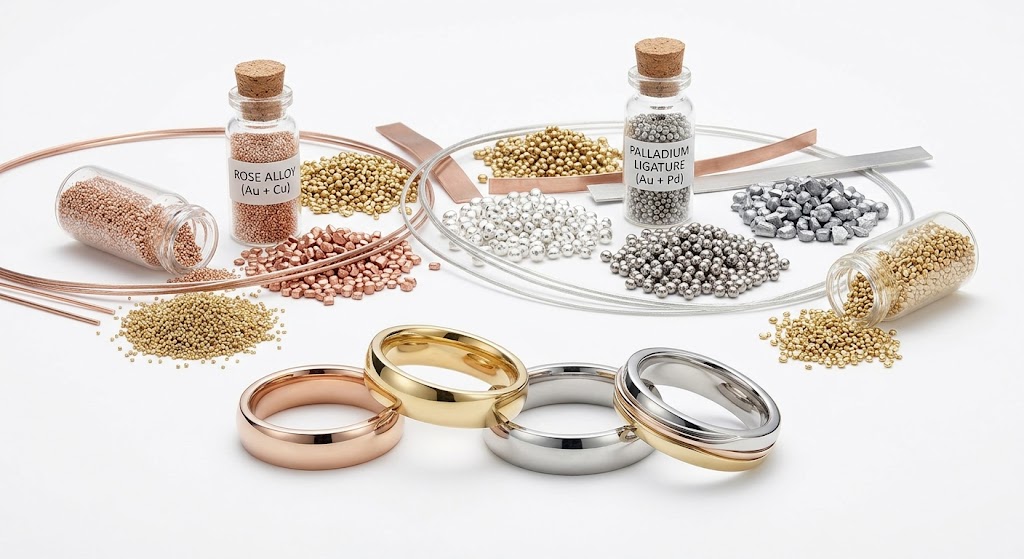
Pure gold (.9999 fine / 24 Karat) is an extremely soft, malleable, and intensely yellow metal in its natural state. A ring made of pure gold would bend easily under simple hand pressure. For this reason, bench jewelers rarely use pure gold for structure—instead, it is alloyed with other metals.
These added non-precious or precious metals are called ligatures (alloying elements), and the resulting mixture is a jewelry alloy.
A ligature is a deliberate blend of metals added to a primary precious metal (gold, silver, platinum).
3 Key Functions of a Ligature:
Structural Strength: Hardens gold to resist scratches, bending, and everyday wear.
Color Manipulation: Enables the creation of yellow, red, rose, white, and even green gold.
Enhanced Workability: Alters melting temperatures, fluidity, and casting characteristics.
| Metal | Primary Function | Resulting Effect |
| Copper | Imparts hardness and a reddish hue. | Higher copper content yields red/rose gold. |
| Silver | Softens the redness of copper; adds a warm yellow tone. | Increases ductility and workability. |
| Nickel | Strongly bleaches (whitens) gold. | Produces hard, inexpensive white gold (can trigger allergies). |
| Palladium | Premium whitening agent; 100% hypoallergenic. | Creates a rich, dark-white, safe gold alloy. |
| Zinc | Lowers melting points and improves flow in casting. | Commonly used in gold solders and white gold mixes. |
585 fine gold contains 58.5% pure gold, while the remaining 41.5% is the ligature. The exact ratio within that 41.5% determines the final color:
Yellow Gold: A balanced blend of silver and copper (approx. 58.5% Gold, 28% Silver, 13.5% Copper). Preserves classic golden warmth.
Red / Rose Gold: Copper-dominant blend (approx. 58.5% Gold, 33.5% Copper, 8% Silver). Historically the most traditional alloy across regional Eastern markets.
White Gold: Formulated with strong whitening agents.
Premium Standard: Gold + Palladium + Silver.
Budget Standard: Gold + Nickel + Copper + Zinc.
Green Gold (Electrum): Gold alloyed exclusively with silver (approx. 58.5% Gold, 41.5% Silver), producing a soft greenish-yellow tint.
Pros:
Design Versatility: Enables two-tone and tri-color jewelry combinations.
Superior Durability: Properly formulated alloys guarantee lifelong structural integrity.
Cons:
Allergy Potential: Nickel-bearing white gold alloys can cause contact dermatitis or skin discoloration.
Tarnish Variance: High-copper alloys (red/rose gold) oxidize slightly faster under extreme sweat or ambient chemicals compared to yellow or palladium-white gold.
When choosing white gold jewelry—especially daily-wear items like wedding bands or earrings—always ask your jeweler: "Is this alloyed with Palladium or Nickel?"
While nickel-formulated white gold is more budget-friendly, palladium-alloyed white gold is completely hypoallergenic, carries a richer natural white-grey hue, and ensures total skin comfort over a lifetime of wear.
 511 40 73 13
 info@silveria.ge


 Eng
Eng