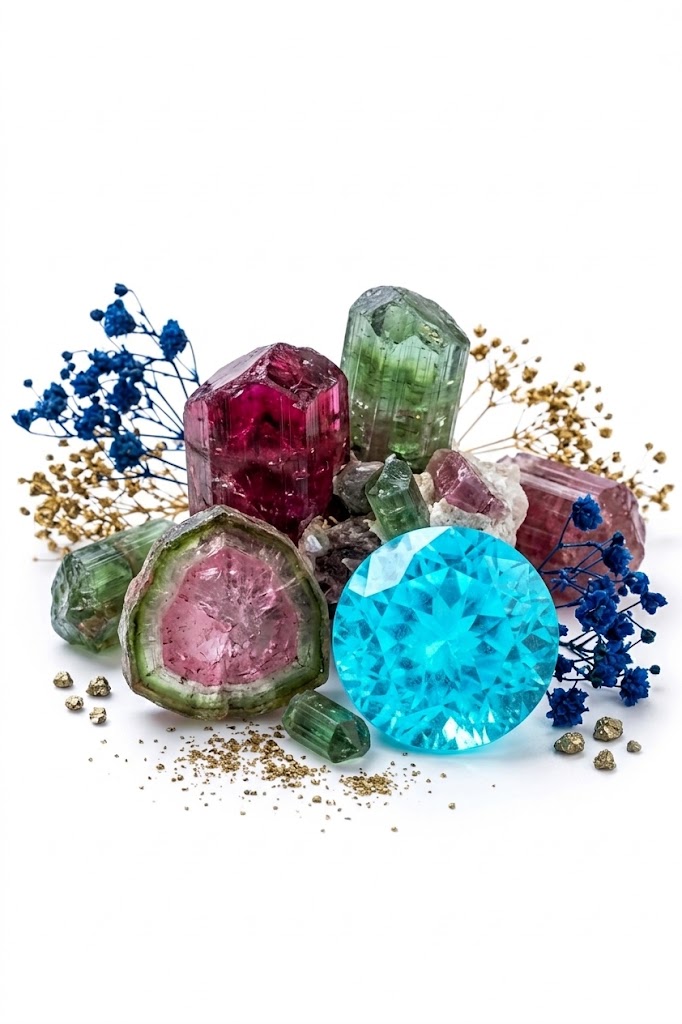
Few gemstones in the fine jewelry world can match the sheer color spectrum and fascination of Tourmaline. It is a mineral that occurs in virtually every color imaginable—from vivid emerald greens and deep ruby reds (Rubellite) to the incredibly rare electric neon-blues of Paraíba.
Loved equally by Haute Joaillerie houses and contemporary avant-garde designers, let’s explore Tourmaline’s origins, legends, varieties, gemological traits, and care requirements.
While tourmaline has been used for centuries, it was often misidentified as emerald or ruby until advanced mineralogy emerged in the 19th century.
Etymology & Origin: The name derives from the Sinhalese word Turmali or Toramalli, meaning "mixed gems." Dutch merchants introduced it to Europe from Ceylon (Sri Lanka) in the early 18th century.
Sources: The world’s richest tourmaline deposits are found in Brazil (Minas Gerais, Paraíba), Nigeria, Mozambique, Madagascar, and Afghanistan.
Lore & Traditions:
The Rainbow Journey: An ancient Egyptian legend tells that tourmaline passed through a rainbow as it traveled up from the Earth’s core, absorbing all its vibrant colors along the way.
Imperial Favor: The Dowager Empress Cixi of China was so enamored with pink and red tourmaline (Rubellite) that she imported tons of it from California mines to carve into fine jewelry, snuff bottles, and artifacts.
The "Ash Attractor": Tourmaline is pyroelectric; when heated or rubbed, it develops a static charge. Dutch traders used it as "Aschentrekker" to pull ash from their meerschaum pipes.
Tourmaline is a complex boron-silicate mineral. Variations in trace elements like iron, manganese, chromium, and copper give rise to its breathtaking array of hues.
Renowned Jewelry Varieties:
Paraíba: The rarest and most valuable tourmaline, displaying a glowing "electric neon" cyan-blue hue caused by copper traces. Fine specimens can exceed diamonds in price per carat!
Rubellite: Deep pink to rich reddish-purple tourmaline resembling fine ruby.
Verdelite: Green tourmaline, prized for its emerald-like tones.
Indicolite: Rare, deep indigo to navy blue tourmaline.
Watermelon Tourmaline: A striking bi-colored gem featuring a pink core surrounded by a green outer ring, mimicking a watermelon slice.
Processing: Measuring 7 to 7.5 on the Mohs scale, tourmaline possesses great durability. Bench jewelers facet it into brilliant, emerald, or oval cuts, or polish it into cabochons (especially for specimens showing a "cat's-eye" chatoyancy effect).
Pros:
Unrivaled Color Variety: Offers endless aesthetic choices for pairing with yellow gold, white gold, or platinum.
Great Hardness: Suitable for everyday wear in rings, pendants, and earrings.
Strong Pleochroism: Exhibits different color intensities and shades when viewed from different angles.
Cons:
Natural Inclusions: Rubellites and Watermelon varieties often contain natural liquid fractures/inclusions, requiring delicate setting techniques.
Dust Magnet: Due to its static electric properties, it attracts dust particles when worn and warmed by body heat.
Cleaning: Clean safely using warm, mild soapy water and a soft-bristled brush.
Avoid Thermal Shock: Sudden temperature shifts can cause heavily included stones to fracture.
Ultrasonic Cleaning: Use with extreme caution. Heavily included or liquid-filled stones should never be ultrasonically cleaned.
Storage: Store in individual soft fabric compartments to prevent friction against harder gems.
When purchasing a high-grade tourmaline, pay attention to its pleochroism. A master lapidary must orient the stone correctly along its optic axis during cutting—if cut incorrectly, the gem can appear muddy or dark.
Exercise extreme caution with Paraíba Tourmaline: If offered a neon-cyan tourmaline at a bargain price, it is likely a standard green tourmaline or dyed glass. Genuine Paraíba comes with an independent gemological laboratory report verifying copper (Cu) and manganese (Mn) trace elements!
 511 40 73 13
 info@silveria.ge


 Eng
Eng