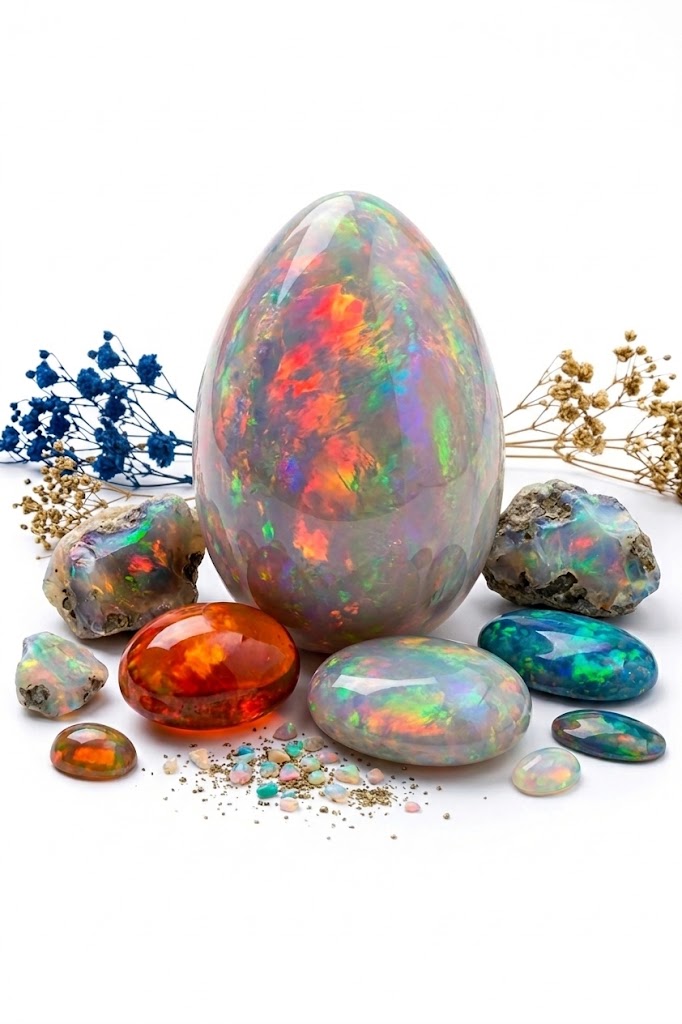
In the fine jewelry universe, Opal stands alone as a truly magical gemstone. While other gems merely reflect light, an opal seems to hold a living rainbow of fire within its matrix. Gemologists call this phenomenal optical effect Play-of-Color—with the slightest movement, flashes of vivid red, green, electric blue, and gold ignite across its surface.
Let’s explore Opal’s origins, unique silica chemistry, distinct varieties, and crucial care guidelines through the eyes of a master jeweler.
For thousands of years, opals have been cherished as symbols of hope, purity, and artistic inspiration.
Etymology & Origins: The name traces back to the Sanskrit Upala (precious stone), later evolving into the Latin Opalus.
Sources: Approximately 95% of the world’s precious opal originates in Australia (Coober Pedy, Lightning Ridge), setting the global standard. Other prominent origins include Ethiopia (Welo region), Mexico (Fire Opal), and the USA.
Lore & Myths:
Australian Aboriginal Legend: Indigenous lore tells of the Creator descending to Earth on a giant rainbow to bring peace. Wherever his feet touched the ground, the rocks came alive, glittering with all the colors of the rainbow.
Ancient Rome: Romans prized opals above almost all gems, believing they combined the burning fire of ruby, the rich green of emerald, and the brilliant blue of sapphire into one stone.
The "Bad Luck" Myth: A 19th-century novel by Sir Walter Scott created a superstitious belief that opals brought bad luck. In truth, bench jewelers perpetuated the myth simply because opals are soft and required extreme delicacy during setting!
Chemically, opal is a hydrated amorphous silica dioxide with a water content ranging from $3\%$ to $21\%$. Microscopic silica spheres stacked within the stone diffract light, creating its signature color flashes.
Primary Jewelry Varieties:
Black Opal: The rarest and most valuable, featuring a dark (black or dark grey) body tone that makes spectral colors pop with intense contrast.
White/Milk Opal: Displays a white or light body tone with softer, pastel-like play-of-color.
Ethiopian Opal (Hydrophane): Translucent to honey-colored opal that readily absorbs water, temporarily altering its transparency.
Fire Opal: Mexican opal celebrated for its vivid yellow, orange, or cherry-red body color, often faceted rather than cut into cabochons.
Processing: Registering a 5.5 to 6.5 on the Mohs scale, opal is soft. Artisans polish it into smooth cabochons to maximize its optical color display.
Pros:
100% Unique: No two opals in the world are identical; every stone exhibits a distinct color pattern.
Unmatched Visual Appeal: Offers a dynamic, constantly shifting play of internal light.
Cons:
Fragile Surface: Susceptible to scratches, cracking, or chipping upon sharp impact.
Dehydration Risk: Extreme heat or dry environments can cause moisture loss, leading to fine surface cracks ("crazing").
Avoid Chemicals: Keep away from perfumes, hairsprays, soaps, and harsh household detergents.
Ethiopian Opal Water Rule: Hydrophane opals absorb water, temporarily losing their play-of-color until fully dried. Keep them away from moisture!
Cleaning: Gently wipe with a soft, slightly damp cloth. Never submerge or use ultrasonic cleaners.
Storage: Store in a soft pouch away from direct heat or prolonged sunlight.
When buying opal jewelry, always understand the critical difference between a Solid Opal, a Doublet, and a Triplet!
Solid Opal: 100% natural, solid gemstone (most valuable and durable).
Doublet: A thin slice of natural opal glued onto a dark backing (like black onyx or ironstone) to enhance color contrast.
Triplet: A paper-thin slice of opal sandwiched between a dark backing and a clear quartz or glass dome.
If buying an heirloom ring for daily wear, always insist on a Solid Opal. Doublets and triplets are far less expensive and can delaminate if exposed to water!
 511 40 73 13
 info@silveria.ge


 Eng
Eng