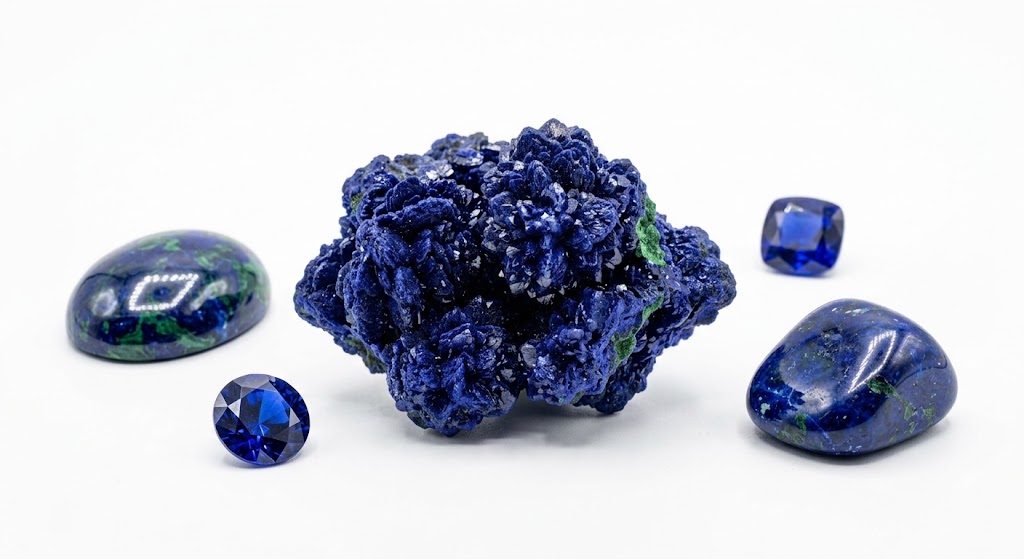
As a practitioner of jewelry craft and mineralogy, I always treat azurite with deep respect. It is not merely a stone—it is a profound, azure-colored elixir crafted by nature. If lapis lazuli, with its golden pyrite inclusions, resembles a starry night sky, azurite—with its intense, almost "electric" dark blue hue—evokes the infinite depth of cosmic space.
Geologically, azurite is a basic copper carbonate ($\text{Cu}_3(\text{CO}_3)_2(\text{OH})_2$). It forms in the oxidized zones of copper ore deposits when carbon dioxide-rich waters interact with copper minerals.
Hardness (Mohs scale): $3.5 - 4$. This makes it a fairly soft and brittle mineral.
Twin Mineral: In nature, azurite is almost always found alongside its "brother"—malachite. When these two minerals grow together, they form a stunningly beautiful stone known as azurmalachite.
Primary Deposits: Morocco, Namibia (specifically the famed Tsumeb mine), the USA (Arizona), France (Chessy), and China.
The history of azurite spans millennia:
Ancient Egypt and Atlantis: Egyptian priests referred to azurite as the "Heavenly Stone." They used it for meditation and connecting with divine forces. Legend has it that the priests of Atlantis preserved secret knowledge through azurite.
Ancient China: In China, it was called the "Gateway to Heaven," and it was believed to bring spiritual enlightenment to those who possessed it.
Renaissance Masters: Before synthetic pigments existed, azurite was used as a precious blue pigment. Renaissance artists ground it into powder to paint the sky and the robes of the Virgin Mary in frescoes and oil paintings.
As a practitioner, I always consider both its technical and energetic characteristics when working with this stone:
Unique Appearance: The depth and vividness of its blue color can only be compared to top-grade sapphire or lapis lazuli.
Strong Metaphysical Energy: In esoteric and energy practices, azurite is considered one of the most powerful activators of the Third Eye (Ajna chakra). It clears the mind, expands consciousness, and enhances intuition.
Rarity and Collector Value: Pure, well-crystallized azurite specimens are highly prized by collectors worldwide.
Softness and Fragility: Due to its low hardness ($3.5-4$), it scratches, cracks, or crumbles easily.
Environmental Sensitivity (Transformation): Azurite is chemically unstable. Prolonged exposure to moisture, air, and heat causes it to gradually lose carbon dioxide and transform into malachite (a green mineral)!
Toxicity During Processing: It contains copper, making it strictly dangerous to inhale its dust or steep it in water (for making elixirs).
From a craftsman’s perspective, here is how we work with azurite:
Cutting and Shaping: Due to its low hardness, azurite is rarely faceted. It is most commonly cut into cabochons (smooth, oval shapes) or kept in its natural druzy/crystalline form.
Stabilization: Before being set into jewelry (like rings or bracelets), azurite's porous structure is often treated with natural resins or polymers to prevent it from crumbling.
Jewelry Placement: It is best used in jewelry pieces that experience minimal mechanical impact—such as earrings, pendants, or brooches.
If you own azurite jewelry or a collector’s piece, follow these golden rules:
Keep Away from Water and Chemicals: Never clean it with soap, chemicals, or ultrasonic cleaners. Wipe it gently using only a dry, soft cloth.
Protect from Direct Sunlight and Heat: Direct sunlight and elevated temperatures can cause it to lose color or develop a greenish tint.
Storage: Store it separately in a soft pouch or lined box in a cool, dry place.
Azurite is a stone of true craftsmanship and spiritual depth. While it demands gentle and cautious handling, it rewards its owner with unmatched aesthetic beauty and profound mental clarity!
 511 40 73 13
 info@silveria.ge


 Eng
Eng