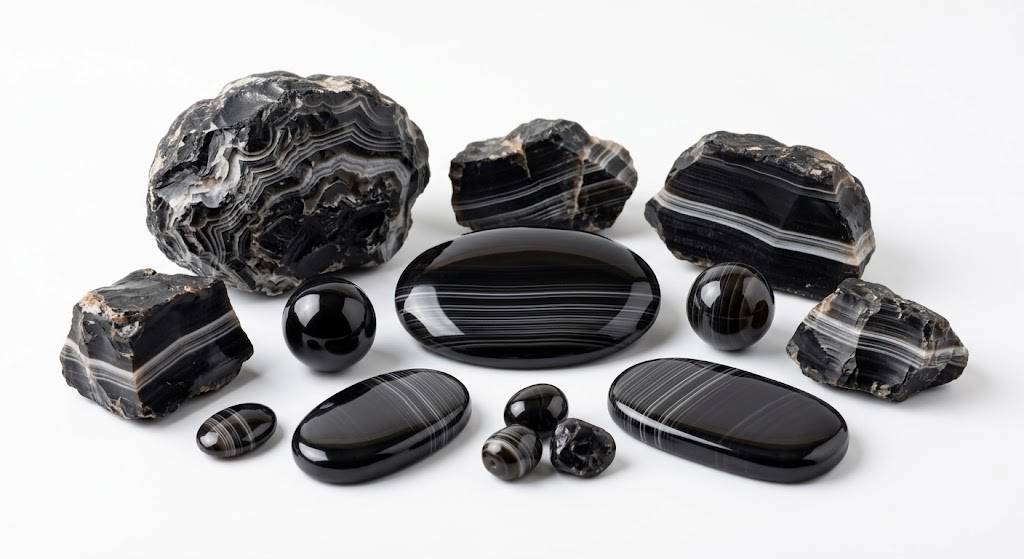
As a practitioner of jewelry craft and mineralogy, Onyx always holds a special place in my workshop. It is a stone possessed of a strikingly austere, refined, and at the same time mysterious character. People often assume that onyx is strictly a black stone, but in reality, it is a band-patterned masterpiece created by nature, where every single layer preserves thousands of years of geological history.
Geologically, onyx is a parallel-banded variety of chalcedony (part of the quartz group) ($\text{SiO}_2$). Its primary defining feature is its sharply defined, parallel bands.
Hardness (Mohs scale): $6.5 - 7$. This is a fairly dense, hard, and durable stone, making it an ideal material for jewelry making and lapidary work.
Color Palette:
Black Onyx: The most popular type, featuring black and white bands (or solid black after specialized treatment).
Sardonyx: Alternating bands of brown, orange, and white.
Green Onyx (Marble Onyx): A translucent green mineral often formed on a calcite or aragonite base (used in carvings and interior decor).
Primary Deposits: India, Brazil, Uruguay, the USA, Mexico, Madagascar, and Pakistan.
The name "onyx" comes from the Greek word Onyx, which means "fingernail" or "claw."
Greek Mythology: According to legend, while Aphrodite, the goddess of love, was sleeping, her son Eros (Cupid) clipped the tips of her fingernails with an arrowhead and scattered them from Mount Olympus into the Indus River. The gods turned these pieces into stone because no part of an immortal deity should ever perish—and thus, onyx was born.
Biblical Era: Onyx is mentioned in the Bible as one of the primary stones used in the construction of the Temple of Jerusalem. It was also engraved on the breastplate of the High Priest (the Ephod) to represent the tribes of Israel.
Ancient Rome and Glyptics (Gem Carving): Roman military commanders used onyx signet rings to seal documents because wax would not stick to the smooth surface of onyx. The stone was also heavily used for carving famous cameos (relief carvings), where the white layer was used for the figure and the dark layer for the background.
As a practitioner, I highlight the following aspects when working with onyx:
High Hardness and Durability: Thanks to its hardness of $6.5-7$, onyx does not scratch easily and retains its polish exceptionally well for decades.
The Stone of Leaders and Rulers: In esoteric and energy practices, onyx is considered a powerful protective (shield) and discipline stone. It helps the wearer master their emotions, maintain focus, overcome stress, and achieve set goals.
Universal Aesthetics: Black and banded onyx pairs seamlessly with both gold and silver. It is equally popular in both men’s and women’s jewelry.
Market Saturation with Enhanced/Dyed Stones: Pure, uniform black onyx is rare in nature. The jewelry industry widely uses chemical dyeing processes on grey chalcedony (using a sugar and sulfuric acid solution) to turn it black.
Heavy Energy for Weak Willpower: It is believed that onyx demands a strong character. For someone timid or weak-willed, it may create an added sense of heaviness.
Brittleness Under Heavy Impact: Despite its hardness, a direct, hard impact can cause it to split along its layered structure.
From a craftsman’s perspective, I follow a few golden rules when working with onyx:
Cut Types: Onyx cuts beautifully into cabochons (smooth domes), flat slabs, beads, or faceted shapes.
Glyptics and Engraving: Its layered structure is ideal for creating engravings, intaglios, and cameos.
Jewelry Placement: Due to its durability, onyx is used across all types of jewelry—rings (especially men’s signet rings), watches, bracelets, and pendants.
While onyx is quite durable, following these simple rules will preserve its original luster:
Cleaning: Clean with warm water, mild soap, and a soft brush. Keep away from harsh chemicals and acids.
Sunlight and Heat: Natural onyx is stable, but if the stone has been color-enhanced/dyed, prolonged exposure to direct sunlight or high heat may cause the color to shift.
Storage: Store in a jewelry box. Although hard itself, harder stones (such as diamonds or sapphires) can still scratch it.
Onyx is a symbol of confidence, spiritual fortitude, and timeless elegance. It is a stone that never goes out of style, instilling inner strength and an unyielding character in its wearer!
 511 40 73 13
 info@silveria.ge


 Eng
Eng