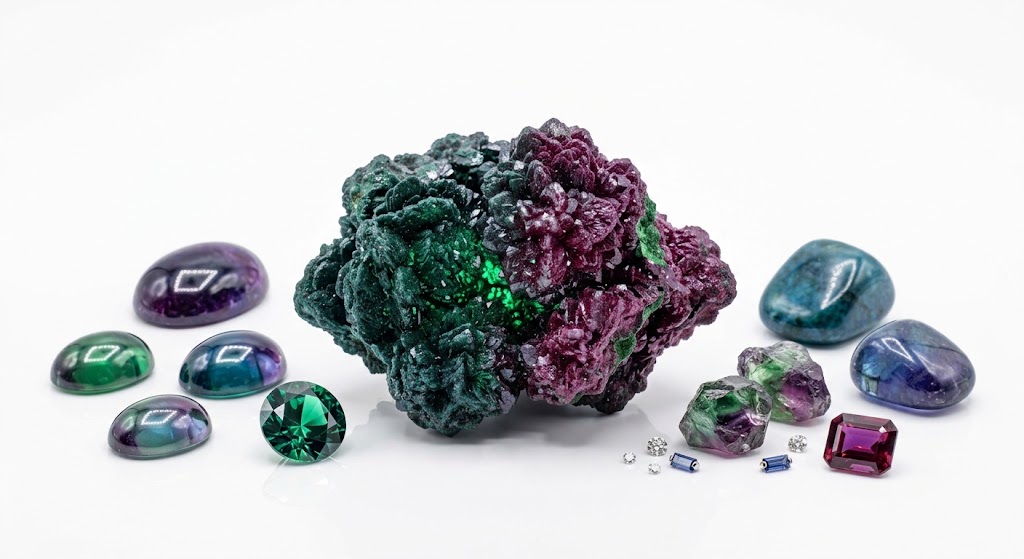
Alexandrite is considered one of nature's most extraordinary and mystical creations. It is not merely a rare semi-precious stone (often held in the same esteem as precious gems)—it is a mineral possessed of a "dual soul." Its ability to dramatically absorb and shift its color under different lighting is regarded as a true miracle in the world of jewelry.
Geologically, alexandrite is a rare natural variety of chrysoberyl ($\text{BeAl}_2\text{O}_4$) containing trace amounts of chromium. It is precisely chromium that imparts its unique optical effect—the alexandrite effect (color change).
Hardness (Mohs scale): $8.5$. It is one of the hardest gemstones in the world, surpassed only by diamond and corundums (ruby and sapphire).
Color Change Effect (Metamerism):
Under natural daylight: The stone glows in emerald-green, blue-green, or olive tones.
Under incandescent (artificial) light: The stone changes color, turning red, raspberry, purple, or violet.
Primary Deposits: First discovered in the Urals (Russia), which produced the highest quality stones with the most vivid color shift (now mostly exhausted). It is also mined in Sri Lanka, Brazil, Madagascar, Tanzania, and Zimbabwe.
Alexandrite is a relatively young gem, yet it possesses a rich history:
Royal Origin: The stone was first discovered in the Ural mines in 1834. Because its primary colors (green and red) matched the military and imperial colors of Tsarist Russia, it was named in honor of the future Emperor, Alexander II (who reached his adulthood on that very day).
Talisman of the Russian Empire: It was called the "Stone of the Russian Tsar (King)" and was believed to protect its owner from misfortune and heighten their intuition.
The "Widow's Stone" Myth: During the Soviet era, a myth emerged claiming that wearing alexandrite alone brought solitude and widowhood. In reality, this was tied to World War II, when women who lost their husbands at the front frequently wore synthetic alexandrite jewelry, which was popular at the time. According to traditional jewelry customs, alexandrite should always be worn in pairs (or set alongside other stones).
In Esotericism:
Alexandrite is a stone of prosperity and longevity. It balances the mind and emotions, thereby assisting its owner in spiritual growth.
In esoteric circles, it is believed to soothe the wearer, making it ideal for hot-tempered individuals. In the 19th century, alexandrite was used to align the physical, astral, and mental bodies. It is also believed to ignite creative abilities and imagination while enhancing intuition, which helps the wearer navigate out of seemingly hopeless situations.
Exclusivity and Rarity: Natural, top-quality alexandrite is rarer and often more expensive than diamond or emerald.
Superior Hardness: An $8.5$ hardness level allows the stone to be set in any type of jewelry for daily wear—it practically does not scratch.
Powerful Energy: In esotericism, alexandrite is considered a stone of strong willpower, adaptability, and good fortune. It aids the wearer in adjusting to change and making sound decisions in stressful situations.
Astronomical Price: A natural alexandrite weighing over 1 carat with a sharp color change can cost tens of thousands of dollars.
Market Saturation with Imitations: Up to 99% of the market is filled with synthetic alexandrite or dyed synthetic corundum/spinel. Finding a genuine natural stone is exceptionally difficult.
Complex Optical Orientation During Cutting: Requires the highest level of craftsmanship to ensure the stone displays both colors (green and red) at their maximum brilliance.
Cut Types: Since the stone is transparent and possesses high luster, it is primarily given faceted cuts—such as oval, brilliant, or cushion.
Crystallographic Orientation: Before cutting, the lapidary master must precisely determine the crystallographic axis so that the color-change effect is not lost.
Jewelry Setting: It pairs beautifully with both white gold or platinum (which highlights the green hue) and yellow gold (which enhances the red hue).
While alexandrite is an exceptionally durable gemstone, proper care is necessary to safeguard a valuable investment:
Cleaning: You can safely clean it using warm soapy water and a soft brush. It also withstands ultrasonic cleaning (provided there are no large fractures in the stone).
Chemicals: Resistant to household chemicals, though it is advisable to keep it away from strong acids.
Storage: Store separately in a soft pouch or lined box so that it does not damage other stones due to its high hardness.
Alexandrite is the pinnacle of luxury, transformation, and master craftsmanship. It is a stone that shows you the serenity of the earth by day, and a fiery passion by night!
 511 40 73 13
 info@silveria.ge


 Eng
Eng