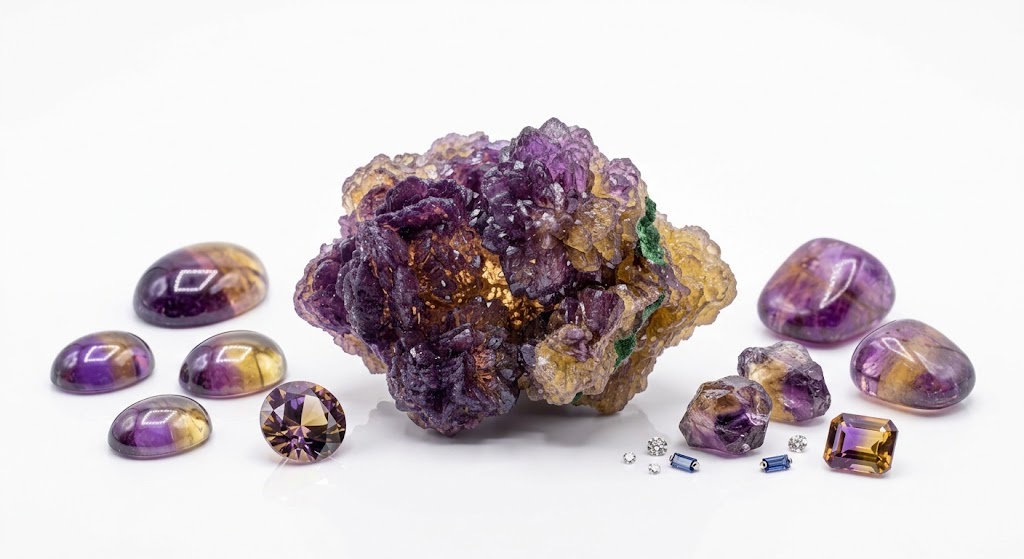
As a practitioner of jewelry craft and mineralogy, I consider ametrine to be one of Earth's most harmonious and aesthetically striking creations. It is a stone in which nature has blended two entirely distinct energies and colors—the deep purple of amethyst and the golden warmth of citrine—within a single crystal.
Geologically, ametrine is a quartz group mineral ($\text{SiO}_2$) that is polychromatic (multi-colored). Its formation is linked to temperature fluctuations during crystallization and varying degrees of oxidation state in iron ($\text{Fe}$) trace elements.
Hardness (Mohs scale): $7$. It is a fairly hard and durable stone, making it very practical and easy to work with in jewelry making.
Color Palette: A sharp or subtle transition between violet, purple, golden-yellow, and orange within a single crystal.
Primary Deposits: The world's only major commercial source for natural ametrine is Bolivia (the Anahí Mine). This is precisely why it is frequently called Bolivianite. Small deposits are also found in Brazil and India, though Bolivian stones remain unmatched in quality and color contrast.
A beautiful South American legend surrounds ametrine:
The Love of Princess Anahí: In the 16th century, the Spanish conquistador Don Felipe de Goitía married Princess Anahí, the daughter of a chief from the local Ayoreo tribe. As a dowry, the chief gave the Spaniard the ametrine mine. When the tribe learned that the princess planned to leave for Spain with her husband, they killed her. Before dying, Anahí handed her husband a two-toned ametrine stone, which symbolically represented her divided heart—her loyalty split between her people and her beloved husband.
Establishing European Popularity: The conquistador presented this unusual bi-color gem to the Queen of Spain, after which ametrine gained immense popularity among royal courts and high society across Europe.
As a practitioner, I highlight the following aspects when working with ametrine:
Unique Optical Effect: The natural synthesis of two distinct colors grants any piece of jewelry an exclusive and memorable appearance.
High Durability and Practicality: Thanks to its hardness of $7$, the stone does not scratch easily and is ideal for daily wear.
Dualism and Energetic Balance: In esotericism, ametrine is regarded as a stone of peace, harmony, and reconciliation. It combines the spiritual tranquility of amethyst with the vital energy of citrine, helping the wearer resolve conflicts and overcome stress.
Market Saturation with Imitations/Synthetics: You will frequently encounter lab-grown quartz or heat-treated amethyst on the market where the yellow color has been produced artificially.
Sensitivity to High Temperatures: Extreme heat or prolonged exposure to direct sunlight can cause the stone's colors to fade over time.
As a craftsman, I pay special attention to cutting technique when fashioning ametrine:
Cut Types: The finest cuts for ametrine are the emerald cut (rectangular) or cushion cut. These shapes best accentuate the distinct divide between the purple and yellow color zones. It is also carved into cabochons and spheres.
Color Orientation: A lapidary master's key skill lies in faceting the stone so that the color boundary line passes precisely through the center of the gem.
Jewelry Setting: It pairs exceptionally well with yellow gold (which highlights the citrine zone) as well as silver and white gold (which accentuate the purple tones of the amethyst).
While ametrine is a reliable and durable gemstone, following a few simple rules will maintain its vibrant colors:
Cleaning: Wash with warm soapy water and a soft brush. Avoid harsh chemical cleaners.
Sunlight and Heat: Do not leave the stone exposed to direct sunlight for long periods to prevent potential color fading.
Storage: Store separately in a soft pouch or jewelry box so that harder gemstones (such as diamonds or sapphires) do not scratch it.
Ametrine (Bolivianite) is an ideal balance crafted by nature. It is a gem that serves as a constant reminder that even the most opposing elements can unite to create complete, perfect harmony!
 511 40 73 13
 info@silveria.ge


 Eng
Eng