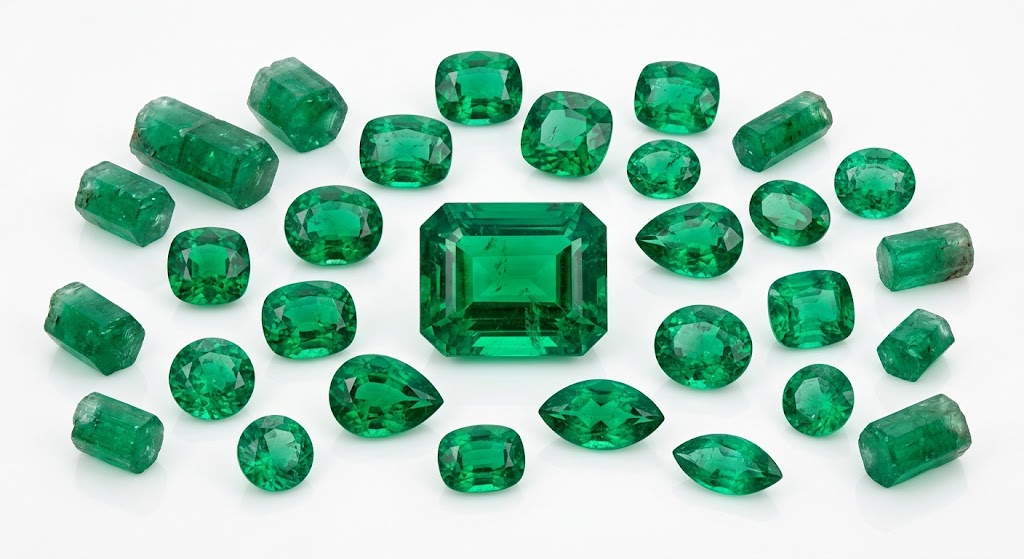
As a practitioner of jewelry craft and mineralogy, I consider the emerald to be the true aristocrat of the gemstone realm. It stands as the most magnificent, delicate, and prized member of the beryl family. Its unique, profound green hue has captivated emperors, tsars, and collectors for millennia.
Geologically, the emerald is the green variety of beryl (Be3Al2Si6O18), deriving its extraordinary color from trace amounts of chromium (Cr) and vanadium (V).
Hardness (Mohs scale): 7.5−8. Despite its high hardness, the emerald is remarkably brittle due to internal micro-fractures and inclusions.
The "Jardin" (Garden): Most natural emeralds feature internal inclusions and fissures. In the jewelry world, this phenomenon is referred to as the jardin (French for "garden")—it serves as the gem's natural passport and proof of authenticity.
Primary Deposits:
Colombia: The premier global source, renowned for producing emeralds with a vivid, deep green color.
Zambia: Famed for gems displaying a bluish-green undertone and exceptional clarity.
Brazil, Zimbabwe, and the Urals (Russia).
Emeralds possess one of the richest and most storied backgrounds in human history:
Cleopatra’s Gem: The queen of Ancient Egypt idolized emeralds above all other gems. She owned personal mines near the Red Sea and frequently gifted foreign dignitaries emeralds carved with her own likeness.
Sacred Stone of the Incas and Aztecs: Ancient South American civilizations revered emeralds as divine artifacts and used them to adorn their sacred temples.
In Esotericism: The emerald is regarded as a talisman of fidelity, love, wisdom, and rebirth. It was believed to grant foresight to its owner, protect against betrayal, and soothe the nervous system.
Supreme Status and Investment Value: High-grade, natural emeralds with exceptional clarity can often command a higher price per carat than fine diamonds.
Incomparable Color: The signature emerald green hue is unique in nature and possesses no true equal.
Uniqueness: Thanks to the jardin, no two natural emeralds in the world are identical.
Fragile Structure: Due to internal fissures, the stone is sensitive to mechanical impacts, pressure, and thermal shocks.
Special Care Requirements: Demands cautious handling and periodic oil re-treatments.
The "Emerald Cut": This signature rectangular faceted cut with step facets was created specifically for this gem. It protects the vulnerable corners from chipping while maximizing the depth of color.
Oil Clarity Enhancement (Oiling): Immersing emeralds in natural cedarwood oil is a centuries-old, globally accepted standard practice. The oil fills micro-fractures and enhances the gem's overall transparency.
If you plan to purchase an emerald, keep these golden rules from a master craftsman in mind:
Embrace Internal Inclusions (The "Jardin"): A completely flawless, vibrant, and inexpensive "emerald" is 99.9% likely to be glass, synthetic material, or an imitation. Natural emeralds almost always exhibit internal structural characteristics.
Prioritize Color Over Absolute Clarity: Up to 70% of an emerald's value is driven by its color saturation. It should showcase a rich, vivid green. Very pale green stones are classified simply as "green beryl," not emeralds.
Demand a Gemological Certificate: Because the market contains laboratory-grown stones and specimens filled with epoxy resins, insist on a certificate from an independent gemological laboratory (e.g., GIA, SSEF, Gübelin) when purchasing a high-value gem.
Understand the Degree of Enhancement:
Minor to Moderate Oiling: Standard, accepted practice in the trade.
Resin or Glass Filling: Significantly reduces the actual market value of the gemstone.
Inspect the Setting: Ensure that the corners of the stone—its most vulnerable points—are securely protected by gold or platinum prongs or a full bezel.
Never Use Ultrasonic or Steam Cleaners: Ultrasonic vibrations can force cedarwood oil out of internal fractures or shatter the stone entirely.
Cleaning Protocol: Wash strictly with room-temperature water, mild soap, and an ultra-soft cloth.
Avoid Heat and Harsh Chemicals: Hot water, dishwashing liquids, and perfumes damage the oil-enhanced surface layer.
Storage: Store separately in a soft pouch to prevent friction against other gemstones.
The emerald is a gem that demands understanding and appreciation. It is not merely a piece of jewelry—it is a living piece of history written by nature over millions of years!
 511 40 73 13
 info@silveria.ge


 Eng
Eng