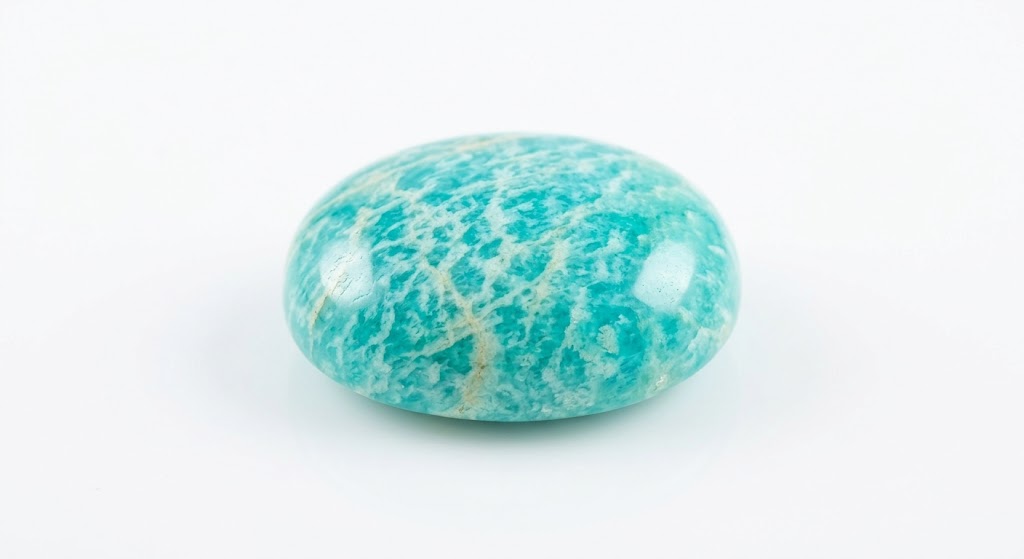
Amazonite is considered one of the most vibrant, exotic, and visually calming gemstones. Its eye-catching blue-green (turquoise) hue and silky internal luster instantly captivate the observer.
Geologically, amazonite is a variety of potassium feldspar (microcline) ($\text{KAlSi}_3\text{O}_8$). Its unique color is caused by trace amounts of lead ($\text{Pb}$) and water molecules integrated within its crystal lattice.
Hardness (Mohs scale): $6 - 6.5$. It is a stone of medium hardness, requiring careful and precise handling.
Color Palette: Ranges from light green and turquoise to vibrant blue-green tones. It is often interlaced with white streaks or spots (albite inclusions), creating a natural ornamental pattern.
Primary Deposits: Brazil, USA (Colorado), Madagascar, Russia (Urals and Kola Peninsula), India, and Namibia.
Talisman of Amazonian Warriors: The name "Amazonite" is linked to the Amazon River, though no actual deposits are found there. Legend has it that South American Amazonian women warriors decorated their armor and weapons with this stone, believing it granted them courage and strength.
Ancient Egypt: Amazonite was held in high esteem during the era of the Pharaohs. Amulets and jewelry crafted from amazonite were discovered in King Tutankhamun's tomb. Furthermore, select chapters of the Egyptian Book of the Dead were carved onto amazonite tablets.
In Esotericism: Amazonite is regarded as a stone of tranquility, harmony, and self-expression. It helps the wearer overcome emotional stress, dispels fears, and enhances communication skills (associated with the Throat Chakra).
Distinctive Aesthetics: Its turquoise shade and white veining lend a natural, vivid appearance to any piece of jewelry.
Affordable Price: Compared to precious gemstones (such as emeralds or sapphires), high-grade amazonite is far more accessible.
Takes a High Polish: When processed correctly, it acquires a beautiful silky or vitreous luster.
Cleavage: Exhibits perfect cleavage in two directions, meaning a hard impact can easily cause the stone to split along its crystallographic planes.
Scratch Sensitivity: With a hardness of $6 - 6.5$, it can be scratched by harder gemstones or metals.
Cut Types: Due to its translucent-to-opaque nature, amazonite is primarily fashioned as cabochons (ground/polished cabochons), beads, or decorative carvings. Faceted cuts are rarely used.
Jewelry Settings: It complements silver exceptionally well (which highlights its cool, ocean-like tones) as well as yellow gold and brass (bronze), which lend it an ethnic, antique aesthetic.
Master's Tip: When setting amazonite in rings, a protective bezel setting is essential to shield the stone's edges from mechanical damage.
Observe Color Intensity: The most valuable specimens feature a vivid, saturated blue-green (deep turquoise) color with minimal white patching.
Do Not Confuse with Turquoise or Jadeite: While often visually compared to turquoise, amazonite displays a distinct internal grid-like texture (microcline twinning structure) and a silky luster.
Inspect the Surface: Ensure the cabochon surface is smooth and free of deep structural fissures that could lead to breakage later on.
Protect from Impacts: Do not wear amazonite jewelry during heavy physical activity or sports.
Avoid Harsh Chemicals: Acids, household cleaners, and strong detergents can damage the stone's surface.
Cleaning: Clean strictly with a soft cloth, warm water, and mild soap. Ultrasonic cleaning must be avoided at all costs!
Storage: Store separately in a soft pouch to prevent scratches from other jewelry pieces.
Amazonite is the true embodiment of natural beauty and serenity. It is an ideal choice for anyone seeking to wear a unique gem steeped in ancient legend and the refreshing calm of the ocean!
 511 40 73 13
 info@silveria.ge


 Eng
Eng