Here is the complete English translation of the article on Nephrite (Nephrite Jade):
As a practitioner of jewelry craft and mineralogy, I consider nephrite to be the most durable mineral in the world, with one of the most spiritually rich histories. It is not merely a beautiful stone—in Eastern culture, particularly in China, nephrite is valued even more than gold or diamonds.
Geologically, nephrite is an amphibole group mineral—a complex silicate composed of fibrous tremolite-actinolite crystals ($\text{Ca}_2(\text{Mg, Fe})_5\text{Si}_8\text{O}_{22}(\text{OH})_2$). Its unique characteristic is that these crystalline fibers are tightly interwoven in a felted structure, granting the stone extraordinary toughness.
Hardness (Mohs scale): $6 - 6.5$. Despite its medium hardness, nephrite is the most impact-resistant mineral on Earth—it is virtually impossible to shatter, even with a hammer.
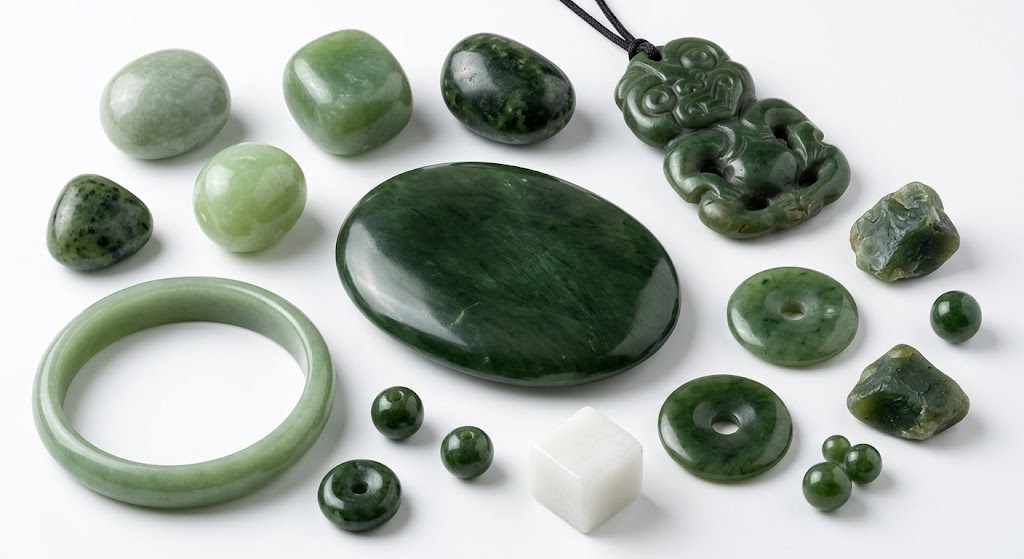
Color Palette: Various shades of green (from light emerald to dark spinach green), white ("mutton-fat" jade), yellow, brown, gray, and rarely, black.
Primary Deposits: China (Khotan), Russia (Sayan Mountains, Lake Baikal), New Zealand, Canada, Australia, and the USA (Wyoming).
Symbol of Chinese Empire: A famous Chinese proverb states: "Gold has a value; jade is invaluable." For millennia, it was used to carve imperial seals, royal regalia, and sacred ceremonial vessels. The Chinese believed that nephrite bestowed immortality.
Sacred Gem of the Māori: The indigenous Māori people of New Zealand regarded nephrite (locally known as Pounamu) as sacred. They crafted both deadly war clubs (Mere) and heirloom ancestral pendants (Hei-Tiki) from it.
Etymology: The name "Nephrite" originates from the Greek word nephros (kidney), as it was anciently believed to cure kidney ailments.
In Esotericism: Nephrite is considered a stone of wisdom, justice, harmony, and spiritual purity. It helps the wearer find inner balance, shields against negative energy, and fosters business and financial success.
Extreme Toughness: Will not chip, crack, or shatter easily under heavy impact. Ideal for everyday wear.
Silky Texture: Accepts a unique, soft waxy or greasy luster upon polishing.
Heat Retention: Retains heat for long periods, which is why it is frequently used as a therapeutic and massage stone.
Market Saturation with Imitations: Cheaper minerals (such as serpentine or aventurine) or dyed marble are frequently sold under the name of nephrite.
Carving Complexity: Due to its extreme tenacity and fibrous density, working with it requires specialized diamond tools and considerable time.
Cut Types: Nephrite is almost never faceted. Its primary forms are cabochons, beads, bangles, solid rings, and artistic carvings—including figurines, talismans, and vessels.
Jewelry Setting: Complements yellow gold exceptionally well (a traditional Eastern style) as well as silver and white gold.
Distinguish Nephrite from Jadeite: Both stones share the overarching commercial label "Jade," but they are distinct minerals. Jadeite is rarer, displays brighter hues, and takes a glass-like luster, whereas nephrite exhibits a softer, waxier sheen.
Test Density and Temperature: Genuine nephrite remains cool to the touch for a long time and feels noticeably dense/heavy in the hand.
Inspect Under Light: Natural nephrite displays an internal fibrous, slightly cloudy structure. If a stone is completely transparent and contains tiny air bubbles, it is glass.
Demand Certification: Especially when acquiring high-value white ("mutton-fat") or uniformly saturated green nephrite.
Cleaning: One of the easiest stones to maintain. Clean simple with warm soapy water and a soft cloth.
Chemical Resistance: Although highly durable, keep it away from strong acids and aggressive household chemicals.
Storage: Can be stored anywhere without worry—it is virtually impossible for other gemstones to break or shatter it.
Nephrite is a gemstone that has stood the test of centuries. It is the true embodiment of resilience and inner tranquility, passed down as a treasured legacy from generation to generation!
 511 40 73 13
 info@silveria.ge


 Eng
Eng