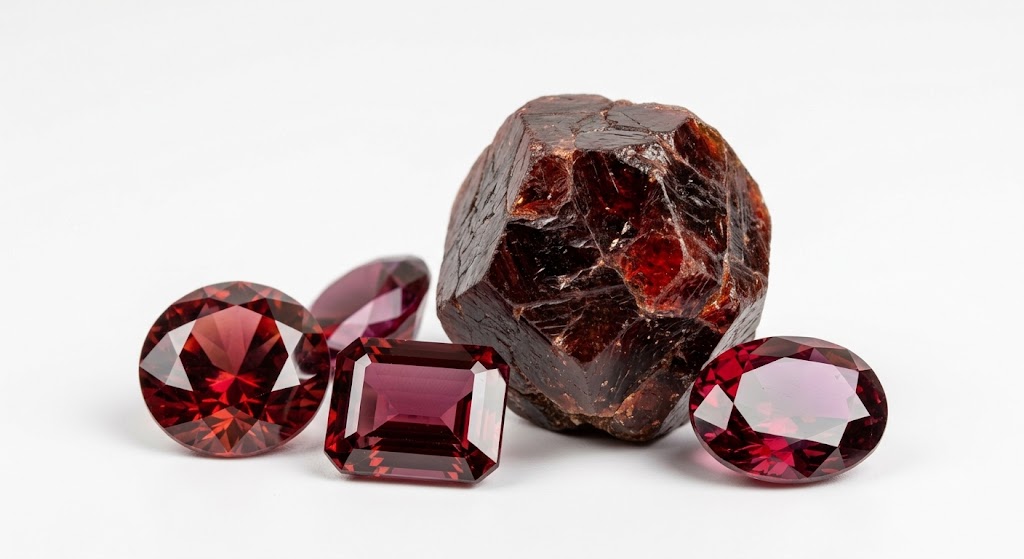
Almandine — The Power of Fiery Garnet, Its History, and Master's Tips
Almandine is the most common and one of the best-known varieties of the garnet group. With its deep cherry-red and purple hues, it has captivated jewelers and collectors for centuries. Through the eyes of a master craftsman, this stone represents a perfect blend of durability and timeless elegance.
The name "Almandine" originates from the historic city of Alabanda in Asia Minor, which in ancient times was a major center for processing and trading this stone. The Roman naturalist Pliny the Elder referred to the "carbuncles" (an ancient term for all red gemstones) from this region as specimens of the highest quality in his writings.
Warriors' Amulet: In medieval Europe, Crusaders and warriors fixed Almandine onto their armor and hilt of their swords. They believed the stone protected its owner from wounds, stopped bleeding, and bestowed courage on the battlefield.
The Light of Noah's Ark: Eastern legends mention garnet as the stone that illuminated the path for Noah's Ark during the Great Flood in the darkness of the night.
Victorian Era Boom: In the 19th century, particularly in Victorian England, Almandine became one of the most popular gemstones in the art of jewelry — it was frequently featured in brooches and rings.
Masters used to say that working with Almandine is a true pleasure because it is a dense and durable stone, allowing for the creation of complex faceted designs.
Chemical Formula: $\text{Fe}_3\text{Al}_2(\text{SiO}_4)_3$ (iron-aluminum silicate). The high iron content gives the stone its dark red color.
Hardness (Mohs Scale): $7.0 - 7.5$. This high rating makes the stone resistant to scratches during daily wear.
Crystal System: Cubic (isometric).
Refractive Index: $1.77 - 1.81$.
Technical Specialty: Almandine is often so dark that it barely transmits light. Because of this, ancient masters would hollow out the underside (concave cut) to allow light to move better through the stone and reveal its inner color.
Common Almandine: Features a dark red, brownish, or purplish hue. These are the most widespread gem-quality specimens.
Star Almandine (Star Garnet): A rare and precious variety. Due to internal rutile inclusions (needles), light reflecting on the stone's surface creates a 4- or 6-rayed star effect (asterism). The most famous deposits are located in Idaho (USA) and India.
Rhodolite: A blend of Almandine and Pyrope garnet, renowned for its stunning pinkish-violet coloration.
Pay attention to the following details:
Color and Clarity: The finest Almandine should not be excessively dark (almost black). High-quality stones should exhibit a cherry-red or deep purple undertone under light.
Distinguishing from Imitations:
Weight: Natural Almandine is dense and feels noticeably heavy in the hand compared to glass or plastic.
Magnetic Properties: Since the stone contains a significant amount of iron, a strong neodymium magnet can slightly attract a small Almandine stone (for instance, one suspended on a string).
Inclusions: Natural gemstones almost always contain minor internal micro-fractures or mineral inclusions. An entirely flawless, inexpensive stone is likely glass.
Care and Maintenance:
Despite its high hardness, avoid sharp impacts against hard surfaces.
Clean with warm soapy water and a soft brush. Avoid sudden temperature changes and harsh chemicals.
 511 40 73 13
 info@silveria.ge


 Eng
Eng