Ammonite — Millions of Years of Fossilized History, Symbol of the Sea, and Master's Tips
Ammonite is not an ordinary mineral or stone — it is the fossilized remain of an ancient mollusk that inhabited Earth's oceans hundreds of millions of years ago. Its unique, coiled spiral shell continues to fascinate jewelers, collectors, and aesthetics enthusiasts to this day. Through the eyes of a master craftsman, Ammonite is a true architectural wonder created by nature, where time, organic life, and mineralization seamlessly merge.
The history of Ammonite spans hundreds of millions of years, though humanity began appreciating it in ancient times.
Divine Horns: The name Ammonite is linked to the ancient Egyptian deity Amun, who was depicted with ram's horns. Later, the Roman naturalist Pliny the Elder named these fossils "Horns of Ammon" (Cornu Ammonis).
Legend of the Petrified Snakes: In medieval England, people believed that ammonites were petrified, decapitated snakes. According to legend, Saint Hilda turned all snakes into stone with her prayers and cast them off the cliff to protect the monastery.
Native American Amulet: Indigenous peoples of North America called ammonites "buffalo stones" and used them to bring good fortune before hunts and in healing rituals.
Feng Shui and Harmony: In Eastern philosophy, the spiral shape of Ammonite is associated with the Golden Ratio and the infinite movement of cosmic energy. It is believed to bring harmony and prosperity to the home.
Working with Ammonite requires a special approach from the craftsman. Since it is a fossilized remain, the mollusk's organic tissues were replaced over centuries by various minerals (calcite, pyrite, quartz, aragonite, etc.).
Composition: Primarily composed of calcium carbonate ($\text{CaCO}_3$) and substituted minerals.
Hardness (Mohs Scale): $3.5 - 4.0$ (depending on the replacing mineral). This is relatively soft, meaning the stone requires gentle handling.
Crystal System: Amorphous / Organic origin (mineralized).
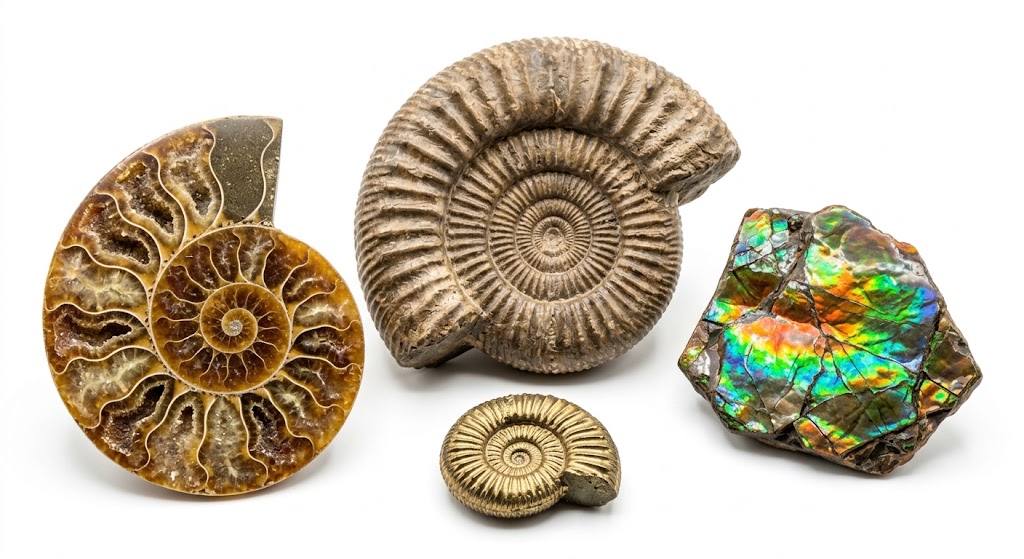
Structure: Internally divided into chambers (septa). When an ammonite is cut in half and polished, its beautiful inner spirals are revealed.
Colors: Brown, golden (pyritized), gray, and in unique cases — iridescent red, green, and orange.
Pyritized Ammonite: A fossil where the organic part has been replaced by pyrite ("fool's gold"). These ammonites feature a metallic, golden luster.
Sliced / Polished Ammonite: Specimens cut in half that clearly showcase internal chambers, which are often filled with calcite or quartz crystals.
Ammolite: The most precious, gem-quality variety of Ammonite! It is a thin layer of aragonite on the surface of the ammonite that displays vibrant rainbow iridescence. It holds rare gemstone status and is primarily mined in Alberta, Canada.
Pay attention to the following details:
Integrity and Restoration: Natural ammonites often have minor cracks. Inspect whether the fossil has been restored (filled with glue or resin). Small natural flaws highlight its authenticity.
Care and Maintenance:
Due to its $3.5 - 4.0$ hardness, Ammonite scratches easily. Avoid contact with harder stones, keys, or metals.
Chemical Shield: Because of its calcium content, keep it away from acids, perfumes, vinegar, and harsh cleaning agents — these can damage the surface and dull its shine.
Cleaning: Clean exclusively with a soft, slightly damp cloth. Do not use ultrasonic cleaning devices.
Jewelry Application: Since the stone is relatively soft, the best choices are pendants, brooches, earrings, or collector display pieces.
 511 40 73 13
 info@silveria.ge


 Eng
Eng