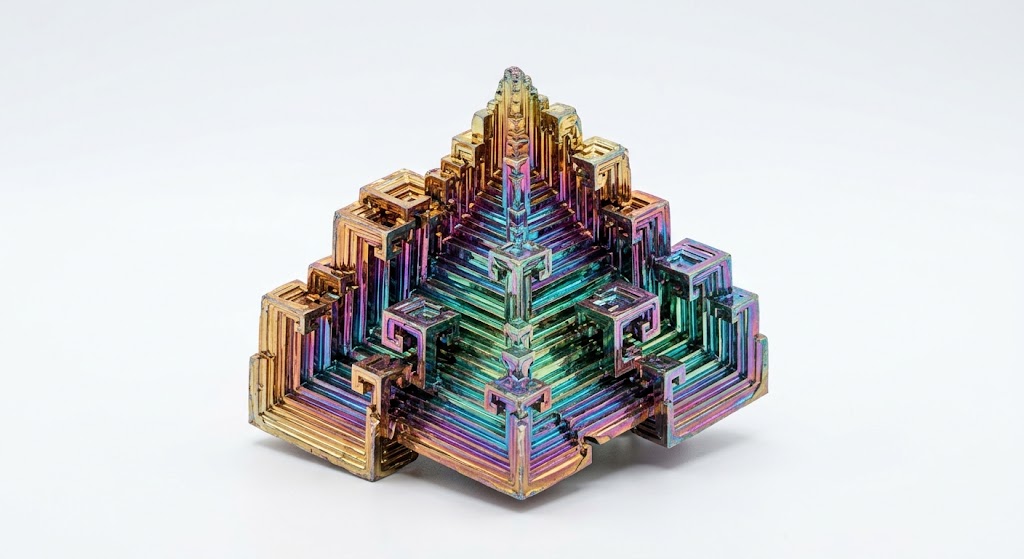
Bismuth — Rainbow Cosmic Architecture, History, and Master's Tips
Bismuth is one of the most astonishing and visually striking members of the periodic table of elements. Although it occurs in nature as a mineral, its lab-grown crystals capture everyone's attention with their futuristic, stepped geometric shapes and iridescent rainbow luster. Through the eyes of a master craftsman, Bismuth is a true wonder born on the boundary of science and art.
Bismuth was known to humanity in ancient times, though it was long confused with lead, tin, and zinc.
Origin of the Name: The name likely derives from the German phrase "Wisse Masse" (white mass) or "Wismut", referring to its natural silvery-white hue.
Alchemists' Secret: Medieval alchemists used bismuth in various alloys. In 1753, French chemist Claude François Geoffroy finally proved that bismuth is an independent element and not a variety of lead.
Energy and Transformation: In modern esotericism, bismuth is believed to bring structure and order. Its geometric spirals symbolically connect to personal growth, transformation, and creating harmony out of chaos.
Working with bismuth is a unique experience for a jeweler and master craftsman because its colors are an optical effect rather than a natural pigment!
Chemical Symbol: $\text{Bi}$ (Atomic Number 83).
Hardness (Mohs Scale): $2.25$. It is a fairly soft and brittle metal that fractures easily upon impact.
Density: $9.78 \text{ g/cm}^3$ (quite heavy).
Melting Point: $271.4 ^\circ\text{C}$ (low melting point, which allows crystals to be grown even in laboratory or home conditions).
Secret of Oxidation (Emergence of Colors): Pure bismuth is silvery-white. As it melts and cools, a thin oxide layer forms upon contact with air. Due to light interference, this layer reflects all the colors of the rainbow — gold, purple, blue, and green.
Diamagnetism: Bismuth is the most strongly diamagnetic metal — it repels magnetic fields.
Native (Natural) Bismuth: Rarely found in nature, occurring as granular or massive aggregates. It lacks vibrant rainbow colors and is mostly silvery-gray.
Lab-Grown Crystals: The most popular form. As it cools, the edges of the crystal grow faster than the center, creating a stepped structure resembling an ancient Egyptian pyramid (Hopper Crystals).
Pay attention to the following details:
Brittleness and Protection: Due to its $2.25$ hardness rating, a bismuth crystal is very delicate. Even a simple drop can snap off its stepped edges.
Jewelry Type: Bismuth is not suitable for everyday rings or bracelets. The best uses are:
Decorative interior collector specimens;
Pendants or necklaces (where mechanical friction is minimal).
Care and Storage:
Avoid Scratches: Store in a soft pouch, separate from other jewelry.
Chemicals: Acids or harsh cleaning agents can destroy the thin oxide layer and strip the stone of its iridescent shine.
Cleaning: Clean exclusively with a dry, very soft microfiber cloth.
 511 40 73 13
 info@silveria.ge


 Eng
Eng