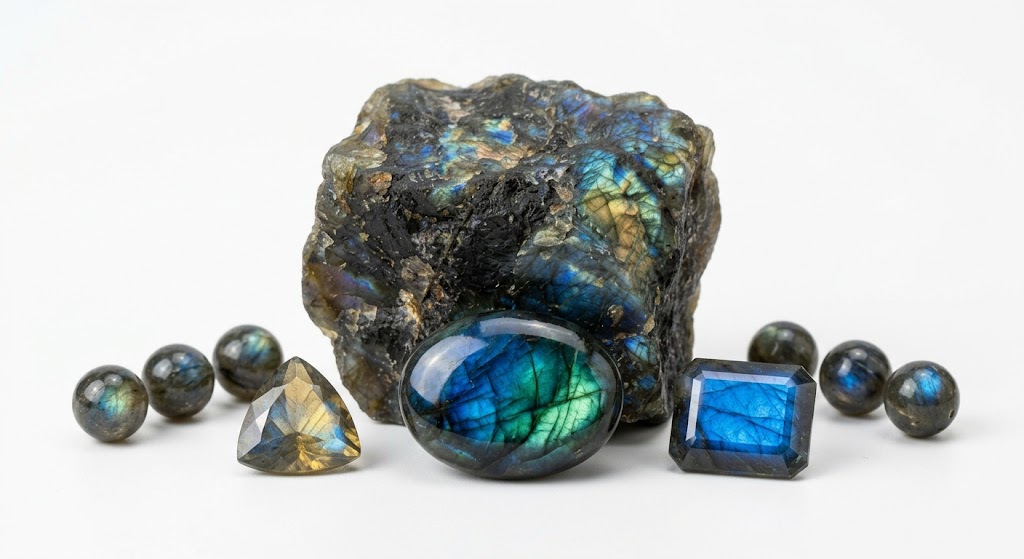
Galaxite — The Stone of the Starry Sky, Its History, and Master's Tips
Galaxite is known in the world of jewelry and gemology as the "Galaxy Stone." It is a unique variety of feldspar/labradorite (or a mineral belonging to the spinel group) that features golden, silver, and bright micro-inclusions set against a dark, almost black background, giving it the appearance of a star-filled night sky. Through the eyes of a master craftsman, this stone is a mini cosmos held right in the palm of your hand.
Origin of the Name: The name of the stone is connected to the small town of Galax in North Carolina, USA, where it was first discovered and described.
Starry Amulet: Due to its appearance, galaxite is referred to as the "Angel Stone" and "Cosmic Guide" in ancient and modern esotericism. It was believed to carry high-vibrational energy, helping its owner enhance intuition and foster spiritual growth.
Creative Inspiration: Jewelers and artists often used it as a "talisman of inspiration," as the inner shimmer within the stone awakens imagination and creativity.
Working with galaxite is an exciting challenge for a jeweler because its unique shimmer (aventurescence or labradorescence) must be properly displayed during cutting and polishing.
Chemical Composition: Mineralogically, the term "galaxite" refers to manganese-aluminum spinel ($\text{MnAl}_2\text{O}_4$), as well as microlitic labradorite popular in the gem market that contains fine inclusions of hematite or magnetite.
Hardness (Mohs Scale): $6.0 - 7.5$ (depending on the specific mineral composition). This provides good durability for everyday wear.
Density: $2.7 - 4.2 \text{ g/cm}^3$.
Color: Dark gray, black, or dark brown with bright golden, silver, and copper flecks.
Optical Effect: Inner iridescence and shimmer that come alive under light.
Pay attention to the following details:
Cut and Shape: Galaxite looks most striking when fashioned into a cabochon (a smooth, rounded shape) or a sphere. Faceted cuts often lose its "starry" inner effect.
Distinguishing from Imitations: You will frequently encounter plastic or glass imitations on the market (such as "aventurine glass"). Natural galaxite is cold, heavy, and its shimmering specks are distributed unevenly and naturally.
Care and Maintenance:
Thanks to its $6.0+$ hardness, the stone is quite durable, though sharp impacts should still be avoided.
Clean with warm soapy water and a soft cloth.
Keep away from harsh chemicals.
 511 40 73 13
 info@silveria.ge


 Eng
Eng