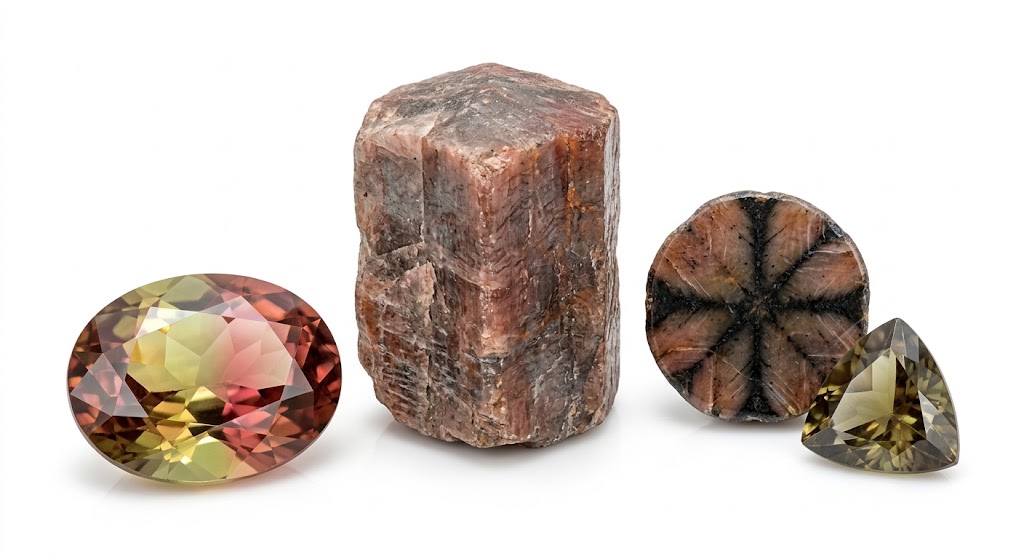
Andalusite — The Chameleon Gemstone, Industrial Wonder, and Master's Tips
Andalusite ($\text{Al}_2\text{SiO}_5$) is a prominent rock-forming aluminum silicate mineral. It was named after the historic region of Andalusia, Spain, where it was first described in 1789 by the French mineralogist Jean-Claude Delamétherie.
Distinguished by its extraordinary optical behavior and remarkable thermal resistance, Andalusite holds a revered position in geological studies, heavy industry, and high-end jewelry design. Through the eyes of a master craftsman, Andalusite is often called "Poor Man's Alexandrite" or "Nature's Chameleon" because of its mesmerizing multi-color play.
Spaniard's Misnomer: Although named after Andalusia, later geological studies revealed that the original specimens analyzed by Delamétherie actually originated from El Cardoso in the province of Guadalajara, near Madrid, rather than Andalusia itself.
The Cross Stone Amulet: A legendary variety of Andalusite known as Chiastolite features naturally occurring dark carbon cross patterns inside the crystal. During the Middle Ages, Christian pilgrims traveling along the Camino de Santiago adopted these stones as sacred protective amulets and symbols of faith.
Talisman of Balance: In esoteric traditions, Andalusite is recognized as a grounding stone that promotes mental clarity, emotional equilibrium, and problem-solving by helping its wearer view situations from multiple perspectives simultaneously.
Working with Andalusite requires exceptional precision and expertise from a gem cutter. Its standout feature—strong trichroism—means the cutter must carefully align the crystal axes to showcase its contrasting colors.
Chemical Formula: $\text{Al}_2\text{SiO}_5$ (Aluminum Silicate)
Hardness (Mohs Scale): $6.5 - 7.5$ (Durable enough for daily jewelry wear).
Crystal System: Orthorhombic (forms long, square-sectioned prismatic crystals).
Density: $3.13 - 3.17 \text{ g/cm}^3$
Luster: Vitreous to sub-vitreous.
Cleavage: Good / Distinct parallel to the prism face.
Refractive Index: $1.629 - 1.650$
Pleochroism / Trichroism (The Master's Touch): Andalusite exhibits one of the strongest pleochroic effects among all gemstones. Depending on the angle of view and light refraction, a single crystal displays combinations of olive green, earthy yellow, pink, brown, and fiery reddish-orange without changing the lighting!
Andalusite is part of a famous geological trimorph system. It shares the exact chemical composition ($\text{Al}_2\text{SiO}_5$) with two other minerals, but each crystallizes under vastly different temperature and pressure regimes:
Andalusite: Low pressure, moderate to high temperature (formed during contact metamorphism when hot granitic magma bakes surrounding clay-rich shale).
Kyanite: High pressure, variable temperature (formed in deep regional metamorphism).
Sillimanite: High temperature, high pressure.
Because of this specific stability field, geologists use Andalusite as an "index mineral" (a natural geothermobarometer) to estimate the depth and pressure conditions at which metamorphism occurred in the Earth's crust.
Gem-Quality Andalusite: Transparent to translucent crystals showcasing vibrant green-to-red color shifts, prized for fine jewelry.
Chiastolite (Cross Stone): Contains dark, graphite/carbon inclusions systematically pushed to the crystal corners during growth, forming a distinct internal cross pattern when sliced in cross-section.
Viridine: A manganese- and iron-rich green variety that displays an intense yellowish-green color.
Beyond its aesthetic charm, Andalusite plays a crucial economic role in heavy manufacturing:
Refractories & High-Heat Linings: When heated above $1100^\circ\text{C} - 1500^\circ\text{C}$, Andalusite transforms into mullite ($3\text{Al}_2\text{O}_3 \cdot 2\text{SiO}_2$) and silica. This transformation occurs with virtually zero volume change, making it an elite raw material for blast furnace linings, glass-making kilns, and cement manufacturing equipment.
Automotive & Aerospace: Used in spark plug insulators, high-strength technical ceramics, and heat-resistant thermal shielding.
Cutting Alignment: When purchasing or cutting faceted Andalusite, examine how the gem is oriented. Master lapidaries aim to showcase both green and reddish tones simultaneously—typically placing the green along the length of the gem and reddish-brown at the ends.
Durability and Setting: With a hardness of $6.5-7.5$, it is suitable for daily rings, pendants, and earrings. However, because it possesses distinct cleavage, setters should avoid heavy direct impact on the corners or tips.
Imitations: Synthetic or treated glass substitutes lack the genuine multi-directional trichroism of natural Andalusite. Always verify that the color shift occurs within the stone when rotated under standard light.
Care and Cleaning:
Clean using mild soap, warm water, and a soft brush.
Ultrasonic and steam cleaning are generally safe if the stone has no internal liquid inclusions or severe fractures, though gentle hand washing is always preferred.
 511 40 73 13
 info@silveria.ge


 Eng
Eng