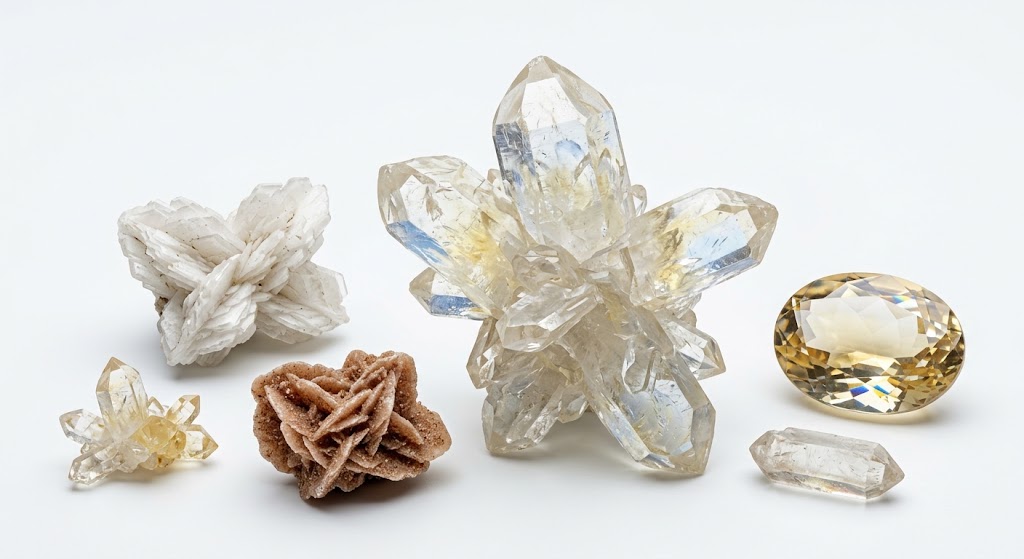
Barite — Heavy Spar, Desert Roses, and Master's Secrets
Barite ($\text{BaSO}_4$), historically known as "Heavy Spar," is one of the most astonishing and paradoxical representatives in the mineralogical world. At first glance, it appears as a delicate, transparent, or elegantly silky-lustrous crystal, yet holding it in your hand reveals an unexpectedly dense, almost "metallic" weight. Through the eyes of a master craftsman, barite is a geometric masterpiece of nature that bridges high-tech industry, ancient esotericism, and rare specimens of lapidary art.
Origin of the Name: The mineral's name derives from the Greek word “Barys” (βαρύς), meaning "heavy." It was officially described and classified by the renowned German mineralogist Dietrich Ludwig Gustav Karsten in 1800.
The Bologna Stone and the Alchemists' Secret: In the early 17th century (around 1602), an Italian alchemist and shoemaker named Vincenzo Casciarolo found unusual barite crystals near Bologna. After calcining the stone with charcoal, it began to emit a glowing light in the dark (phosphorescence). Alchemists believed they had stumbled upon the "Philosopher's Stone" that trapped sunlight. This phenomenon became known as the "Bologna Stone".
Desert Rose (Barite Rose): In arid desert regions and ocean margins (such as the Sahara), barite crystallizes alongside sand grains, forming remarkable tabular aggregates that resemble blooming roses. According to local tribal legends, these "roses" are protective talismans crafted by desert spirits.
Energy and Spiritual Significance: In modern lithotherapy, barite is regarded as a "stone of mental clarity and intuition." It is believed to bring inner harmony, help its wearer distill essential insights from chaotic thoughts, and enhance memory.
Working with barite requires extreme caution from both jewelers and mineralogists—the stark contrast between its high density and low hardness demands refined lapidary technique.
Chemical Formula: $\text{BaSO}_4$ (Barium Sulfate)
Crystal System: Orthorhombic (forms tabular, prismatic, or bladed crystals, as well as rosette-like and massive aggregates).
Hardness (Mohs Scale): $3.0 - 3.5$ (Quite soft; scratches easily).
Density: $4.3 - 4.5 \text{ g/cm}^3$ (Unusually high for a non-metallic mineral).
Cleavage: Perfect, making crystal processing highly challenging and delicate.
Color: Predominantly colorless, white, or gray. Depending on impurities, it also occurs as:
Yellowish / Golden (from iron oxides);
Blue / Pale Blue (from radiation defects and structural lattice variations);
Reddish / Pink (from copper or iron inclusions).
Luster: Vitreous, turning pearly or silky along cleavage planes.
Optical Effects: Strong birefringence, occasionally exhibiting vivid fluorescence or phosphorescence under UV light.
Chemical Stability: Practically insoluble in water and acids.
Collectible and Gem-Grade Crystals: Rare, completely transparent golden, blue, or yellow crystals.
"Desert Rose" (Barite Rose): Rosette-shaped aggregates of tabular crystals interwoven with sand grains.
Bologna Stone: A spherulitic, radially fibrous variety of barite famed for its phosphorescence.
Drilling / Industrial Barite: Massive, dense, granular aggregates used primarily in extraction industries.
Barite is unique in serving simultaneously as a prized collector's gem and a critical strategic industrial raw material:
Oil and Gas Industry (Primary Consumer): Approximately 80-85% of globally mined barite is used as a weighting agent in drilling muds. Its high density regulates pressure in deep wells and prevents gas/oil blowouts.
Medicine (Radiology): Because barium blocks X-rays and $\text{BaSO}_4$ is insoluble and completely non-toxic to the human body, it is administered as a "barium meal" for diagnostic imaging of the gastrointestinal tract.
Radiation Shielding: Barite-enriched concrete is used to line walls in nuclear power plants, laboratories, and X-ray facilities.
Jewelry and Lapidary Arts: Faceting transparent blue or golden barite crystals represents a pinnacle of cutting skill. Due to its softness and perfect cleavage, faceted barite is prized as an exclusive, premium collector's gemstone.
Processing and Cutting: Barite is not recommended for high-wear everyday jewelry (such as rings or bracelets), as its $3.0-3.5$ hardness makes it prone to scratching. Ideal uses include:
Exclusive collectible pendants;
Earrings (where mechanical friction is minimal);
Display-grade mineral specimens for interiors.
Identifying Genuine Barite (Master's Trick): The fastest way to distinguish barite from glass or plastic imitations is its heaviness. Even a small specimen feels surprisingly dense and heavy in the hand.
Care and Maintenance:
Prevent Scratches: Store in a soft pouch away from harder gemstones (quartz, topaz, etc.).
Thermal Shock: Avoid sudden temperature changes—internal stress can cause the stone to cleave along its planes.
Cleaning: Clean only with warm water, mild soap, and a soft brush or microfiber cloth. Never use ultrasonic cleaners!
 511 40 73 13
 info@silveria.ge


 Eng
Eng