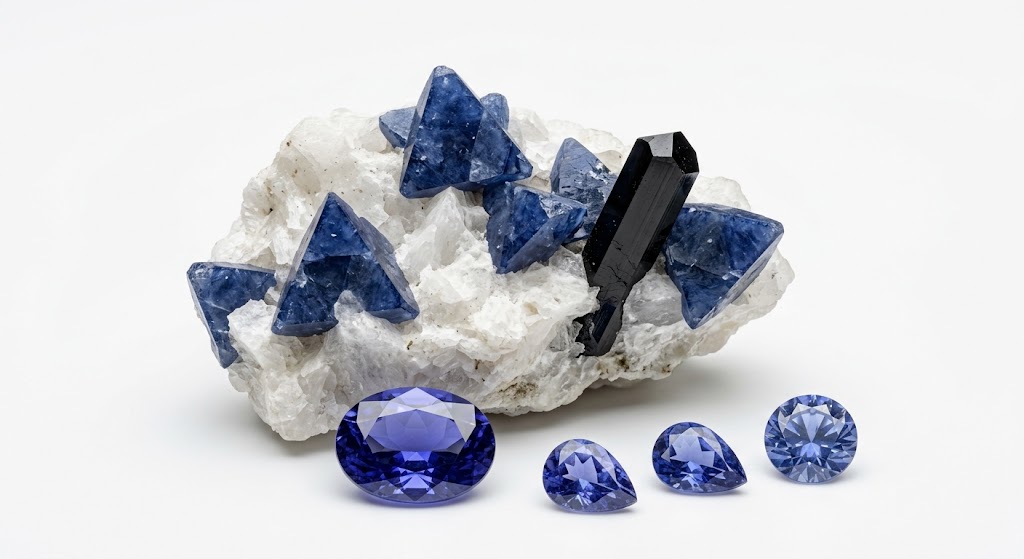
Benitoite — California’s Blue Diamond, Rare Symmetry, and Master's Secrets
Benitoite ($\text{BaTiSi}_3\text{O}_9$) is one of the rarest, most valuable, and most mysterious gemstones on Earth. It is renowned for its vivid, sapphire-like blue color, fire that exceeds that of a diamond, and a unique crystallographic structure. Through the eyes of a master craftsman, benitoite represents a true pinnacle of lapidary art—a gem that can be found natively in only a handful of places worldwide.
Discovery History: Benitoite was first discovered in 1907 in San Benito County, California, by James Coleman. Initially mistaken for sapphire due to its intense blue hue, Professor George Louderback of the University of California, Berkeley, soon determined that it was an entirely new mineral previously unknown to science.
Official State Gemstone: In 1985, benitoite was officially designated as the official State Gemstone of California.
Energy and Spiritual Significance: In esoteric traditions, benitoite is regarded as a "high-vibration stone." It is believed to bring mental clarity, heighten intuition, build self-confidence, and assist in astral exploration.
Benitoite boasts extraordinary optical properties that make it even more visually striking than diamond or sapphire:
Chemical Formula: $\text{BaTiSi}_3\text{O}_9$ (Barium Titanium Cyclosilicate).
Crystal System: Hexagonal (ditrigonal-dipyramidal). It is the only known mineral that crystallizes in this rare class of symmetry!
Hardness (Mohs Scale): $6.0 - 6.5$ (Durable enough for fine jewelry, though requires mindful care).
Density: $3.65 - 3.68 \text{ g/cm}^3$
Cleavage: Poor / Indistinct, which reduces the risk of fracturing during cutting compared to softer minerals like barite.
Color: Intense blue, violet-blue, or sky blue. Colorless or rare pinkish/yellowish specimens occur very infrequently.
Dispersion (Fire): $0.046$ — This value exceeds the dispersion of diamond ($0.044$), causing faceted benitoite to flash with spectacular multicolored sparks under light.
Dichroism (Strong Pleochroism): A single crystal appears intensely blue from one direction and completely colorless or white from another.
Ultraviolet Fluorescence: Under shortwave UV light, benitoite glows with a striking, brilliant electric-blue fluorescence.
While microscopic traces of benitoite have been found in a few locations globally (such as Japan and Australia), the world's only commercial deposit for gem-quality crystals was the Dallas Gem Mine in San Benito County, California.
Today, this deposit is virtually exhausted and closed, making benitoite one of the most scarce and costly collector gemstones in the world (with prices often reaching several thousand dollars per carat).
Premium Fine Jewelry: Used in exclusive, custom-designed jewelry pieces (rings, pendants, and earrings).
Top-Tier Collector Mineralogy: Natural faceted gems or raw matrix specimens—where benitoite grows alongside black neptunite prisms on white natrolite—are prize centerpieces in museums and elite private collections.
Faceting & Lapidary Secrets: Due to its strong dichroism, a master cutter must orient the crystal table precisely to maximize the rich blue hue and avoid washing out into the colorless optical direction.
Determining Authenticity: The most reliable method to verify natural benitoite is a shortwave UV lamp—under UV light, genuine benitoite instantly fluoresces an unmistakable electric blue.
Care and Maintenance:
Protect from Direct Impact: A hardness of $6.0-6.5$ warrants gentle wear (avoid wearing during heavy physical labor).
Cleaning: Wash using warm soapy water and a soft brush. Ultrasonic cleaning should only be used if the gem is free of internal fractures.
 511 40 73 13
 info@silveria.ge


 Eng
Eng