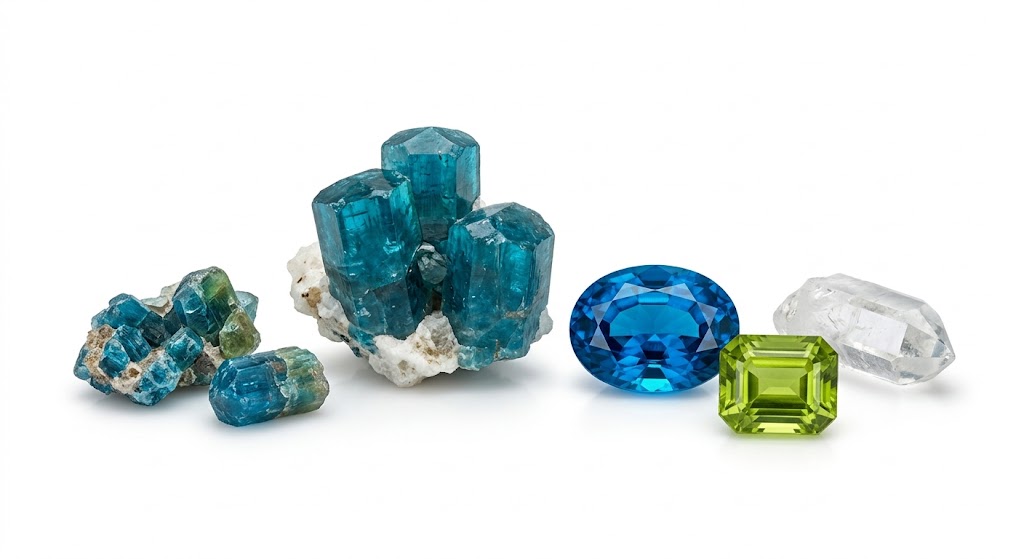
Apatite ($\text{Ca}_5(\text{PO}_4)_3(\text{F,Cl,OH})$) represents the most common and important mineral of the phosphate class. It serves simultaneously as the chemical foundation of biological life, a strategic industrial raw material, and one of the most spectacular, "neon-like" gemstones in the jewelry world. Through a master's eye, apatite is a chameleon mineral that often rivals tourmaline, Paraiba, topaz, and emerald in its color and brilliance.
"The Deceptive Stone": The mineral's name derives from the Greek word Apatao (ἀπατάω), which means "to deceive" or "to mislead." It was named in 1786 by the German geologist Abraham Gottlob Werner because, for centuries, jewelers and mineralogists mistook apatite crystals for aquamarine, amethyst, topaz, peridot, or emerald.
The Mineral of Life: Apatite holds a unique place in biology. Hydroxylelapatite ($\text{Ca}_5(\text{PO}_4)_3\text{OH}$) forms the primary mineral component of human and vertebrate animal bones and tooth enamel.
Energy and Spiritual Significance: In lithotherapy, apatite is considered the "stone of inspiration and motivation." It is believed to relieve apathy, expand the desire to absorb knowledge, assist in public speaking, and soothe emotional tension.
Working with apatite requires exceptional care from a jeweler, as the stone's beauty stands in stark contrast to its low mechanical durability.
Chemical Group: Phosphates. Based on the presence of fluorine, chlorine, and hydroxyl groups in its chemical formula, it is divided into three main species:
Fluorapatite (the most common)
Chlorapatite
Hydroxylapatite
Crystal System: Hexagonal (forms beautiful, six-sided prismatic or tabular crystals).
Hardness (Mohs Scale): Exactly 5.0 (apatite serves as the benchmark mineral for position 5 on the Mohs scale).
Density: $3.16 - 3.22 \text{ g/cm}^3$
Cleavage: Indistinct / Poor.
Color: Uniquely diverse — neon blue-green (similar to Paraiba), intense sky blue, yellow (golden), purple, green ("asparagus stone"), and colorless.
Luster: Vitreous, sometimes greasy/pearly-greasy.
Optical Effects:
Pleochroism: A sharp change in color intensity depending on the angle of observation (especially in blue/green specimens).
Cat's Eye Effect (Chatoyancy): A cat's eye effect is produced when apatites containing parallel fibrous inclusions are processed into cabochons.
Fluorescence: Frequently glows yellow, purple, or green under ultraviolet light.
Neon/Paraiba-type Apatite: An intense electric-blue or green-blue stone that is visually almost identical to expensive Paraiba tourmaline (mined mainly in Madagascar and Brazil).
Moroxite / "Asparagus Stone": Yellowish-green colored apatite.
Cat's Eye Apatite: A rare variety with silky inclusions.
Ore / Industrial Apatite: Massive, granular aggregates used in the chemical industry.
Agriculture and Chemistry (Primary Consumer): The vast majority of apatite mined worldwide is used to produce phosphoric acid and phosphate fertilizers (superphosphate), which form the foundation of global agriculture.
Medicine and Biotechnology: Synthetic hydroxylapatite is used in bone tissue implants, bone cement, and toothpastes designed for enamel regeneration.
Jewelry Art: Transparent, brightly colored crystals are faceted into gemstones. Its "neon" shades are particularly popular in modern exclusive jewelry.
Processing and Cutting (Lapidary Precision): Due to its 5.0 hardness and sensitivity to heat, apatite is a very delicate stone. During faceting, the jeweler must avoid overheating and excessive pressure.
Jewelry Type: Apatite is not recommended for everyday rings, as it scratches easily. Its best applications are:
Earrings
Pendants and necklaces
Exclusive collector specimens
Authenticity and Imitations: Neon apatite is often confused with tourmaline; however, apatite is much softer (it can be scratched even with an iron hairpin).
Care and Storage:
Chemical Sensitivity: Avoid acids, perfumes, hairsprays, and household chemicals — apatite easily dissolves in acid and loses its luster.
Cleaning: Clean only with warm water, mild soap, and a very soft cloth. Never use ultrasonic or steam cleaners!
Storage: Store separately in a soft pouch so that other, harder stones (such as quartz or topaz) do not scratch it.
 511 40 73 13
 info@silveria.ge


 Eng
Eng