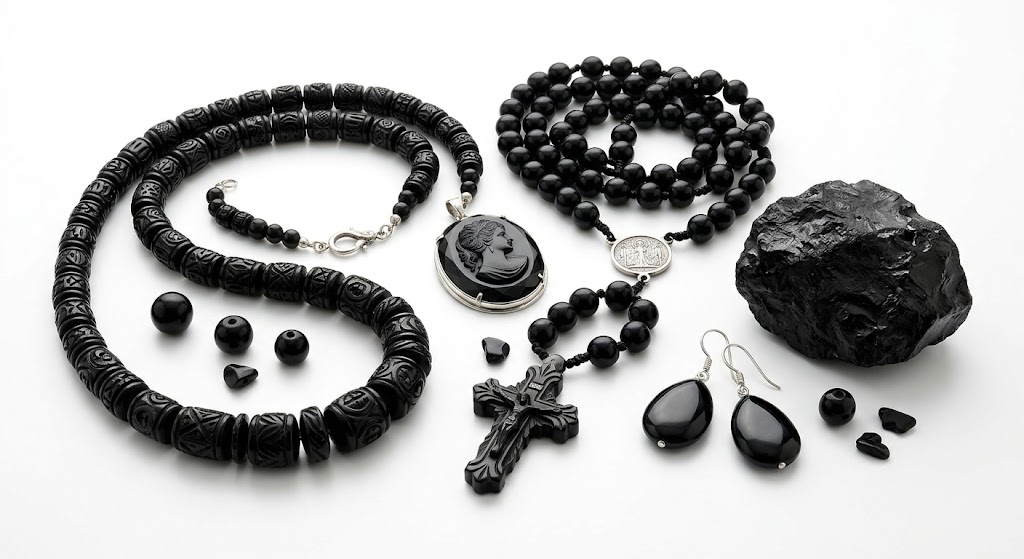
Jet — Black Diamond, Royal Mourning Gems, and Master's Secrets
Jet (German: Gagat) represents one of the most fascinating, mysterious, and historically significant materials of organic origin. It is not a classical mineral—jet is an exceptionally hard, dense, and polishable variety of fossilized coal (lignite) formed from the wood of ancient coniferous trees (primarily of the Araucariaceae family) submerged and compressed under immense pressure over millions of years.
Through the eyes of a master craftsman, jet is a "warm gem"—gentle, lightweight, with a silky tactile feel and a deep, velvety black luster that has been prized for centuries in fine jewelry, protective amulets, and sacred artifacts.
Origin of the Name: The international designation Gagat originates from the ancient river Gagas (in modern-day Turkey). In Georgian literature and mineralogy, it is known as "Gisheri" (გიშერი)—a term embedded in classical poetry (such as Rustaveli's The Knight in the Panther's Skin) to describe an extraordinary, deep-black color of hair or eyes.
The Victorian Era and Mourning Jewelry: Jet reached the pinnacle of its popularity in the 19th century under the reign of Britain's Queen Victoria. Following the death of Prince Albert, the Queen entered a prolonged period of mourning, permitting only black jewelry at court. Whitby jet from England became the world's most sought-after material for mourning rings, pendants, and photo lockets.
Ancient Talisman: As far back as Roman times and the European Middle Ages, jet was believed to possess potent protective energy against the evil eye and negative influences. It was widely carved into rosaries, protective amulets, and decorative ornaments.
Energy and Spiritual Significance: In modern lithotherapy, jet is regarded as a "powerful shield and purifying stone." It is believed to absorb negative emotions, assist its wearer through times of grief, alleviate fears, and restore emotional equilibrium.
Working with jet requires specialized lapidary techniques from jewelers and carvers, as its physical nature differs fundamentally from crystalline gemstones.
Chemical Composition: Organic compound (hydrocarbons, plant-derived fossilized wood).
Structure: Amorphous (lacks a crystalline lattice).
Hardness (Mohs Scale): $2.5 - 4.0$ (Relatively soft and pliable, carving easily while requiring mindful handling).
Density: $1.3 - 1.4 \text{ g/cm}^3$ (Extremely lightweight—nearly half the density of quartz or glass).
Cleavage: None (Exhibits a conchoidal fracture).
Color: Intense pitch-black, dark brownish-black, or velvety deep black.
Luster: Waxy, resinous, or metallic/silky luster after high-grade polishing.
Thermal & Electrical Properties: Jet feels warm to the touch (unlike cold crystalline minerals). When rubbed, it builds a negative electrostatic charge, attracting light dust or paper particles (similar to amber).
Combustibility: When exposed to heat, it emits a distinct odor of coal and burning resin.
Hard Jet: Formed under high pressure in saltwater (marine sedimentary) environments. It is resilient, retains an exceptional polish, and is favored in fine jewelry making (e.g., the famous Whitby Jet).
Soft Jet: Formed in freshwater environments (swamps and lakes). It is more brittle, prone to cracking under sudden temperature shifts, and less durable for gem cutting.
Fine Jewelry & Carving: Jet is used to carve exclusive beads, rosaries, pendants, earrings, and intricate cameos. Because of its light weight, large and dramatic statement pieces can be worn comfortably without strain.
Sacred & Religious Artifacts: For centuries, jet has been a preferred material for carving crosses, prayer beads, and devotional objects.
Local Craftsmanship: In Georgia (notably around the Tkibuli region), jet mining and carving have a rich heritage, where master artisans traditionally pair jet with fine silver and gold settings.
Carving & Polishing Techniques: Carvers must work at low friction speeds with proper cooling to prevent overheating and fracturing. Final polishing requires soft felt pads and specialized compounds to unveil its deep, mirror-like black finish.
Determining Authenticity:
Weight: Jet is remarkably light. If a "black gem" feels heavy and cold, it is likely black onyx, black tourmaline (schorl), or glass.
Tactile Warmth: Jet immediately retains body heat when touched.
Scent Test: A cautious hot-needle test on an inconspicuous spot yields the smell of coal and pine resin rather than burnt plastic.
Care and Maintenance:
Prevent Scratches: With a hardness of $2.5-4.0$, jet scratches easily. Store it separately in a soft cloth pouch.
Chemical Sensitivity: Avoid exposure to acetone, alcohol, perfumes, and harsh household chemicals.
Cleaning: Wipe clean with a damp microfiber cloth and dry thoroughly. To restore its natural shine, apply a tiny drop of almond or mineral oil and buff gently. Never clean jet in an ultrasonic or steam cleaner!
 511 40 73 13
 info@silveria.ge


 Eng
Eng