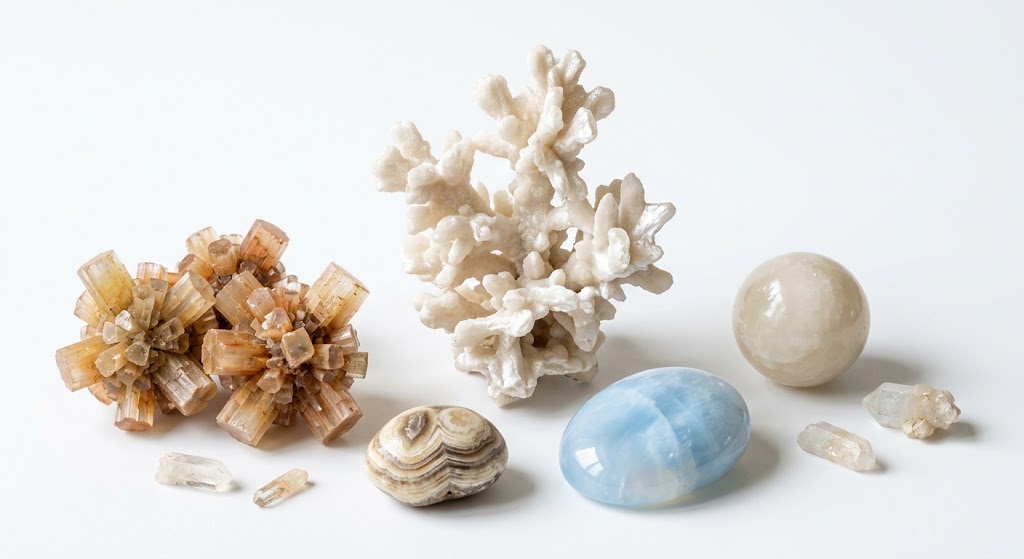
Aragonite — Ocean Corals, the Secret of Pearls, and Master's Advice
Aragonite ($\text{CaCO}_3$) is a natural, polymorph variety of calcium carbonate. It has the same chemical composition as calcite but differs in its crystal lattice and formation conditions. Aragonite is a unique synthesis of living nature and the mineral world — it is this mineral that creates the inner mother-of-pearl layer of pearls, ocean coral reefs, and mollusk shells.
Through the eyes of a master craftsman, aragonite is a wonderfully warm, delicate, and plastic mineral that charms collectors with its diverse forms: ranging from fine "coral-like" branches to spherical aggregates and pearlescent luster.
Origin of the Name: The mineral was named by the famous German geologist Abraham Gottlob Werner in 1797. He named the rocks after the historical region of Spain — Aragon (specifically, Molina de Aragón), where its hexagonal crystals were first described.
The Mollusks' "Secret Armor": For millions of years, marine organisms (mollusks, corals) have used aragonite to build their shells and skeletons. A pearl, formed inside a mollusk's body, primarily consists of microscopic plates of aragonite bonded by an organic substance — conchiolin.
"Mother of the World Stone" and Energetics: In esotericism and lithotherapy, aragonite is considered a talisman of the family hearth, warmth, and emotional balance. It is believed to help the owner overcome stress, develop patience, and establish a harmonious connection with the Earth.
Working with aragonite requires special caution, as it is less stable and may transform into calcite over time with changes in environmental conditions.
Chemical Formula: $\text{CaCO}_3$ (Calcium Carbonate)
Crystal System: Orthorhombic (often forming pseudo-hexagonal twins, prismatic, or acicular crystals).
Hardness (Mohs Scale): $3.5 - 4.0$ (Quite soft, scratches easily).
Density: $2.93 - 2.95 \text{ g/cm}^3$ (Slightly denser than calcite).
Cleavage: Imperfect / Poor.
Color: Colorless, white, gray; depending on impurities:
Light blue / Blue (with copper impurities — very popular for jewelry);
Yellow / Golden / Orange (with iron oxides);
Green or Pink.
Luster: Vitreous, and greasy or pearly on fractures.
Chemical Sensitivity: Reacts with acids (dissolves with effervescence releasing $\text{CO}_2$ in dilute hydrochloric acid).
Coral-like Aragonite ("Flos Ferri" — Flower of Iron): White, coral-like branching aggregates, often found in the karstic caves of iron ore deposits.
Blue Aragonite: A delicate light blue or turquoise mineral, particularly valued in collector and jewelry art.
Aragonite Spherulites ("Sputnik" Aragonite): Star-like or sea urchin-like crystal aggregates (often mined in Morocco).
Pisolite ("Cave Pearl"): Spherical, concentrated aggregates formed by the action of water droplets in caves.
Jewelry Art and Artistic Carving: Cabochons, pendants, beads, decorative vases, statuettes, and spheres are made from blue, yellow, and banded aragonite.
Collector Mineralogy: "Flowers of Iron" (Flos Ferri) and Moroccan "Sputniks" are the pride of the world's leading museums and collections.
Construction and Decor: Massive banded aragonite (often mistakenly called "marble onyx") is used in interior cladding.
Metamorphism and Stability: Aragonite represents a metastable phase of calcium carbonate. At high temperatures (above $400^\circ\text{C}$) or over a long period of time, it gradually transforms into calcite.
Processing and Cutting: Due to its $3.5-4.0$ hardness, aragonite is easily cut and polished, but the jeweler must avoid overheating and mechanical shocks. It is not recommended for everyday rings.
Identification: Aragonite differs from calcite by its higher density and less pronounced cleavage.
Care and Maintenance:
Keep Away from Acids and Chemicals: Perfumes, vinegar, soaps, and household chemicals damage the stone's surface.
Humidity and Sun: Avoid direct sunlight and high humidity.
Cleaning: Clean only with a dry or slightly damp soft cloth. Never use ultrasonic or steam cleaners!
 511 40 73 13
 info@silveria.ge


 Eng
Eng