Grossularite — Green Treasure of the Gooseberry, Garnet Warmth, and Master's Secrets
Grossularite ($\text{Ca}_3\text{Al}_2(\text{SiO}_4)_3$) is a calcium-aluminum member of the garnet group. Its name derives from the Latin word "grossularia", meaning gooseberry, in reference to the characteristic light-green color of its initial specimens resembling the fruit.
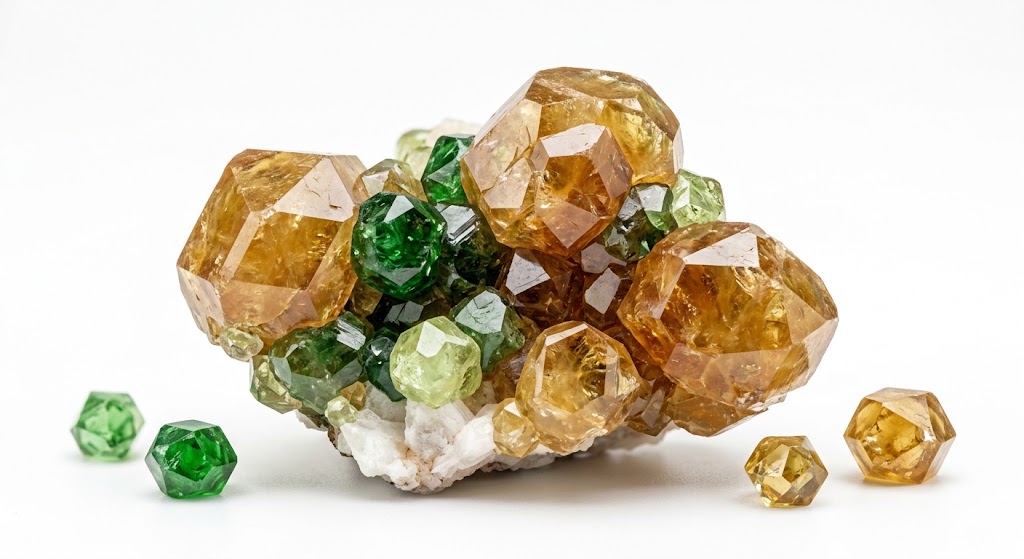
Through the eyes of a master craftsman, grossularite is the most versatile and warm-toned representative of the garnet family, encompassing rare vivid green crystals as well as golden-orange, honey, and pink gem varieties.
Origin of the Name: The mineral was named in 1799 by the renowned geologist Abraham Gottlob Werner, who compared the green crystals discovered near the Vilyui River in Siberia to gooseberry fruits.
Ancient Talismans: In medieval Europe and the East, grossularite was revered as a protective stone for travelers and merchants. It was believed to bring material prosperity, success, and shield its wearer from venomous bites.
Energy and Spiritual Significance: In lithotherapy, grossularite is regarded as a "stone of vitality and tranquility." It is associated with the Heart (Anahata) and Solar Plexus (Manipura) chakras. It is believed to relieve stress, help heal emotional wounds, and awaken creative potential.
Working with grossularite is a delight for jewelers due to its high hardness, lack of cleavage, and brilliant vitreous luster.
Chemical Formula: $\text{Ca}_3\text{Al}_2(\text{SiO}_4)_3$ (Calcium aluminum silicate).
Crystal System: Cubic (commonly forms beautiful rhombic dodecahedrons and trapezohedrons).
Hardness (Mohs Scale): $6.5 - 7.5$ (Highly resistant to scratches, ideal for everyday jewelry).
Density: $3.57 - 3.65 \text{ g/cm}^3$
Cleavage: None (significantly reduces the risk of cracking during processing).
Refractive Index: $1.734 - 1.745$ (Provides strong brilliance and light play).
Color: Colorless, light green, emerald-green, yellow, orange, brownish-red, pink, and even violet.
Tsavorite: The most valuable and rare variety of grossularite. Vanadium and chromium impurities give it an intense emerald-green color. Mined exclusively in East Africa (Kenya, Tanzania).
Hessonite: The "cinnamon stone"—a golden-orange, brown, or honey-colored grossularite. It often exhibits a characteristic "wavy" or "roiled" internal structure (whisky in water effect) due to microscopic inclusions.
Leucogrossular: Completely colorless or water-clear grossularite.
Hydrogrossular: A green or pink massive, dense variety frequently used for cabochons and ornamental carvings (often mistaken for jadeite).
Rosolite: Pink or raspberry-red grossularite colored by manganese impurities.
Fine Jewelry: Faceted tsavorites and hessonites are set into high-end gold and platinum rings, earrings, and necklaces. Tsavorite is often considered a superior (and more durable) alternative to emerald.
Artistic Carving & Decor: Massive grossularite (hydrogrossular) is carved into statuettes, cameos, beads, and collector spheres.
Collector Mineralogy: Perfectly symmetrical crystals and druses are prized display pieces in museums and private collections worldwide.
Cutting & Faceting: Thanks to the absence of cleavage and hardness up to $7.5$, cutting and polishing grossularite is straightforward. The lapidary should choose angles that maximize its high refractive index.
Hessonite Identification: When inspecting a hessonite, do not be alarmed by an oily or roiled appearance inside the stone—this internal swirl is its primary mark of natural authenticity.
Care and Maintenance:
Durability: Grossularite is robust and well-suited for daily wear.
Cleaning: Clean with warm soapy water and a soft brush. Ultrasonic cleaning is generally safe if the stone has no deep fractures.
Chemicals & Temperature: Avoid extreme thermal shocks and exposure to strong acids.
 511 40 73 13
 info@silveria.ge


 Eng
Eng