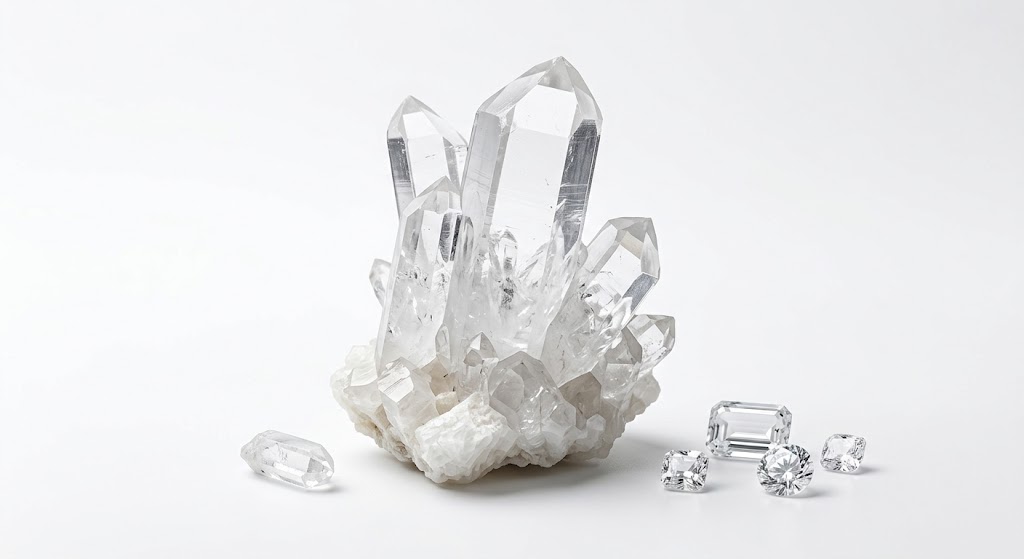
Goshenite — Purity of Beryl, Transparent Alchemy, and Master's Secrets
Goshenite ($\text{Be}_3\text{Al}_2\text{Si}_6\text{O}_{18}$) is the completely colorless, water-clear gem variety of the beryl group. While chromium and vanadium give emerald its green color, iron gives aquamarine its blue, and manganese gives morganite its pink, goshenite is the purest form of beryl, containing virtually no chromophoric (color-causing) impurities.
Through the eyes of a master craftsman, goshenite is a "stone of light and truth"—a crystal-clear, elegant, and completely natural mineral that captivates jewelers with its aristocratic simplicity and brilliant vitreous luster.
Origin of the Name: The mineral was named after the small town of Goshen, Massachusetts, USA, where it was first described and studied.
History of Optics: In the Middle Ages and the Renaissance, before the manufacturing of artificial glass reached a high quality, crystals of highly transparent goshenite and rock crystal were used to make spectacle lenses, magnifying glasses, and telescopic optics. The German word for eyeglasses—Brille—originates directly from the mineral "beryl".
Energy and Spiritual Significance: In lithotherapy, goshenite is regarded as a "stone of wisdom, truth, and mental clarity." It is associated with the Crown (Sahasrara) chakra. It was believed that goshenite helps its wearer expose lies and illusions, improves memory, and promotes logical thinking.
Working with goshenite is exceptionally comfortable for jewelers, as it possesses the high hardness and excellent mechanical stability characteristic of beryl.
Chemical Formula: $\text{Be}_3\text{Al}_2\text{Si}_6\text{O}_{18}$ (Beryllium aluminum silicate).
Crystal System: Hexagonal (forms sharp six-sided prismatic crystals).
Hardness (Mohs Scale): $7.5 - 8.0$ (Very hard, virtually scratch-resistant during daily wear).
Density: $2.63 - 2.80 \text{ g/cm}^3$
Cleavage: Imperfect/Poor (providing high durability for the stone).
Refractive Index: $1.568 - 1.602$
Color: Colorless, water-clear (sometimes with a barely noticeable grayish, yellowish, or pinkish tint).
Luster: Bright vitreous.
Jewelry Art: Goshenite is used as a faceted gemstone in gold and silver jewelry (rings, earrings, pendants). Due to its purity, it is frequently utilized as a natural, elegant alternative to other colorless stones (e.g., colorless topaz or rock crystal).
Collector Mineralogy: Perfectly formed, transparent hexagonal goshenite crystals are highly popular among collectors (especially Brazilian and Pakistani specimens).
High Technology: Due to its beryllium content, raw beryl ore is used in aviation and electronics to create lightweight, high-strength alloys.
Processing and Faceting: Thanks to its high hardness ($7.5-8.0$) and low cleavage, cutting and polishing goshenite yields flawless results. Lapidaries should utilize brilliant or step (emerald) cuts to maximize the play of light and internal brilliance.
Identification and Imitations: Goshenite is easily confused with rock crystal (quartz), colorless topaz, and glass.
Distinction from Quartz: Goshenite is denser and has a higher hardness ($7.5-8.0$ vs. quartz's $7.0$).
Distinction from Topaz: Topaz is heavier and possesses perfect cleavage.
Enhancement: Occasionally, colorless goshenite is irradiated to produce an intense yellow or golden beryl (heliodor); however, natural, untreated colorless goshenite is most valued for its purity in the collecting world.
Care and Maintenance:
Durability: Goshenite is highly durable and ideal even for daily-wear rings.
Cleaning: Clean with warm soapy water and a soft brush. Ultrasonic cleaning is completely safe if the stone has no internal fractures.
 511 40 73 13
 info@silveria.ge


 Eng
Eng