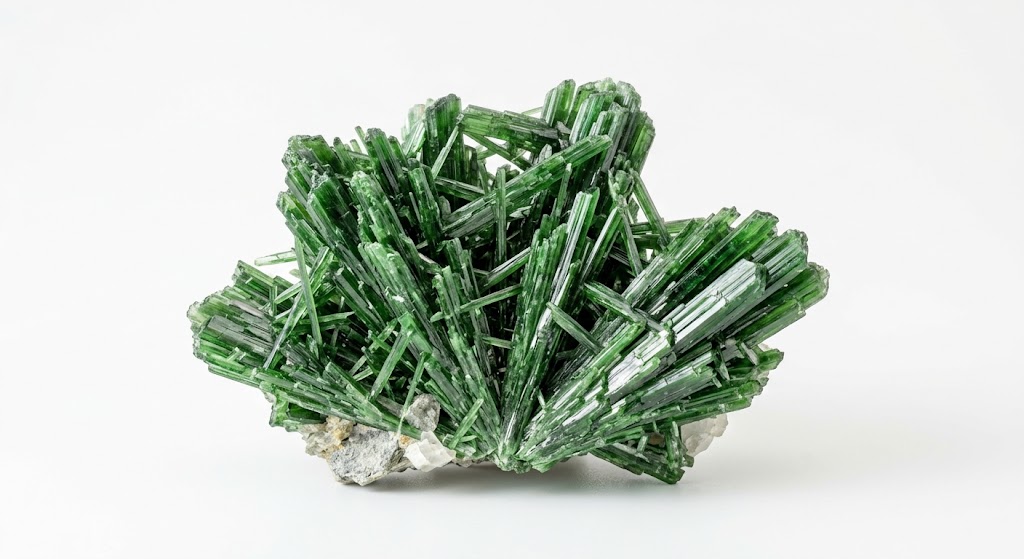
Actinolite — Radiant Amphibole, "Green Needles," and Master's Secrets
Actinolite ($\text{Ca}_2(\text{Mg}, \text{Fe})_{5}\text{Si}_8\text{O}_{22}(\text{OH})_2$) is a silicate mineral belonging to the amphibole group. Its name originates from the Greek word "aktis" (ray), which directly references its characteristic radiant, fibrous, or acicular (needle-like) crystal structure that often creates the impression of a "radiant stone."
Through the eyes of a master craftsman, actinolite is a favorite mineral among collectors and gemologists, occurring both as gem-quality, delicate, transparent green crystals and as massive, ornamental varieties. It is frequently confused with its closely related counterpart, tremolite; however, actinolite is characterized by a higher iron content, which grants it its rich green coloration.
Origin of the Name: The mineral was named in 1794 by the prominent Irish mineralogist Richard Kirwan.
Ancient Talismans: In the Middle Ages and the East, actinolite was considered a "stone of heart-tranquility and stability." It was used as a talisman to protect its owner from fears, improve sleep, and help maintain emotional balance.
Energy and Spiritual Significance: In lithotherapy, actinolite is regarded as a "stone of grounding and purification." It is associated with the Heart (Anahata) and Solar Plexus (Manipura) chakras. It is believed that the stone helps individuals release emotional blockages, enhances intuition, and aids in clearly perceiving life goals.
Working with actinolite is comfortable for lapidaries due to its moderate hardness; however, its fibrous structure demands caution during cutting.
Chemical Formula: $\text{Ca}_2(\text{Mg}, \text{Fe})_{5}\text{Si}_8\text{O}_{22}(\text{OH})_2$ (Calcium magnesium iron silicate).
Crystal System: Monoclinic (commonly forms long prismatic, needle-like, or fibrous crystals).
Hardness (Mohs Scale): 5.5 - 6.0 (Moderate hardness, easily worked).
Density: $2.98 - 3.10 \text{ g/cm}^3$
Cleavage: Perfect in two directions (at angles of $124^\circ$ and $56^\circ$).
Refractive Index: $1.614 - 1.636$
Color: Typically green (light green, grass-green, dark green-black), gray, yellow, and rarely white.
Luster: Vitreous, and pearly or silky in fibrous varieties.
Nephrite: A dense, microcrystalline variety of actinolite-tremolite amphiboles. Along with jadeite, it is historically known as "Jade." Nephrite is prized for its extreme toughness and beauty. It is used for ornamental carving, statuettes, cameos, beads, and fine jewelry (especially in China).
Actinolite Asbestos: A fibrous, fire-resistant variety. Important note: Inhaling asbestos fibers is extremely dangerous to health, so handling this material requires strict safety protocols. Used primarily in industrial applications.
Gem-Quality Actinolite: Transparent, green crystals are faceted into gemstones for gold and silver jewelry (rings, earrings, pendants).
Processing and Faceting: Due to its moderate hardness ($5.5-6.0$) and fibrous structure, faceting and polishing actinolite require precision. Lapidaries must select cutting angles that maximize the stone's luster and color. For massive varieties (such as nephrite), cabochon cuts are ideal.
Identification: Actinolite is easily confused with tremolite, hornblende, epidote, and jadeite.
Distinction from Tremolite: Actinolite contains more iron, resulting in a more intense green color.
Distinction from Epidote: Epidote possesses higher hardness ($6.0-7.0$).
Care and Maintenance:
Prevent Scratches: Store in a soft pouch away from harder minerals.
Chemical Sensitivity: Avoid exposure to acids, perfumes, hairsprays, and household detergents.
Cleaning: Clean using only warm water, mild soap, and a soft microfiber cloth. Never use ultrasonic cleaners!
 511 40 73 13
 info@silveria.ge


 Eng
Eng