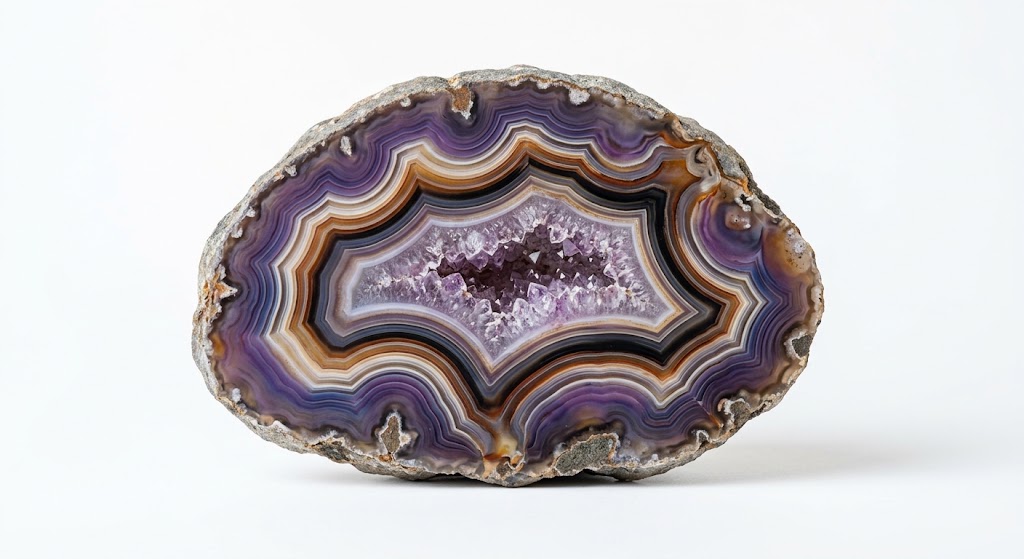
Agate — Banded Wonder, Nature's Canvas, and Master's Secrets
Agate is a banded, layered variety of chalcedony (microcrystalline quartz, $\text{SiO}_2$). It is distinguished by its stunning color zoning and unique internal patterns, which formed over thousands or millions of years through the gradual precipitation of silica-rich hydrothermal solutions.
Through the eyes of a master craftsman, agate is one of the most rewarding, durable, and diverse minerals. No two agates on Earth are absolutely identical—each slice is a unique painting drawn by nature.
Origin of the Name: The mineral was named by the ancient Greek philosopher and botanist Theophrastus (4th century BCE) after the Achates River (now the Dirillo River in Sicily, Italy), where it was mined in abundance.
Ancient Talismans and Glyptics: In ancient Greece and Rome, agate was widely used for crafting precious engraved gems (intaglios and cameos). In the Middle Ages, it was believed to protect its owner from the evil eye, scorpion and snake bites, and to help yield a bountiful harvest.
Energy and Spiritual Significance: In lithotherapy, agate is regarded as a "stone of stability, grounding, and inner harmony." It is associated with the Root (Muladhara) and Heart (Anahata) chakras. It is believed to balance emotional, physical, and intellectual energies.
Working with agate is a pure joy for lapidaries and jewelers due to its high hardness and lack of cleavage.
Chemical Formula: $\text{SiO}_2$ (Silicon dioxide with impurities).
Structure: Microcrystalline (an aggregate of microscopic quartz and moganite fibers).
Hardness (Mohs Scale): 6.5 - 7.0 (Quite hard, does not scratch easily).
Density: $2.58 - 2.64 \text{ g/cm}^3$
Cleavage: None (making the stone exceptionally tough).
Refractive Index: $1.530 - 1.540$
Color: Almost all colors—white, gray, blue, red, brown, black, green, yellow.
Luster: Vitreous, waxy, or silky on fractures.
Banded (Botswana) Agate: Classic agate featuring distinctly pronounced concentric or parallel bands.
Moss Agate: Transparent to translucent chalcedony containing iron and manganese oxide inclusions that form moss-like or foliage-like internal patterns.
Dendritic Agate: White or gray chalcedony with black/brown tree-like dendritic inclusions.
Fire Agate: A rare variety in which layers of limonite create stunning iridescence (play of color resembling flames of fire).
Specific Regional Types: Laguna Agate (Mexico, famous for vibrant red and orange bands) and Oregon Thunderegg Agates.
Agate is found in many locations worldwide, but the following countries are renowned for exceptional quality and volume:
Brazil and Uruguay: The world's largest suppliers, producing giant filled geodes and a vast array of banded agates.
Germany (Idar-Oberstein): A historic deposit that laid the foundation for European stone-carving mastery (supplies are now largely exhausted).
Mexico: Famous for the magnificent Laguna Agate and Fire Agate.
Botswana: Produces exclusive parallel-banded agates featuring subtle pink, gray, and brown tones.
USA: (Oregon, Montana, Arizona) Rich in moss, dendritic, and fire agates.
India, Madagascar, Scotland, and Australia.
Georgia: Small but interesting occurrences and deposits are found in the Akhaltsikhe region (Shurdo deposit), associated with volcanogenic rocks.
Jewelry Art: Rings, pendants, bracelets, beads, cameos, and intaglios.
Decorative & Applied Arts: Vases, trinket boxes, sliced coasters, decorative spheres, and carvings.
Precision Instrument Manufacturing (Industry): Due to its high hardness and chemical resistance, agate is used to make laboratory mortars and pestles, balance beam bearings, and specialized fulcrums.
Cutting & Polishing: Because agate is microcrystalline, it polishes to a flawless mirror finish. When cutting, lapidaries should carefully align the orientation of the bands to highlight the stone's natural artwork.
Dyeing (Staining): Agate has a porous structure, allowing it to easily absorb dyes. Artificially dyed agates in vivid purples, bright pinks, and neon greens are common in the market. Natural agate typically displays softer, organic tones.
Care and Maintenance:
Durability: Agate is highly durable and resistant to scratches, making it ideal for daily wear.
Cleaning: Clean with warm soapy water. Ultrasonic cleaning is safe provided the stone is not dyed.
Chemicals: Keep away from harsh household chemicals.
 511 40 73 13
 info@silveria.ge


 Eng
Eng