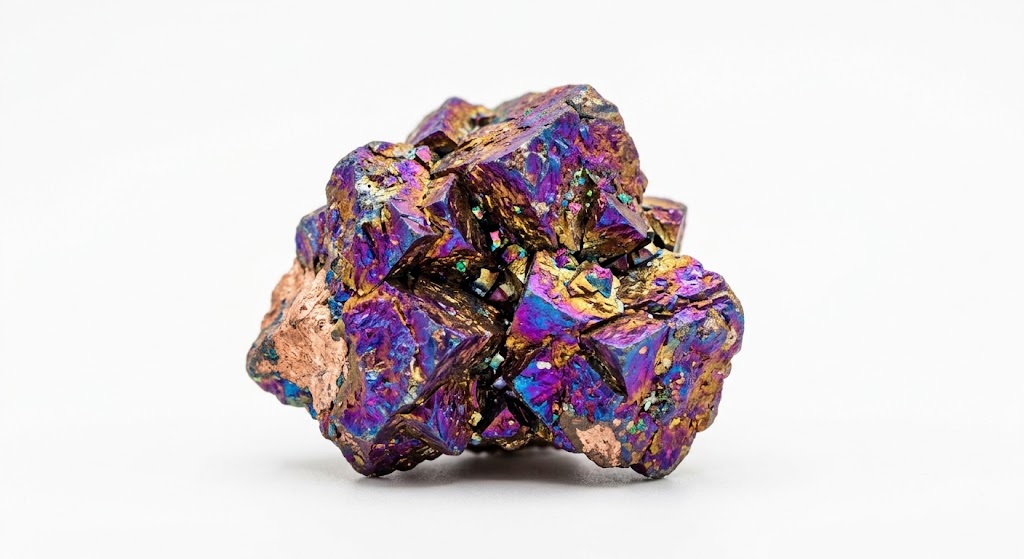
Bornite — "Peacock Ore," Copper Rainbow, and Master's Secrets
Bornite ($\text{Cu}_5\text{FeS}_4$) is a copper-iron sulfide mineral. It is one of the most important copper ores, though in the mineral collecting and decorative worlds, it is renowned for its unique optical property: upon exposure to air, its freshly broken bronze-colored surface becomes coated with a stunning, intensely iridescent tarnish that shimmers in all colors of the rainbow (blue, purple, violet, green, and gold). Because of this, it is commonly known as "Peacock Ore."
Bornite is one of nature's most impressive metallic-aesthetic creations, combining high industrial value with rare collector appeal.
Origin of the Name: The mineral was named in 1845 in honor of the Austrian mineralogist Ignaz von Born, who made significant contributions to mineralogy and metallurgy.
Ancient Beliefs: Among ancient miners, bornite was considered a "sign of a rich mine"—its discovery indicated that a rich copper vein lay deeper below.
Energy and Spiritual Significance: In lithotherapy, bornite is regarded as a "stone of joy and transformation." It is associated with all chakras (especially the Solar Plexus—Manipura). It was believed that bornite helps individuals transform negative energy into positive, overcome obstacles, and clear internal blockages.
Bornite belongs to the relatively soft and heavy minerals, which determines the specific way it is handled.
Chemical Formula: $\text{Cu}_5\text{FeS}_4$ (Copper-iron sulfide, containing approximately 63% copper).
Crystal System: Orthorhombic (cubic at high temperatures; rarely forms sharp cubic or octahedral crystals, mostly occurring as massive, granular aggregates).
Hardness (Mohs Scale): 3.0 (Relatively soft, scratches easily).
Density: $5.06 - 5.09 \text{ g/cm}^3$ (Quite heavy).
Cleavage: Imperfect/Poor (has a conchoidal or uneven fracture when broken).
Color: Reddish-brown or bronze on a fresh fracture, but quickly becomes coated with an iridescent purple-blue tarnish upon contact with air.
Luster: Strong metallic.
Bornite is widely distributed in hydrothermal veins and magmatic copper deposits:
Chile and Peru: The Andes region is known for gigantic industrial reserves of bornite.
USA: (Butte, Montana; Arizona; Bingham Canyon, Utah) Serves as a source of stunning collector crystals and ores of bornite.
United Kingdom (Cornwall): A historic deposit known for high-quality crystalline specimens.
Kazakhstan, Russia (Urals, Transbaikal), and South Africa (Namaqualand).
Important Note on Imitations: In the jewelry and souvenir markets, chalcopyrite ($\text{CuFeS}_2$) that has been artificially treated with acid to produce colorful iridescence is frequently sold as "Peacock Ore." Authentic bornite develops these colors naturally, displays darker tones (purple-blue hue), and is relatively soft.
Mining and Metallurgical Industry: Bornite is one of the primary and richest sources for copper extraction.
Jewelry: Used very rarely, though exceptions exist.
Collector Mineralogy: Natural, vibrant purple-blue druses and crystals of bornite are highly popular among collectors.
Decorative Arts: Polished massive bornite is occasionally used in decorative interior elements and small sculptures.
Processing and Handling: Due to its low hardness ($3.0$), bornite is not suitable for active-wear jewelry (e.g., rings), as it scratches easily.
Oxidation Process: The natural, fresh fracture of bornite is bronze-colored. The rainbow tarnish forms through reaction with air and moisture.
Care and Maintenance:
Dryness: Keep in a dry environment. Excess humidity can alter or ruin its surface luster over time.
Mechanical Protection: Protect from impacts and friction against harder minerals.
Cleaning: Clean only with a dry, soft brush or soft cloth. Do not use chemical solutions, acids, or ultrasonic cleaning devices.
 511 40 73 13
 info@silveria.ge


 Eng
Eng