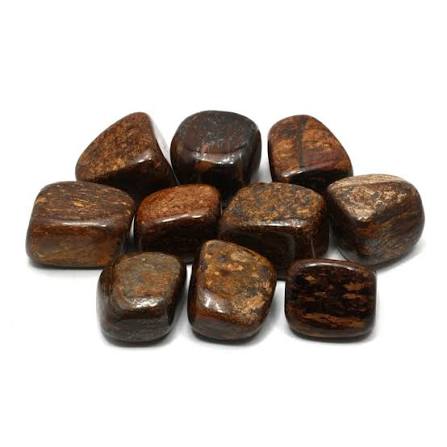
Bronzite — Bronze Luster, Golden Secrets of Hypersthene, and Master's Tips
Bronzite is an iron-rich variety of enstatite ($\text{Mg}_2\text{Si}_2\text{O}_6$) belonging to the pyroxene group. It is distinguished by its characteristic brown-golden coloration and internal metallic luster (silky/bronze iridescence). As the iron content increases in the mineral, thin layers of iron and magnesium form within the crystal structure, granting the stone a bronze-like shimmer—which is precisely where its name originates.
Through the eyes of a master craftsman, bronzite is a remarkably warm, elegant, and cozy mineral. Its polished surface often resembles wood grain or liquid bronze, making it particularly attractive in both jewelry making and decorative arts.
Origin of the Name: The mineral was officially named for its visual resemblance to bronze.
Ancient Talismans: Among ancient Romans, bronzite was considered a protective talisman. It was believed that its metallic luster acted as a "shield," reflecting negative energy and ill intentions back to the sender.
Energy and Spiritual Significance: In lithotherapy, bronzite is known as the "stone of serenity and confidence." It is associated with the Root (Muladhara) and Solar Plexus (Manipura) chakras. It is believed that the stone helps individuals maintain a calm mind in stressful situations, make decisions, and find inner harmony.
Working with bronzite is quite convenient for jewelers and lapidaries, though its cleavage requires some attention.
Chemical Formula: $(\text{Mg}, \text{Fe})_2\text{Si}_2\text{O}_6$ (Magnesium iron silicate).
Crystal System: Orthorhombic.
Hardness (Mohs Scale): 5.5 (Moderate hardness, easily cut and polished).
Density: $3.3 - 3.4 \text{ g/cm}^3$
Cleavage: Perfect in two directions (near $90^\circ$).
Refractive Index: $1.65 - 1.68$
Color: Dark brown, chocolate brown, greenish-brown, with golden or bronze inclusions.
Luster: Waxy, pearly, and metallic/bronze-like on fresh fracture.
Bronzite forms in ultramafic igneous rocks (peridotites, gabbros, and norites) and is found in several key regions globally:
Austria (Styria): A historic and famous deposit for bronzite.
South Africa (Bushveld Complex): Renowned for rich, massive deposits of bronzite.
USA: (Montana, California) American specimens are notable for their high decorative quality.
India, Brazil, Madagascar, and Finland.
Russia (Urals and Kola Peninsula): Features beautiful bronzite-bearing rocks.
Jewelry Art: Bronzite is mostly fashioned into cabochons, beads, bracelets, and pendants. It is especially popular in men's jewelry and ethno-style pieces due to its understated, natural tones.
Decorative & Applied Arts: Massive bronzite is used in making small sculptures, trinket boxes, decorative spheres, and interior cladding tiles.
Collector Mineralogy: Well-defined crystals and polished slices are prized by collectors.
Processing and Cutting: Due to its moderate hardness ($5.5$) and perfect cleavage, care must be taken during cutting, especially when applying pressure. Cabochon cutting is ideal for bronzite, as the convex surface maximizes the display of its "bronze-like" play of light.
Polishing: Upon proper polishing, bronzite acquires a beautiful silky luster.
Care and Maintenance:
Prevent Scratches: Since its hardness is $5.5$, it can be scratched by harder minerals (e.g., quartz, topaz), so store it separately in a soft pouch.
Chemicals & Temperature: Avoid harsh household chemicals and acids.
Cleaning: Clean with warm, soapy water and a soft cloth. Ultrasonic cleaning is not recommended due to internal cleavage fractures.
 511 40 73 13
 info@silveria.ge


 Eng
Eng