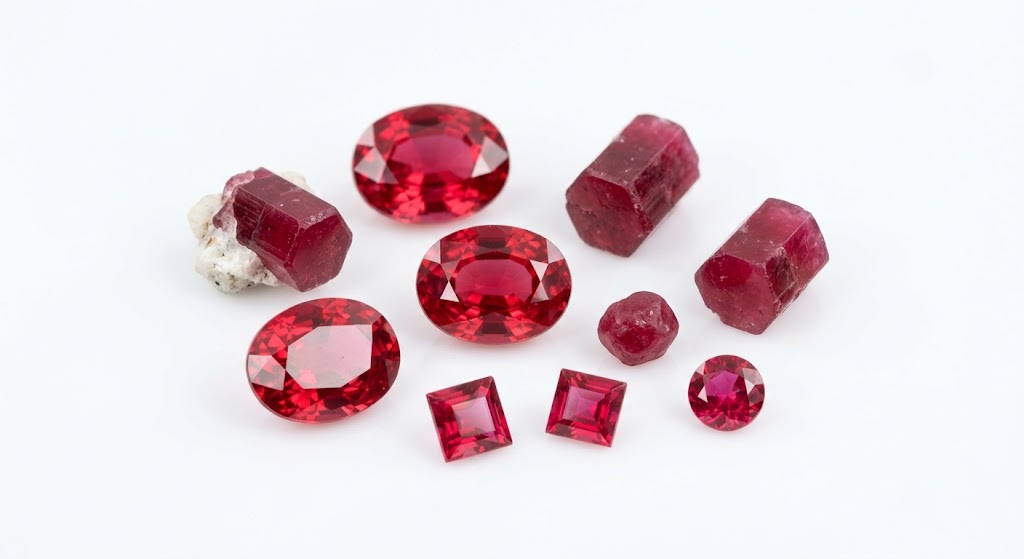
Bixbite — Red Beryl, One of the World's Rarest Gemstones, and Master's Secrets
Bixbite ($\text{Be}_3\text{Al}_2\text{Si}_6\text{O}_{18}$) is an extremely rare, intensely red to raspberry-red variety of the beryl family. It is considered one of the rarest gemstones on the planet—so rare that for every 150,000 gem-quality diamonds, only one red beryl is mined. Its unique crimson/raspberry coloration is caused by manganese ($Mn^{3+}$) inclusions within its crystal structure.
Through the eyes of a master craftsman, bixbite is the true "Holy Grail" for gemologists and high-jewelry collectors. Its vibrant color, high hardness, and unbelievable rarity make it one of the most expensive minerals in the world.
Origin of the Name: The mineral was first discovered in 1904 by American mineralogist Maynard Bixby in the state of Utah. The stone was named "Bixbite" in his honor.
Naming Confusion (Gemological Note): International gemological associations often avoid using the term "Bixbite" to prevent confusion with a completely different mineral—Bixbyite ($(\text{Mn},\text{Fe})_2\text{O}_3$). Therefore, in the jewelry world, it is officially referred to as "Red Beryl."
Energy and Spiritual Significance: In lithotherapy, red beryl is regarded as a "stone of vitality and passion." It is closely associated with the Root (Muladhara) and Heart (Anahata) chakras. It was believed that the stone imparts boundless physical energy, self-confidence, enhances creative potential, and protects against emotional burnout.
Working with bixbite demands the highest level of craftsmanship from a master lapidary, as every carat of the stone represents a colossal monetary value.
Chemical Formula: $\text{Be}_3\text{Al}_2\text{Si}_6\text{O}_{18}$ with manganese ($Mn$) impurities (Beryllium aluminum silicate).
Crystal System: Hexagonal (forms short prismatic crystals).
Hardness (Mohs Scale): 7.5 - 8.0 (Very high hardness, ideal for fine jewelry).
Density: $2.66 - 2.70 \text{ g/cm}^3$
Cleavage: Imperfect/Poor.
Refractive Index: $1.568 - 1.574$
Color: Raspberry-red, dark pink, ruby-red, crimson.
Luster: Vitreous.
Bixbite / Red Beryl is mined in gem quality in only one single region worldwide:
USA (State of Utah):
Wah Wah Mountains: The world's only location (Ruby-Violet Claim) producing gem-quality red beryl suitable for faceting.
Thomas Range and Juab County: Deposits of small, non-gem or collector micro-crystals.
No gem-quality red beryl has ever been discovered in any other country.
High Jewelry Art: Red beryl is used in exclusive, premium-class jewelry (rings, pendants, earrings). Clean bixbite weighing over 1 carat often fetches higher prices per carat at top-tier auctions (Christie's, Sotheby's) than top-quality emeralds or diamonds.
Investment and Collecting: Due to its extreme rarity, red beryl is considered one of the finest capital investments in the gemstone world.
Inclusions and Faceting: Much like emeralds, most bixbite crystals contain natural internal fractures and inclusions (classified as Type III gemstones by GIA). When faceting, the master must maximize weight retention while taking care to relieve internal structural stress.
Size: Clean, faceted bixbite weighing over 2 carats is practically non-existent in nature. The majority of faceted stones weigh under 1 carat.
Synthetics and Imitations: Because the stone is immensely valuable, hydrothermal synthetic red beryl grown in Russia is present on the market. When purchasing a natural stone, a certificate from a reputable gemological laboratory (GIA, SSEF, Gübelin) is imperative.
Care and Maintenance:
High Hardness ($7.5-8.0$): Makes the stone highly resistant to daily wear and abrasion.
Cleaning: Due to internal fractures, ultrasonic or steam cleaning must never be used. Clean using only warm, soapy water and a soft brush.
 511 40 73 13
 info@silveria.ge


 Eng
Eng