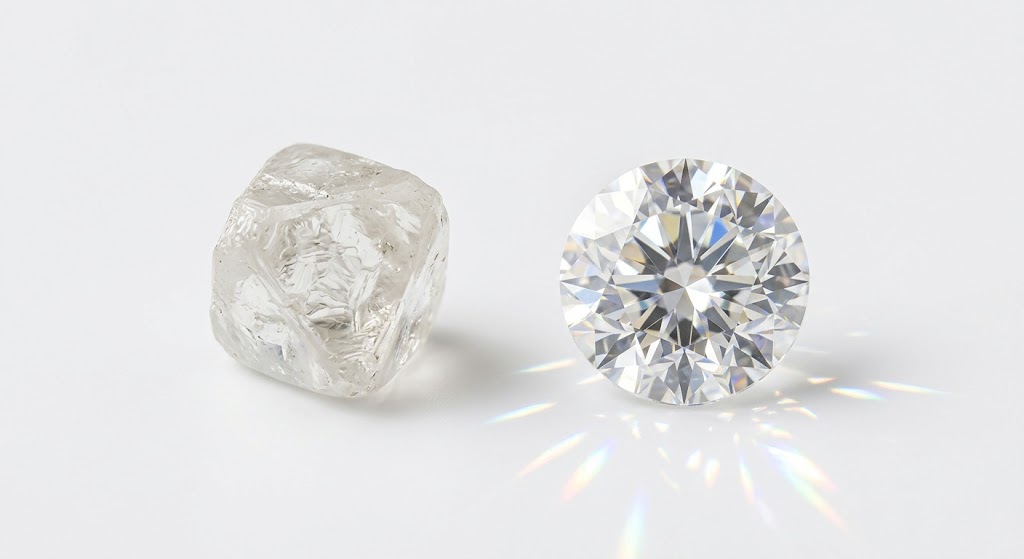
Diamond and Brilliant: Nature's Wonder and Human Mastery
Diamond ($\text{C}$) is one of the most famous and invaluable gemstones in the world. Its name originates from the Greek word "adamas", which means "unconquerable" or "indestructible." This name is entirely justified, as diamond is renowned for its incredible strength. It is the hardest naturally occurring substance on Earth, making it unique not only in fine jewelry art but also in industrial applications.
Through the eyes of a master craftsman, diamond represents the ultimate union of elemental physics and lapidary perfection—a pure carbon lattice transformed by extreme deep-earth pressure into an eternal showcase of light.
Diamonds are formed deep within the Earth's mantle, under conditions of colossal pressure and extremely high temperatures. This process takes place over hundreds of millions to billions of years.
Diamonds are primarily brought to the Earth's surface through kimberlite pipes—magmatic conduits created by deep-source volcanic eruptions. Thanks to these ancient, high-velocity volcanic events, diamond deposits became accessible for human extraction.
Working with diamonds demands specialized tools, as no other natural material can scratch or shape them.
Chemical Formula: $\text{C}$ (Pure Carbon arranged in a diamond cubic crystal structure).
Crystal System: Cubic (Isometric).
Hardness (Mohs Scale): 10.0 (The highest on the scale; can only be scratched by another diamond).
Density: $3.51 - 3.53 \text{ g/cm}^3$
Cleavage: Perfect in 4 directions parallel to the octahedral faces (requiring precise skill when cleaving/cutting).
Refractive Index: $2.417 - 2.419$ (Extremely high, creating intense brilliance).
Dispersion: $0.044$ (Strong ability to split light into spectral fire).
Luster: Adamantine.
Diamond mining is a global industry, with deposits concentrated across primary (kimberlite) and secondary (alluvial) sources:
Russia: The world leader in diamond production volume. Most deposits are located in Yakutia (Sakha Republic), Northern Siberia.
Key Deposits: Mir (historic open-pit/underground mine), Udachnaya (massive kimberlite pipe), and Aikhal (comprehensive mining complex).
Botswana: Second globally in volume, but often first in total value due to the exceptional gem quality of its yield.
Key Deposits: Jwaneng (the richest mine in the world by value), Orapa (largest mine by surface area), and Letlhakane.
Canada: A major producer since the 1990s, offering high-quality, ethically mined gems from the Northwest Territories.
Key Deposits: Ekati (Canada's first diamond mine), Diavik (located on an island in a frozen lake), and Gahcho Kué.
Democratic Republic of the Congo (DRC): A major supplier primarily producing industrial-grade and lower-quality gem diamonds from alluvial deposits (e.g., Kasai region).
Australia: Historically famous for fancy colored diamonds, particularly pinks and reds.
Key Deposit: Argyle (famous primary source for rare pink and brown diamonds; ceased operations in 2020 due to depletion).
Mining Types:
Primary Deposits (Kimberlite Pipes): Deep magmatic pipes extracted via large-scale open pits or underground mines.
Secondary Deposits (Alluvial Deposits): Weathered diamonds washed out of primary host rocks by rivers and concentrated in gravels, riverbeds, beaches, or ocean floors.
While raw diamonds display a unique rustic beauty, their optical potential is fully unlocked through professional cutting and polishing.
What is a "Brilliant"?
The term "Brilliant" (from French brillant — "shining" or "radiant") specifically refers to a diamond cut featuring a geometric pattern of facets designed to maximize light reflection and refraction.
Common Diamond Cut Styles:
Round Brilliant: The classic 57- or 58-facet cut that offers maximum brilliance and fire.
Princess: A square cut combining modern geometric lines with high brilliance.
Emerald: A rectangular step-cut featuring parallel facets that highlight the stone's clarity and transparency.
Pear: A teardrop shape combining round and marquise cuts, ideal for elegant pendants and rings.
The quality and market value of a faceted diamond are graded globally using the standard 4 Cs:
Carat Weight: The mass of the diamond ($1 \text{ carat} = 0.2 \text{ grams}$).
Color: Graded from $D$ (completely colorless, most valuable) to $Z$ (light yellow/brown). Natural fancy colored diamonds (pink, blue, red, green) follow a separate grading scale and command premium prices.
Clarity: Evaluates internal inclusions and surface blemishes (ranging from FL/IF [Flawless/Internally Flawless] to I1-I3 [Included]).
Cut: Assesses the proportion, symmetry, and polish quality, which directly dictate the stone's brilliance, dispersion (fire), and scintillation.
Beyond jewelry, diamond's unmatched physical hardness and thermal conductivity make it indispensable in modern industry:
Drilling & Cutting Tools: Diamond-tipped bits are used for heavy industrial drilling through solid rock, concrete, and metals.
Abrasives: Diamond powder and pastes are used for precision grinding, lapping, and polishing hard materials.
Electronics & High-Tech: Used in heat sinks for high-power electronics and specialized optical windows due to high thermal conductivity and electrical insulation properties.
Durability: With a Mohs hardness of $10.0$, diamonds resist scratching from all other everyday materials.
Cleavage Vulnerability: Despite its hardness, diamond possesses perfect octahedral cleavage. A hard, angled blow along a cleavage plane can cause the stone to chip or split.
Cleaning: Diamonds attract grease and oil (lipophilic property). Clean using warm soapy water and a soft brush, or ultrasonic cleaners (provided the stone does not contain heavy, oil-filled fractures).
 511 40 73 13
 info@silveria.ge


 Eng
Eng