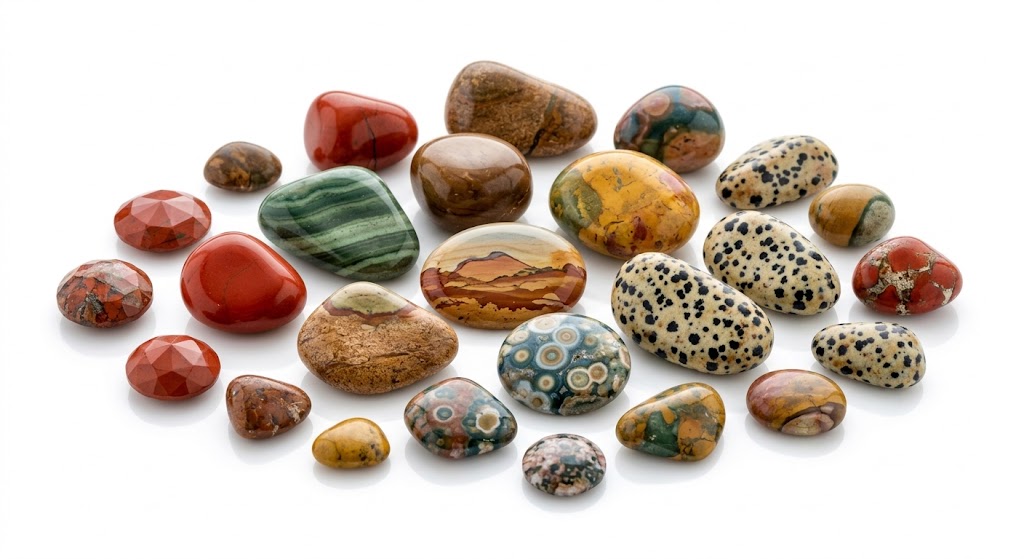
Jasper — Nature's Colorful Canvas, A Diverse Agate Mystery, and Master's Advice
Jasper is a rock composed of microcrystalline quartz ($\text{SiO}_2$) with substantial mineral impurities (primarily iron oxides, clay, and other minerals). Its name originates from the Greek word "iaspis", meaning "spotted" or "speckled stone." Due to its high impurity content (sometimes up to 20%), jasper is distinguished by an incredible variety of patterns, unique ornaments, and a rich color palette.
Through the eyes of a master craftsman, jasper is a true painting created by nature. No two jasper specimens are identical, making it a unique material in both fine jewelry and decorative lapidary arts.
Ancient Civilizations: Jasper is one of the oldest minerals known to humanity. During the Paleolithic era, it was used to manufacture tools and weapons (arrowheads, scrapers) due to its hardness and tough structure.
Ancient Egypt and Greece: In Egypt, protective amulets and rings dedicated to the goddess Isis were carved from red jasper. The Greeks considered it a powerful talisman protecting its owner from poisons and the evil eye.
Energy and Spiritual Significance: In lithotherapy, jasper is known as the "supreme nurturer and energy stabilizer." Different colors of jasper are associated with different chakras (e.g., red jasper with the Root chakra, green jasper with the Heart chakra). It is believed that the stone grants inner peace, physical endurance, and guards against negative energy.
Working with jasper is exceptionally comfortable for lapidaries and jewelers because it lacks cleavage and responds very well to processing and carving.
Chemical Formula: $\text{SiO}_2$ (Quartz/Chalcedony) with impurities of $\text{Fe}_2\text{O}_3$, $\text{FeO}$, clay, and aluminosilicates.
Crystal System: Trigonal (microcrystalline aggregates).
Hardness (Mohs Scale): 6.5 - 7.0 (High hardness, scratch-resistant).
Density: $2.58 - 2.91 \text{ g/cm}^3$
Cleavage: None (Conchoidal fracture).
Refractive Index: $1.54 - 1.55$
Color: Virtually all colors — red, brown, green, yellow, banded, spotted, "picture/landscape."
Luster: Vitreous, waxy, or silky (upon good polish).
Jasper is categorized based on its patterns and coloration:
Red Jasper: Contains a high percentage of hematite ($\text{Fe}_2\text{O}_3$).
Picture / Landscape Jasper: Displays natural scenes resembling mountains, deserts, and valleys.
Ocean Jasper: Features a spherulitic structure with circular, orbicular patterns.
Green / Ribbon Jasper: Displays banded or mottled structures.
Jasper is widely distributed around the globe, but high-grade decorative specimens are notably mined in the following regions:
India (Deccan Plateau): Famous for red and multicolored jasper.
USA (Oregon, Idaho, California): Home to the world's finest picture/landscape jasper deposits.
Russia (Urals and Altai): Historically famous for giant deposits of ribbon and porphyritic jasper.
Madagascar: The primary source of Ocean Jasper.
Brazil, Australia, Germany, and Egypt.
Jewelry Art: Cut into cabochons, beads, bracelets, rings, and pendants. Extremely popular in ethnic and boho-style jewelry collections.
Decorative and Lapidary Arts: For centuries, jasper has been used to craft vases, trinket boxes, countertops, mosaics, and small sculptures (e.g., the famous massive jasper vases preserved in the State Hermitage Museum).
Interior Design: Used as facing tiles and luxury decorative architectural elements.
Cutting and Polishing: Thanks to its high hardness ($6.5-7.0$) and lack of cleavage, jasper is ideal for lapidary work and engraving. Cabochon cuts and flat polishes best accentuate the natural patterns of the stone.
Quality of Polish: Jasper takes a mirror-like shine when properly finished with diamond pastes and felt wheels.
Care and Maintenance:
Durability: Highly durable and resistant to everyday scratches.
Cleaning: Easily cleaned with warm, soapy water. Ultrasonic cleaning is generally safe.
Chemicals: Keep away from strong acids and aggressive chemicals.
 511 40 73 13
 info@silveria.ge


 Eng
Eng