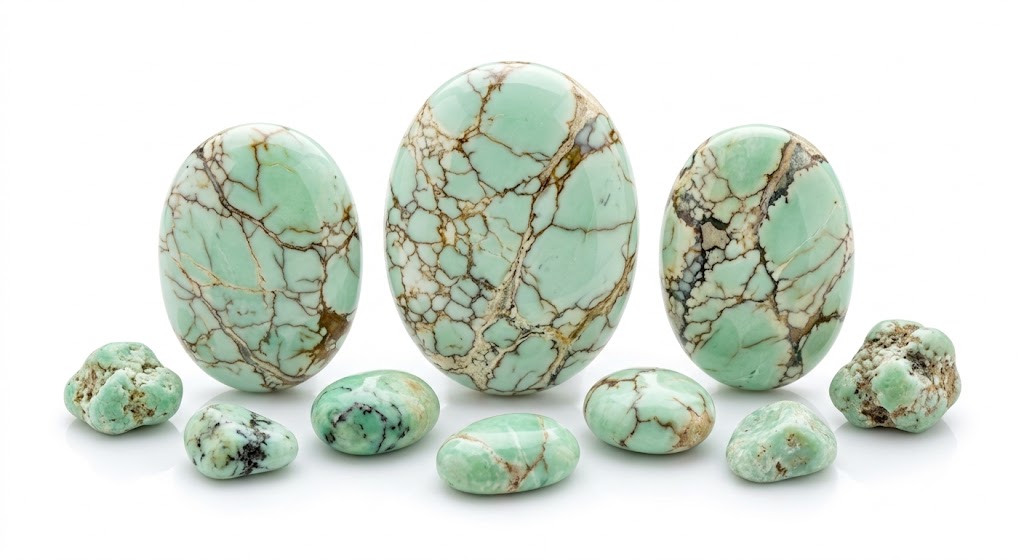
Variscite — Rare Green Treasure, An Golden Emerald Alternative, and Master's Secrets
Variscite (AlPO4⋅2H2O) is a hydrated aluminum phosphate mineral distinguished by its delicate green, light turquoise, or apple-green coloration. It is often visually confused with turquoise; however, it possesses a distinctly richer green hue and a completely different chemical composition. The name of the mineral is derived from Variscia (the present-day Vogtland region in Germany), the historical district where it was first discovered and described in 1837.
Through the eyes of a master craftsman, variscite is a collector's and jeweler's gem of exceptional beauty. Its soft tones, unique veined patterns, and waxy-to-vitreous luster make it an exquisite choice for fine ethnic and contemporary jewelry pieces.
Origin of the Name: As mentioned, the name stems from the German region of Variscia. In the jewelry trade, it is also known by alternative names such as "Utahlite" (variscite mined in Utah) or "Calaite."
Archaeological Discoveries: In European archaeological sites (particularly in Spain and France), variscite beads and amulets dating back to the Neolithic era have been uncovered, proving that ancient civilizations prized this gemstone thousands of years ago.
Energy and Spiritual Significance: In lithotherapy, variscite is regarded as a "stone of emotional balance and soul harmony." It is closely connected with the Heart (Anahata) chakra. It is believed to help relieve stress, bring inner peace, elevate mood, and attract positive energy.
When working with variscite, the master must take into account its relatively low hardness to prevent damage during processing.
Chemical Formula: AlPO4⋅2H2O (Hydrated aluminum phosphate).
Crystal System: Orthorhombic (rarely forms well-defined crystals; usually occurs as fine-grained, nodular, or heavily veined masses).
Hardness (Mohs Scale): 3.5 - 4.5 (Medium/Low hardness, requires careful lapidary handling).
Density: 2.57−2.61 g/cm3
Cleavage: Good (in individual crystals, though absent in massive aggregate forms).
Refractive Index: 1.56−1.59
Color: Apple-green, emerald-green, turquoise-blue, yellow-green (coloration is driven by trace amounts of chromium [Cr3+] and vanadium).
Luster: Waxy, silky, or vitreous.
Gem-quality variscite deposits are relatively rare worldwide:
USA (States of Utah and Nevada):
Utah (Lucin & Clay Canyon): Utah variscite (often called "Utahlite") is considered among the finest in the world, renowned for its rich apple-green color and striking white or brown quartz vein matrix.
Nevada: Known for producing beautiful blue-green variscite resembling high-grade turquoise.
Spain (Catalonia / Gavà): Historic prehistoric mines where variscite was extracted as early as the Neolithic period.
Australia (Queensland): Produces intense green variscite specimens.
Germany, Brazil, and Poland.
Jewelry Art: Variscite is primarily fashioned into cabochons, beads, pendants, earrings, and bracelets. It pairs exceptionally well with sterling silver settings.
Collecting: Natural veined matrix slabs and rough specimens are highly sought after by mineral collectors.
Cutting and Polishing: Due to its low hardness (3.5−4.5), variscite is easy to cut and shape, but requires gentle pressure during polishing. Cabochon cuts or flat freeform slabs best accentuate its natural vein patterns.
Sensitivity: The stone is sensitive to high heat, acids, and harsh household chemicals.
Care and Maintenance:
Cleaning: Clean only with warm water, mild soap, and a soft cloth. Never use ultrasonic or steam cleaners.
Storage: Store in a separate soft pouch or jewelry slot to prevent harder gemstones (such as quartz or beryl) from scratching its surface.
 511 40 73 13
 info@silveria.ge


 Eng
Eng