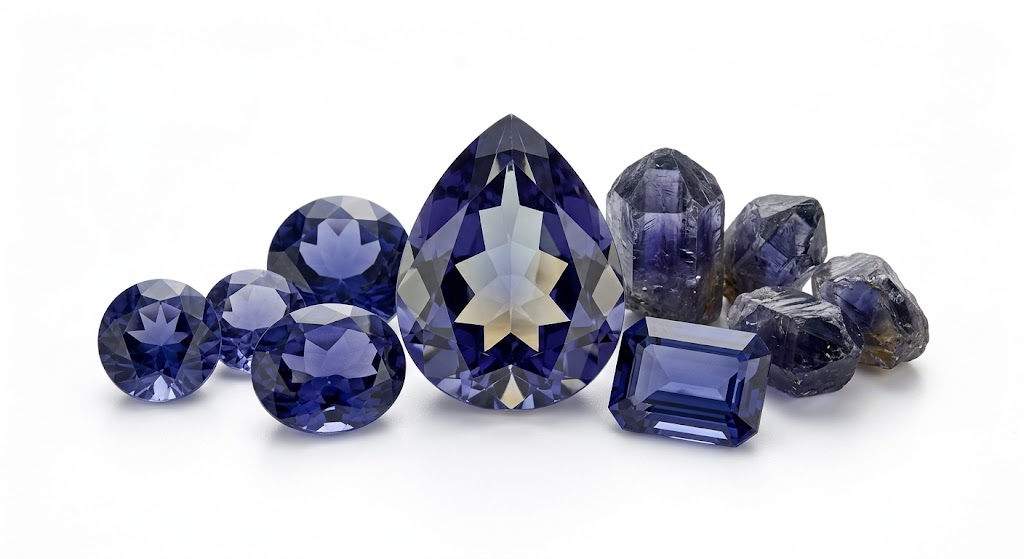
Iolite (Cordierite / Water Sapphire) — The Magic of Pleochroism, The Viking Compass, and Master's Secrets
Iolite (mineralogically Cordierite, $\text{Mg}_2\text{Al}_4\text{Si}_5\text{O}_{18}$) is a complex magnesium aluminum silicate mineral. Its name is derived from the Greek word "ion", which means "violet." The most astonishing feature of iolite is its strong trichroism (a type of pleochroism) — when viewed from different angles, the stone changes color, exhibiting deep blue-violet, yellowish-gray, or nearly colorless tones.
Through the eyes of a master craftsman, iolite is one of the most intriguing yet challenging gemstones to work with. When cut with precise orientation, it serves as a brilliant and affordable alternative to sapphire; however, incorrect faceting angles can cause the stone to lose its desirable color entirely.
The Viking Compass: According to legend, Vikings used thin slices of iolite as polarizing lenses. Even on cloudy days, the iolite filter allowed navigators to pinpoint the exact position of the sun in the sky, earning it the nickname "The Viking Compass Stone."
Water Sapphire: In gemological history, iolite was often referred to as "Water Sapphire" due to its transparent blue hue and watery luster.
Energy and Spiritual Significance: In lithotherapy, iolite is considered a stone of intuition, inner vision, and spiritual awakening. It is closely connected to the Third Eye (Ajna) chakra. It is believed to help the wearer focus their mind, relieve stress, and unlock creative potential.
When working with iolite, jewelers must carefully account for its optical axes and cleavage.
Chemical Formula: $\text{Mg}_2\text{Al}_4\text{Si}_5\text{O}_{18}$ (Magnesium aluminum silicate, often containing iron [$\text{Fe}^{2+}$] impurities).
Crystal System: Orthorhombic.
Hardness (Mohs Scale): 7.0 - 7.5 (High hardness, scratch-resistant).
Density: $2.56 - 2.66 \text{ g/cm}^3$
Cleavage: Distinct/fair in one direction (making it susceptible to fracturing upon impact).
Refractive Index: $1.531 - 1.558$
Optical Feature (Pleochroism): Strong trichroism (violet/blue, yellowish-gray, light blue).
Luster: Vitreous.
Gem-quality iolite is primarily mined from alluvial deposits and metamorphic rocks:
India: One of the leading suppliers of top-grade gem-quality iolite.
Sri Lanka: Famous for its rich deposits of "Water Sapphires" found in gravel deposits.
Madagascar: Produces large, clean crystals with intense blue coloration.
Brazil, Namibia, Tanzania, and the USA (Wyoming): Notable regional sources.
Jewelry Art: Iolite is faceted into brilliant, oval, pear, and emerald cuts. It is used in rings, earrings, and pendants (looking particularly striking in silver and white gold settings).
Collecting: Raw crystals and faceted gems exhibiting strong pleochroism are highly prized by mineral collectors.
Orientation of Cut (Critically Important): Before cutting, the lapidary artist must accurately determine the optical axis. The stone's table facet must be oriented perpendicular to the blue/violet direction to maximize the rich blue hue. Incorrect faceting will make the stone appear washed-out yellowish or gray.
Setting and Handling: Since iolite possesses distinct cleavage, avoid applying excessive mechanical pressure during setting.
Care and Maintenance:
Cleaning: Clean using warm, soapy water and a soft brush. Ultrasonic or steam cleaning is not recommended, as internal stress may crack the stone.
Temperature: Protect from sudden temperature changes.
 511 40 73 13
 info@silveria.ge


 Eng
Eng