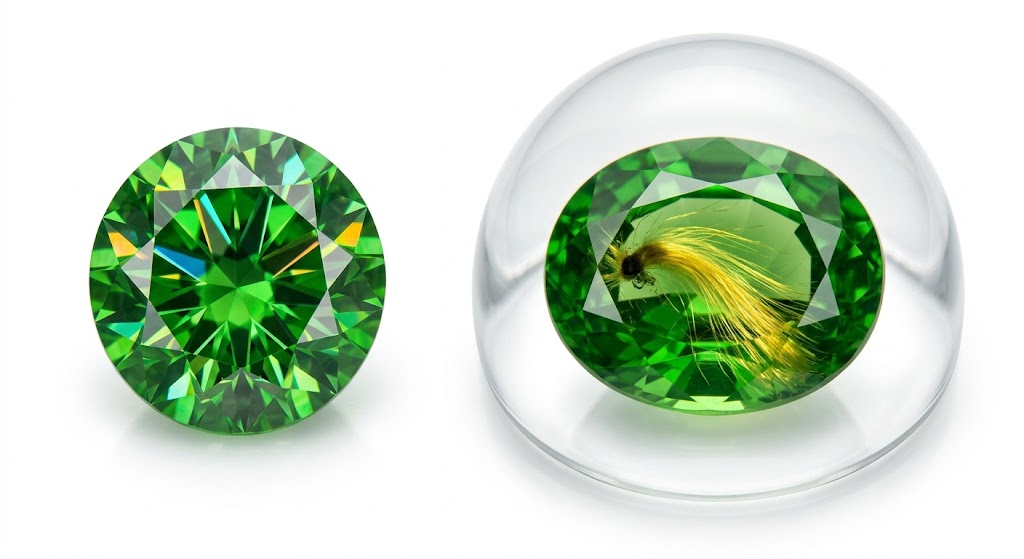
Demantoid — Adamantine Luster, The Precious Green Garnet, and Master's Secrets
Demantoid ($\text{Ca}_3\text{Fe}_2(\text{SiO}_4)_3$) is the rarest and most valuable green variety of garnet, belonging to the andradite group. Its name derives from the German word "Demant" (diamond) and the Greek suffix "eidos" (resembling), literally meaning "diamond-like." This name is entirely fitting, as demantoid possesses an exceptionally high refractive index and dispersion (fire) that, in certain cases, even surpasses that of a diamond.
Through the eyes of a master craftsman, demantoid represents the pinnacle of jewelry art — a gemstone that combines the deep green saturation of an emerald with the fiery radiance of a diamond.
Discovery in the Urals: Demantoid was first discovered in 1853 in Russia, within the Central Ural Mountains (near the Bobrovka River). It rapidly gained global acclaim and became a favorite gemstone of the Imperial Russian Court, most notably utilized by the House of Fabergé.
"Horsetail" Inclusions: Demantoid's iconic signature is the presence of fibrous bissoite (chrysotile-asbestos) inclusions that resemble a golden "horsetail." In gemology, this is one of the rare instances where an internal inclusion does not diminish a stone's value, but rather significantly increases it.
Energy and Spiritual Significance: In lithotherapy, demantoid is regarded as a stone of success, passion, and financial prosperity. It is closely linked to the Heart (Anahata) chakra. It is believed to help the wearer make sound decisions, bestow inner tranquility, and shield against negative energy.
When working with demantoid, jewelers must account for its high dispersion and medium-to-high hardness.
Chemical Formula: $\text{Ca}_3\text{Fe}_2(\text{SiO}_4)_3$ (Calcium iron silicate, with green coloration caused by trace amounts of chromium [$\text{Cr}^{3+}$] and iron [$\text{Fe}^{3+}$]).
Crystal System: Cubic (Isometric).
Hardness (Mohs Scale): 6.5 - 7.0 (Medium to high hardness).
Density: $3.82 - 3.85 \text{ g/cm}^3$
Cleavage: None (Conchoidal to uneven fracture).
Refractive Index: $1.880 - 1.889$ (Extremely high).
Dispersion: 0.057 (For comparison, diamond's dispersion is $0.044$, making demantoid even more fiery).
Luster: Adamantine to strong vitreous.
Demantoid is one of the rarest garnets in the world:
Russia (Ural Mountains): The historical and most valuable deposits to this day. Uralian demantoids are famous for hosting classic "horsetail" inclusions.
Namibia (Green Dragon Mine): Produces vivid, transparent green and yellow-green demantoids (typically without horsetail inclusions).
Madagascar: Relatively new yet rich deposits yielding high-grade stones.
Italy (Val Malenco), Iran, and Pakistan: Small, collector-oriented deposits.
Jewelry Art: Used in exclusive and High Jewelry pieces — rings, earrings, and pendants. It looks exceptionally striking when set in yellow gold or platinum, which accentuates its green fire.
Collecting: Specimens showcasing well-defined "horsetail" inclusions are intensely sought after by collectors worldwide.
Cutting and Faceting: Due to the stone's high dispersion, the brilliant (round) or oval cut is preferred, as it maximizes light performance and fire.
Preserving Inclusions: Lapidaries aim to position the stone during cutting so that the "horsetail" inclusion centers right under the table facet, ensuring it is clearly visible.
Care and Maintenance:
Caution: With a hardness of $6.5-7.0$, demantoid rings should be protected from harsh mechanical impacts and scratches.
Cleaning: Clean strictly using warm, soapy water. Avoid steam and ultrasonic cleaners.
 511 40 73 13
 info@silveria.ge


 Eng
Eng