Ruby — King of Gems, Fire of Love, and Master's Secrets
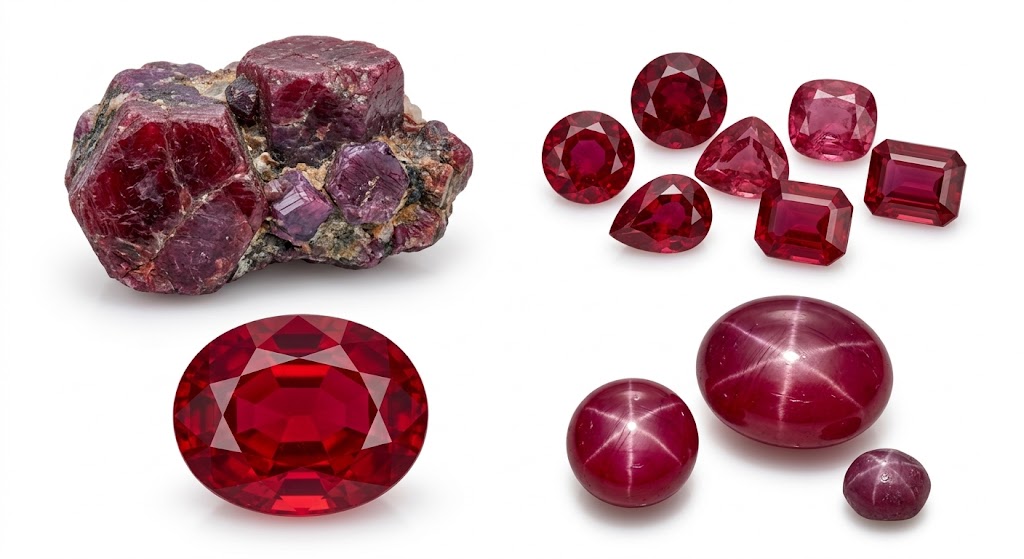
Ruby (mineralogically Corundum, $\text{Al}_2\text{O}_3$) is the most valuable red variety of the corundum family. Its Latin name, "ruber", literally translates to "red." The captivating, fiery color of ruby is caused by the replacement of aluminum ions with chromium ($\text{Cr}^{3+}$) ions within the crystal lattice. Alongside diamond, emerald, and sapphire, it occupies an honored place among the world's top four cardinal gemstones.
Through the eyes of a master craftsman, ruby is the ultimate symbol of hardness and passion. It demands the highest level of expertise from a jeweler to fully unleash the stone's inner fire and natural fluorescence during cutting.
Ancient India and the East: In Sanskrit, ruby was called "Ratnaraj", which translates to "King of Precious Stones." Ancient Indian mythology held that the owner of a ruby was protected from enemies, diseases, and misfortune.
Royal Regalia: For centuries, rubies adorned the crowns and scepters of monarchs. Remarkably, many famous historic "rubies" (such as the British Crown Jewels' "Black Prince's Ruby") were proven by modern gemological analysis to actually be red spinels.
Energy and Spiritual Significance: In lithotherapy, ruby is regarded as a gemstone of leadership, vital energy, power, and passionate love. It is closely connected to the Root (Muladhara) and Heart (Anahata) chakras. It is believed to boost self-confidence, enhance vitality, and protect its wearer from negative influences.
Working with ruby is a pleasure for a master due to its exceptional hardness, though internal strain can sometimes complicate the process.
Chemical Formula: $\text{Al}_2\text{O}_3$ (Aluminum oxide with chromium [$\text{Cr}^{3+}$] impurities).
Crystal System: Trigonal.
Hardness (Mohs Scale): 9.0 (Second only to diamond as the hardest natural mineral on Earth).
Density: $3.97 - 4.05 \text{ g/cm}^3$
Cleavage: None (Exhibits false cleavage / parting).
Refractive Index: $1.762 - 1.770$
Optical Feature: Dichroism (Purplish-red and orangey-red tones).
Fluorescence: Strong red emission under ultraviolet light (due to chromium content).
Luster: Bright vitreous to sub-adamantine.
"Pigeon’s Blood": The most expensive and sought-after shade — an intense, vivid red color with a subtle purplish undertone.
Star Ruby: A rare phenomenon (asterism) caused by silky rutile silk inclusions that form a 6-rayed star across the surface of the stone.
Myanmar (Burma / Mogok): Historically and currently the premier source of top-tier "Pigeon's Blood" rubies.
Mozambique: The largest modern market supplier of high-quality, vivid red rubies.
Sri Lanka: Produces lighter, pinkish-red rubies.
Madagascar, Tanzania, Vietnam, and Afghanistan.
Jewelry Art: Featured in fine and high jewelry collections. Typically faceted into oval, pear, brilliant, or cushion shapes. Star rubies are always cut as cabochons.
Watchmaking: Synthetic rubies are widely used as jewel bearings in mechanical watches to minimize friction.
Orientation of Cut: Due to dichroism, the lapidary artist must position the main table facet perpendicular to the optical axis to showcase the rich red hue rather than an orange tint.
Heat Treatment: Most rubies on the commercial market undergo thermal treatment to enhance color and clarity. Unheated, natural rubies displaying true "Pigeon's Blood" color command exponentially higher values.
Care and Maintenance:
Durability: With a hardness of $9.0$, ruby is exceptionally durable and ideal for everyday wear.
Cleaning: Safe to clean with warm soapy water, as well as ultrasonic and steam cleaners (provided the stone does not contain severe fractures or glass-filling treatments).
 511 40 73 13
 info@silveria.ge


 Eng
Eng