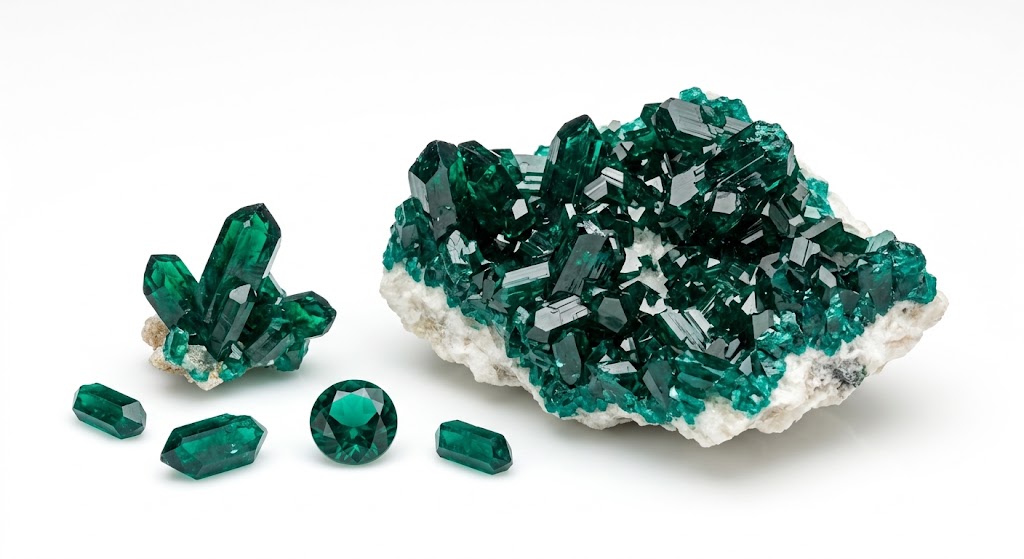
Dioptase — Emerald-Green Treasure, The Stone of Inner Sight, and Master's Secrets
Dioptase ($\text{Cu}_6\text{Si}_6\text{O}_{18} \cdot 6\text{H}_2\text{O}$) is a hydrated copper cyclosilicate mineral distinguished by its intensely rich, emerald-green to bluish-green coloration. Its name is derived from the Greek words "dia" (through) and "optima" (vision), as the cleavage planes inside its crystals are clearly visible upon close inspection.
Through the eyes of a master craftsman, dioptase is a true crown jewel of collector's mineralogy. Its deep hue is often even more vivid and saturated than that of a fine emerald; however, due to its relatively low hardness and perfect cleavage, it requires exceptional patience, caution, and skill from the lapidary artist.
Discovery History: In the late 18th century (1790s), dioptase was discovered in the Kazakh steppes of Kazakhstan and was initially mistaken for emerald before being sent to St. Petersburg. In 1797, French mineralogist René Just Haüy determined it to be a completely new copper-bearing mineral and officially named it dioptase.
Alternative Names: Historically, it has often been referred to as "Copper Emerald" or "Achirite" (after its type locality).
Energy and Spiritual Significance: In lithotherapy, dioptase is regarded as a "healer of heart wounds." It is deeply connected to the Heart (Anahata) chakra. It is believed to help the wearer release emotional trauma from the past, promoting forgiveness, inner harmony, and spiritual awakening.
When working with dioptase, a master craftsman must carefully account for its delicate internal structure.
Chemical Formula: $\text{Cu}_6\text{Si}_6\text{O}_{18} \cdot 6\text{H}_2\text{O}$ (Hydrated copper silicate).
Crystal System: Trigonal (forms beautiful, short prismatic crystals and druses).
Hardness (Mohs Scale): 5.0 (Moderate hardness, easily scratched).
Density: $3.28 - 3.35 \text{ g/cm}^3$
Cleavage: Perfect (making faceting extremely challenging).
Refractive Index: $1.644 - 1.709$
Birefringence: $0.053$ (High, imparting exceptional depth to the crystal).
Color: Intense emerald-green, deep blue-green.
Luster: Vitreous, sub-adamantine on fractures.
Dioptase is classified as a rare mineral, typically forming in the oxidation zones of copper deposits:
Namibia (Tsumeb): World-renowned for producing the finest, largest, and most brilliant dioptase crystals.
Kazakhstan (Altyn-Tyube): The historic locality where the mineral was first studied, famous for deep emerald-green crystal clusters.
Democratic Republic of the Congo and Republic of the Congo (Reneville): Exceptionally rich deposits yielding top-grade collector specimens.
USA (Arizona), Chile, and Peru.
Collecting: Dioptase crystal druses and matrix specimens are among the most coveted display items for mineral collectors worldwide.
Jewelry Art: Due to its low hardness and perfect cleavage, faceted dioptase is exceedingly rare. In fine jewelry, it is primarily featured as small cabochons or preserved natural druse formations set in protective mountings (mostly in pendants and earrings).
Processing Complexity: Because of its perfect cleavage, even slight improper pressure during cutting or polishing can cause the stone to shatter along its cleavage planes. Lapidaries often prefer preserving the natural crystalline shape.
Sensitivity: The mineral is sensitive to physical impacts, acids, and ammonia.
Care and Maintenance:
Cleaning: Clean gently using a dry or slightly damp soft cloth. Never use ultrasonic or steam cleaners, nor harsh chemical soap solutions.
Storage: Store in a padded pouch separate from harder gemstones to prevent surface scratches.
 511 40 73 13
 info@silveria.ge


 Eng
Eng