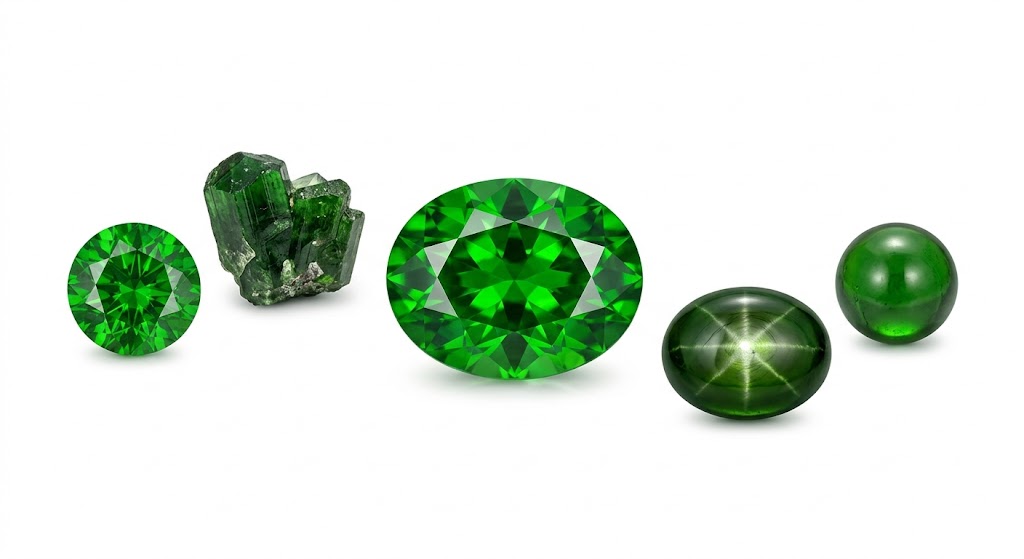
Diopside (Chrome Diopside / "Siberian Emerald") — A Mineral of Dual Aspect, Nature's Green Fire, and Master's Secrets
Diopside ($\text{MgCaSi}_2\text{O}_6$) is a calcium magnesium silicate mineral belonging to the pyroxene group. Its name originates from the Greek words "dis" (double) and "opsis" (appearance or view), referring to the fact that the crystal faces can exhibit two distinct visual aspects and orientations when viewed from different angles. The most famous and gemologically valuable variety of diopside is chrome diopside, which derives its vivid, emerald-like green color from trace amounts of chromium ($\text{Cr}^{3+}$).
Through the eyes of a master craftsman, chrome diopside serves as one of the finest, most vibrant, and relatively affordable natural alternatives to emerald; however, its moderate hardness requires exceptional care from the lapidary artist during faceting and setting.
Discovery and "Siberian Emerald": Although diopside was first described in the late 18th century, its most brilliant gem-quality variety — chrome diopside — was discovered in the mid-20th century in Yakutia (Siberia, Russia). Due to its deep green saturation, it is often referred to as "Siberian Emerald" or "Yakutian Emerald."
Black Star Diopside: Another intriguing variety is black or dark brown diopside, which exhibits a distinct 4-rayed star effect (asterism) caused by aligned microscopic inclusions of magnetite.
Energy and Spiritual Significance: In lithotherapy, diopside is considered a stone of connection to the Earth's energy and emotional equilibrium. It is closely tied to the Heart (Anahata) chakra. It is believed to help the wearer release stress and fear, fostering compassion and creative thinking.
When working with diopside, jewelers must carefully account for its medium hardness and distinct cleavage.
Chemical Formula: $\text{MgCaSi}_2\text{O}_6$ (Calcium magnesium silicate, with chromium impurities in chrome diopside).
Crystal System: Monoclinic.
Hardness (Mohs Scale): 5.5 - 6.0 (Moderate hardness; can be scratched by quartz or steel).
Density: $3.22 - 3.38 \text{ g/cm}^3$
Cleavage: Distinct/Perfect in two directions (at nearly $87^\circ$ angles), making it susceptible to fracturing under impact.
Refractive Index: $1.664 - 1.730$
Birefringence: $0.024 - 0.030$
Color: Bright green, emerald-green, dark green, brown, black.
Luster: Vitreous.
Russia (Yakutia, Inagli Deposit): The premier global source for top-grade, vivid chrome diopside.
India and Sri Lanka: Renowned for deposits of "Black Star" diopside.
Italy (Alps / Violane - violet diopside): Rare violet and blue varieties.
Madagascar, Pakistan, USA, Finland, and Canada.
Jewelry Art: Chrome diopside is faceted into oval, pear, marquise, and emerald cuts. Star diopside (Black Star) is invariably fashioned into cabochons.
Collecting: Rare color varieties (such as violet violane) and large, clean crystals are highly sought-after display specimens.
Faceting and Size Constraints: Chrome diopside is intensely saturated. If a stone exceeds $2-3$ carats, it tends to look excessively dark green (almost black) and loses light transmission. Therefore, lapidaries prefer smaller sizes ($0.5 - 2$ carats) to maintain bright brilliance.
Setting: With a hardness of $5.5-6.0$ and distinct cleavage, avoid applying heavy mechanical pressure when mounting the stone into a setting (bezel/prongs).
Care and Maintenance:
Caution: Protect from scratches, severe physical impacts, and harsh acids.
Cleaning: Clean strictly using warm soapy water and a soft cloth. Do not use steam or ultrasonic cleaners.
 511 40 73 13
 info@silveria.ge


 Eng
Eng