Lodolite (Garden Quartz / Aquarium Quartz) — Nature's Painted Landscapes, the Stone of the Inner World, and Master's Secrets
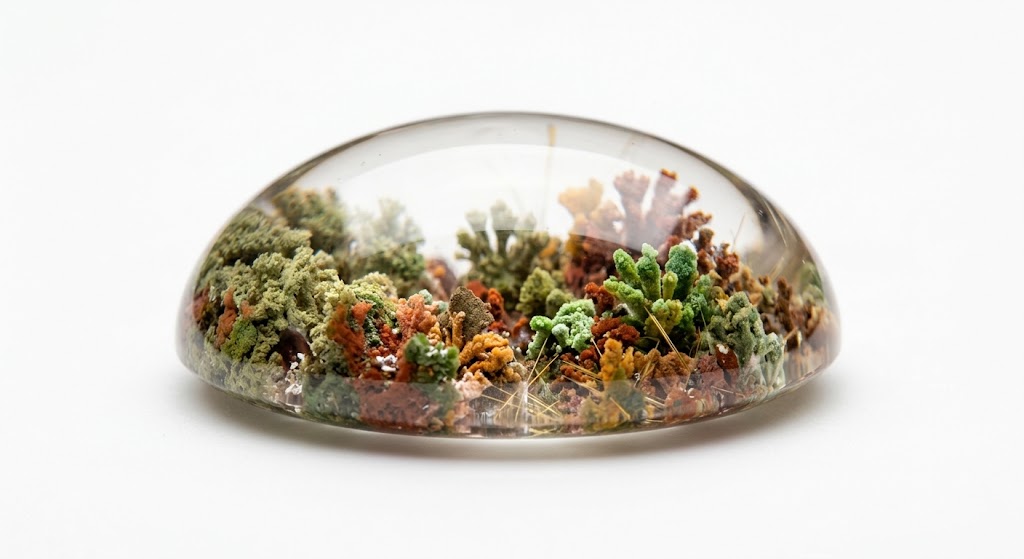
Lodolite (mineralogically Quartz with various mineral inclusions, $\text{SiO}_2$) is a specific variety of transparent quartz (rock crystal) containing diverse inclusions of other minerals, such as chlorite, epidote, rutile, hematite, and clay minerals. Its name is derived from the Portuguese/Spanish word "Lodo" (mud, sludge) or the Greek "Lithos" (stone); however, within the jewelry world, it is frequently referred to as "Garden Quartz," "Landscape Quartz," or "Aquarium Quartz" because the inclusions within the stone strikingly resemble underwater gardens, coral reefs, and mountain landscapes.
Through the eyes of a master craftsman, lodolite is a unique painting created by nature — no two identical lodolites exist, rendering every specimen exclusive.
Origin and Popularity: Lodolite has been used for centuries as a collector's stone and a talisman; however, it gained particular popularity in the modern jewelry market at the end of the 20th century, when high-quality Brazilian specimens achieved global recognition.
Natural Aquarium: In ancient legends, it was believed that tiny natural worlds were frozen within the crystal, connecting the owner to nature's secrets.
Energy and Spiritual Significance: In lithotherapy, lodolite is regarded as a stone of deep meditation and inner journeying. It is connected to the Crown (Sahasrara) and Third Eye (Ajna) chakras. It is believed that the stone helps an individual understand past-life traumas, calms the mind, enhances intuition, and facilitates the materialization of desires.
Working with lodolite is a creative process for a master, where the primary task is to present the internal landscape as effectively as possible.
Chemical Formula: $\text{SiO}_2$ (Silicon dioxide with inclusions of chlorite, hematite, epidote, etc.).
Crystal System: Trigonal.
Hardness (Mohs Scale): 7.0 (High hardness; the quartz matrix provides the stone's durability).
Density: $2.65 \text{ g/cm}^3$ (May vary slightly depending on the density of the inclusions).
Cleavage: None (Fracture is conchoidal).
Refractive Index: $1.544 - 1.553$
Color: Transparent background with green, brown, red, orange, pink, or creamy inclusions.
Luster: Vitreous.
Brazil (Minas Gerais): The world's primary source of the highest-quality lodolites, yielding specimens with the clearest and most colorful "landscapes."
Madagascar: Known for quartz containing rich and diverse mineral inclusions.
India, Namibia, and USA.
Jewelry Art: Primarily used in exclusive designer jewelry — pendants, rings, and bracelets.
Collecting and Decorative Field: Large, processed polished crystals and spheres are highly popular in interior design and mineral collections.
Cutting and Shape Selection: Lodolite is almost always cut and polished into a High Cabochon or a freeform dome. The domed surface acts as a magnifying glass (lens), giving the internal "garden" three-dimensional (3D) depth and volume.
Orientation: Before cutting, the master must position the stone so that the "bottom" of the inclusions lands at the base of the cabochon, and the transparent quartz remains in the upper part.
Care and Maintenance:
Durability: Thanks to its hardness of $7.0$, the stone is quite durable and convenient for daily wear.
Cleaning: Clean with warm soapy water and a soft cloth. Ultrasonic cleaning is also safe, provided the crystal does not have open cracks on its surface.
 511 40 73 13
 info@silveria.ge


 Eng
Eng