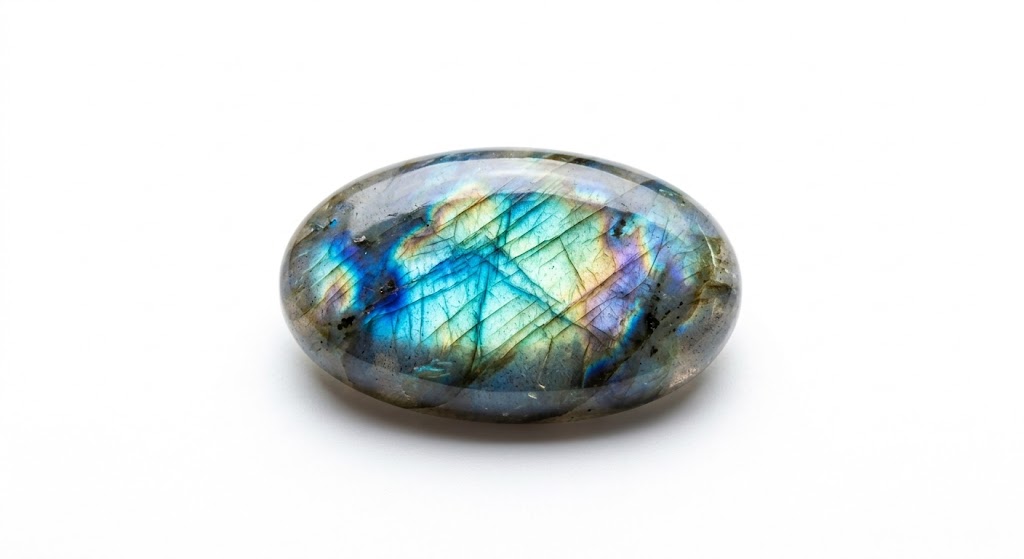
Labradorite (Spectrolite) — Stone of the Northern Lights, Play of Color, and Master's Secrets
Labradorite ($\text{(Na,Ca)(Al,Si)}_4\text{O}_8$) is a mineral belonging to the plagioclase feldspar group. It enjoys global acclaim due to its unique optical phenomenon — labradorescence (or labradorization) — which manifests as vivid flashes of sky-blue, deep blue, green, gold, and violet across the stone's surface when light refracts within it.
Through the eyes of a master craftsman, labradorite is one of nature's most magical stones. It demands precise calculation of the cutting angle to fully ignite the fire of hidden colors within the stone's inner layers.
Discovery History: The mineral derived its name from Canada's Labrador Peninsula, where it was first brought to Europe by missionaries in the 1770s.
Inuit Legend: According to the lore of northern native peoples (the Inuit), the Northern Lights (Aurora Borealis) were once trapped within the rocks along the coast of Labrador. A brave warrior struck the rock with his spear, freeing most of the lights into the sky, while the remaining glow stayed forever trapped inside the labradorite stones.
Spectrolite: The highest-grade variety of labradorite, mined in Finland, which flashes across the entire color spectrum (including rare reds and oranges), is officially called spectrolite.
Energy and Spiritual Significance: In lithotherapy, labradorite is regarded as a gemstone of transformation, protection, and intuitive enhancement. It is deeply connected to the Third Eye (Ajna) and Crown (Sahasrara) chakras. It is believed that the stone shields the wearer's aura from energy leaks.
When fashioning labradorite, a lapidary master must carefully account for its layered internal structure and cleavage.
Chemical Formula: $\text{(Na,Ca)(Al,Si)}_4\text{O}_8$ (Sodium calcium aluminosilicate).
Crystal System: Triclinic.
Hardness (Mohs Scale): 6.0 - 6.5 (Moderate hardness).
Density: $2.68 - 2.72 \text{ g/cm}^3$
Cleavage: Perfect in two directions, requiring gentle handling.
Refractive Index: $1.559 - 1.573$
Optical Effect: Labradorescence — light interference within the mineral's microscopic lamellar (layered) structure.
Color: Gray, dark gray, or black base displaying blue, cyan, green, yellow, orange, or violet iridescence.
Luster: Vitreous, pearly on cleavage planes.
Canada (Labrador, Paul's Island): The historic locality from which the mineral first became known.
Finland (Ylämaa Deposit): The world's sole source of genuine, full-spectrum spectrolite.
Madagascar: Renowned for magnificent sky-blue and deep blue labradorites (frequently referred to as "Black Moonstone").
Ukraine, Australia, Mexico, and USA (Oregon - Sunstone varieties).
Jewelry Art: Extensively used in sterling silver and gold settings for rings, pendants, and bracelets.
Architectural & Facing Stone: Large-grained labradorite blocks (labradorite-anorthosite) are used as luxury interior facings, columns, countertops, and building facades.
Orientation of Cut: The labradorescent flash is highly directional. Before polishing, the lapidary artist must precisely locate the plane of iridescence and align the cabochon dome parallel to this plane. Cutting at an incorrect angle leaves the stone appearing as an ordinary gray rock.
Cut Shape: Principally fashioned into flat or low-domed cabochons to maximize the broad surface area needed for vivid light refraction.
Care and Maintenance:
Caution: Due to its perfect cleavage, protect the stone from sharp physical impacts, as it can easily fracture along its internal layers.
Cleaning: Clean gently using warm soapy water. Do not use steam or ultrasonic cleaning systems.
 511 40 73 13
 info@silveria.ge


 Eng
Eng