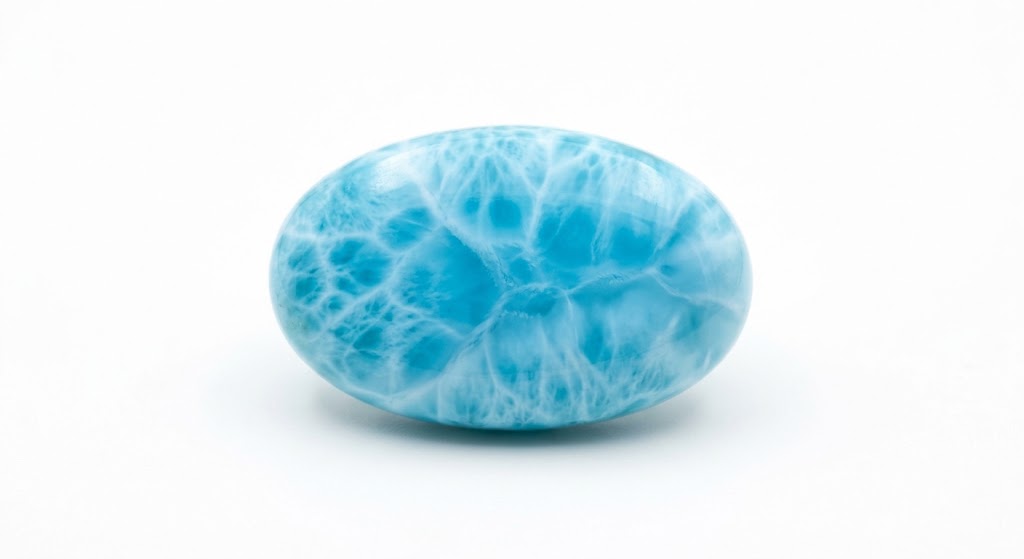
Larimar (The Stone of Atlantis) — Caribbean Blue Treasure, Stone of the Sea Breeze, and Master's Secrets
Larimar ($\text{NaCa}_2\text{Si}_3\text{O}_8(\text{OH})$) is a rare blue variety of pectolite. While common pectolite is widely distributed throughout the world and typically appears gray or white, Larimar's unique Caribbean wave-like sky-blue to deep blue coloration is caused by the substitution of copper ions ($\text{Cu}^{2+}$) for calcium.
Through the eyes of a master craftsman, Larimar is one of the most striking and highly sought-after semi-precious gemstones in modern jewelry arts. Its structure and subtle color transitions turn every single specimen into a unique Caribbean landscape.
Discovery History: The stone was first noticed in 1916 in the Dominican Republic, though its official "rediscovery" and naming took place in 1974 when local craftsman Miguel Méndez and Peace Corps volunteer Norman Rillhart found specimens along the shoreline.
Origin of the Name: Miguel Méndez combined his daughter's name, Larisa, with the Spanish word for sea, Mar, creating the name Larimar.
"The Stone of Atlantis": According to legend, the Dominican Republic is believed to be a remnant of the lost continent of Atlantis. The famous American psychic Edgar Cayce predicted that a blue stone with Atlantean healing powers would be found on one of the Caribbean islands.
Energy and Spiritual Significance: In lithotherapy, Larimar is regarded as a stone of peace, love, and emotional balance. It is deeply connected to the Throat (Vishuddha) chakra. It is believed to help the wearer express their thoughts freely, relieve stress, and attain inner harmony.
When working with Larimar, a lapidary artist must carefully account for its fibrous structure and sensitivity to light.
Chemical Formula: $\text{NaCa}_2\text{Si}_3\text{O}_8(\text{OH})$ (Sodium calcium hydroxy silicate with trace copper).
Crystal System: Triclinic (forms dense fibrous and pectinated radial aggregates).
Hardness (Mohs Scale): 4.5 - 5.0 (Moderate/Low hardness; can be scratched by steel).
Density: $2.70 - 2.90 \text{ g/cm}^3$
Cleavage: Perfect in two directions.
Refractive Index: $1.595 - 1.645$
Color: Sky-blue, light blue, bluish-green with white veins and "cloud-like" or "wave-like" patterns.
Luster: Vitreous, silky on fibrous surfaces.
Larimar is an exclusive mineral — its only commercial deposit in the entire world is located in the Dominican Republic (Barahona Province, Los Chupaderos mine).
Jewelry Art: Extensively featured in sterling silver and gold settings for summer and exclusive designer jewelry pieces (rings, pendants, earrings, bracelets).
Collecting: High-grade specimens featuring deep, vivid blue saturation (frequently referred to as "Volcano Blue") represent valuable collector items.
Faceting and Polishing Features: Larimar is almost exclusively cut into cabochons or freeform domes to best display its sea-wave patterns. Polishing requires low rotational speeds and cooling to prevent damage to its fibrous structure.
Sensitivity to Sunlight: Prolonged exposure to direct sunlight can cause Larimar's color to fade (lightening its vivid blue hue).
Care and Maintenance:
Caution: Due to its low hardness ($4.5-5.0$), protect it from scratches, physical impacts, and harsh chemicals (acids, perfumes, soaps).
Cleaning: Clean strictly using warm water and a soft cloth. Never use steam or ultrasonic cleaning systems.
 511 40 73 13
 info@silveria.ge


 Eng
Eng