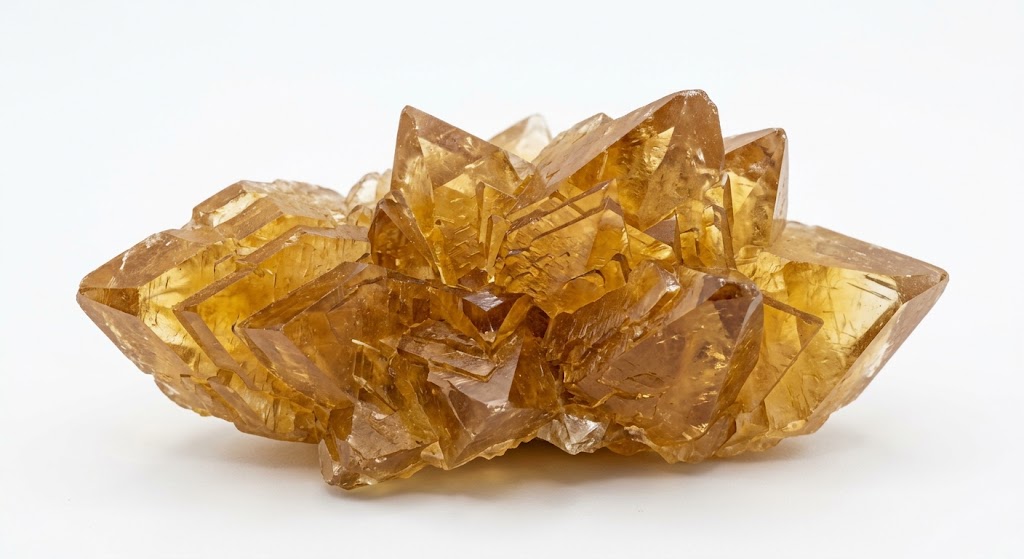
Calcite — A Symphony of Forms and Colors, Master of Double Refraction, and Mineralogist's Secrets
Calcite ($\text{CaCO}_3$) is one of the most abundant and visually diverse minerals on Earth, belonging to the calcium carbonate group. Its name derives from the Latin word "Calx" (lime). Calcite is renowned for its astonishing variety of crystal habits and optical properties, the most famous of which is its strong double refraction (birefringence).
Through the eyes of a master craftsman, calcite represents a true laboratory of nature. Although its low hardness and perfect cleavage make jewelry faceting a challenge, it remains an indispensable material for collectors, decorative arts, and optical instrumentation.
The Viking "Sunstone": Iceland Spar (a completely transparent, optical variety of calcite) is historically linked to Viking navigation. According to legends and scientific hypotheses, Vikings utilized the polarizing properties of calcite crystals to locate the sun on overcast days or during twilight.
Diverse Varieties: Calcite occurs in virtually every color — colorless (Iceland Spar), golden/honey, blue, green, pink (manganocalcite), orange, and red.
Energy and Spiritual Significance: In lithotherapy, calcite is regarded as a powerful cleanser and amplifier of energy. Depending on its color, it aligns with different chakras (e.g., blue with the Throat chakra, golden with the Solar Plexus, pink with the Heart chakra). It is believed to foster spiritual growth, enhance memory, and encourage emotional stability.
When working with calcite, a lapidary artist must strictly account for its low hardness and high sensitivity to acids.
Chemical Formula: $\text{CaCO}_3$ (Calcium carbonate).
Crystal System: Trigonal (forms over 300 distinct crystal habits, including scalenohedrons, rhombohedrons, and prisms).
Hardness (Mohs Scale): 3.0 (The defining reference mineral for 3 on the Mohs scale; very soft, easily scratched by a copper coin or steel knife).
Density: $2.71 \text{ g/cm}^3$
Cleavage: Perfect rhombohedral in 3 directions (at $105^\circ$ angles).
Refractive Index: $1.486 - 1.658$
Birefringence: $0.172$ (Exceptionally high; text or lines viewed through a clear crystal appear visibly doubled).
Color: Colorless, white, yellow, orange, pink, blue, green, brown.
Luster: Vitreous, pearly on cleavage planes.
Calcite is widespread across the globe:
Iceland (Eskifjörður): The historic and famous locality for optical Iceland Spar.
Mexico: The primary source for top-quality vibrant orange, blue, and green calcites.
USA (Tennessee, Missouri): Renowned for magnificent golden and honey-colored crystal clusters.
United Kingdom, China, Brazil, Madagascar, and Morocco.
Collecting and Decorative Arts: Calcite clusters, spheres, and carved ornamental figurines are extraordinarily popular among mineral collectors and interior designers.
Optics: Flawlessly transparent calcite (Iceland Spar) is utilized in polarizing optical instruments (such as Nicol prisms).
Jewelry Art: Due to its soft nature, it is rarely faceted for everyday jewelry (reserved mainly for collector gems). It is more frequently fashioned into cabochons, prayer beads, and decorative pendants.
Acid Reactivity: Calcite reacts immediately with dilute hydrochloric acid (and even household vinegar), effervescing vigorously as it releases carbon dioxide. Keep it away from all chemical agents.
Lapidary Challenges: Given its low hardness ($3.0$) and perfect cleavage, cutting and polishing demand extreme care and minimal pressure to prevent the crystal from cleaving into rhombohedral fragments.
Care and Maintenance:
Caution: Scratches very easily from almost any other stone or metal object.
Cleaning: Clean strictly using a soft dry or slightly damp cloth with warm water. Do not use soaps, household chemicals, steam, or ultrasonic cleaners.
 511 40 73 13
 info@silveria.ge



 Eng