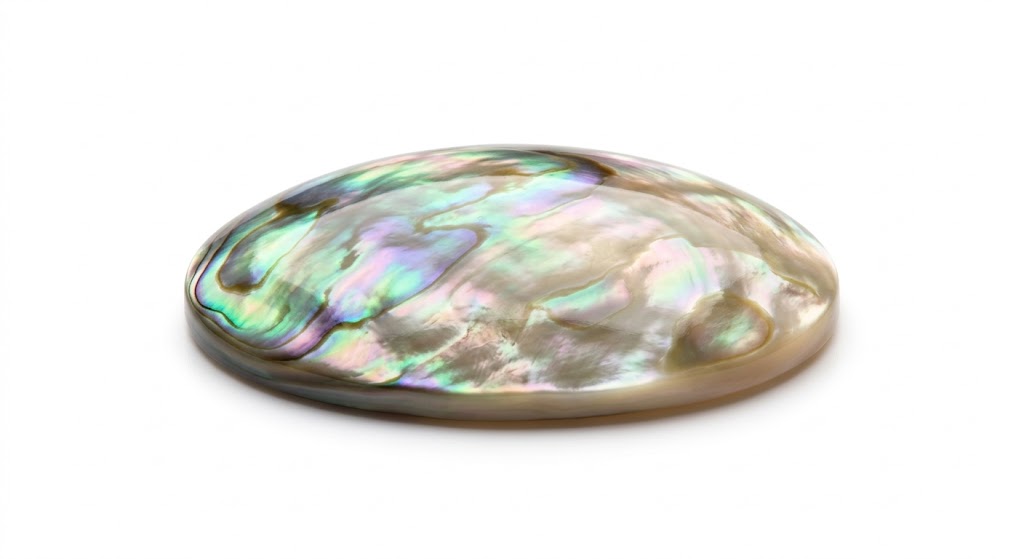
Mother of Pearl (Nacre) — Ocean's Organic Treasure, Light Iridescence, and Master's Secrets
Mother of pearl (nacre) is a unique jewelry material of organic origin formed within the inner layer of the shells of certain mollusks (both marine and freshwater). Mineralogically, it consists of microscopic platelets of aragonite ($\text{CaCO}_3$) bound together by an organic biopolymer — conchiolin. The term "mother of pearl" originates from the German word "Perlmutter" (mother of pearl), as this layer serves as the foundation from which a pearl is born inside the mollusk.
Through the eyes of a master craftsman, mother of pearl is one of the most refined and elegant organic materials. Its delicate iridescent luster and soft color transitions have been utilized for centuries in fine jewelry art and decorative inlay work.
Historical Significance: Mother of pearl has been known to humanity since ancient times. In Ancient Egypt, Sumer, and China, it was used to adorn jewelry, vessels, furniture, and sacred ceremonial items.
Royal Luxury: During the Renaissance in Europe, mother-of-pearl inlaid goblets and caskets were considered symbols of royal luxury.
Energy and Spiritual Significance: In lithotherapy, mother of pearl is regarded as a protector of family harmony, serenity, and intuition. It is closely connected to the Heart (Anahata) and Throat (Vishuddha) chakras. It is believed to protect the wearer from negative emotions, boost immunity, and promote inner peace.
When working with mother of pearl, a master craftsman must carefully account for its layered organic-mineral structure and sensitivity to heat.
Chemical Composition: $\text{CaCO}_3$ (Aragonite, $85-90\%$), water ($4-6\%$), and conchiolin (organic protein, $4-8\%$).
Hardness (Mohs Scale): 3.5 - 4.0 (Low hardness; easily scratched by metal).
Density: $2.60 - 2.78 \text{ g/cm}^3$
Cleavage: None (Exhibits a layered, sheet-like structure).
Refractive Index: $1.530 - 1.685$
Optical Effect: Iridescence — diffraction and interference of light between microscopic, parallel sheets of aragonite.
Color: White, cream, pink, silver, sky-blue, green, golden, and rare black (from the Pinctada margaritifera mollusk).
Luster: Pearly (Nacreous).
Persian Gulf and Red Sea: Historic, ancient sources for high-grade white and cream mother of pearl.
Australia and Pacific Islands: The principal hub for giant mother-of-pearl shells (Pinctada maxima), producing white, golden, and silver specimens.
Tahiti and Polynesia: Renowned for unique black mother of pearl.
Japan, China, and the Philippines: Leading regions for both marine and freshwater mother-of-pearl production.
Jewelry Art: Featured in rings, earrings, pendants, and bracelets (frequently as flat tiles, cabochons, or carved elements).
Watchmaking: Dials for high-end luxury timepieces are often crafted from ultra-thin mother-of-pearl slices.
Decorative and Inlay Art: Ornamentation of furniture, musical instruments (guitar fretboards, piano keys), jewelry boxes, and luxury buttons.
Processing and Cutting: Cutting mother of pearl into thin sheets requires low rotational speeds and continuous water cooling. Dust generated during sawing contains aragonite and conchiolin, making respirators mandatory for the craftsman's safety.
Sensitivity to Chemicals and Heat: Because mother of pearl contains organic matter and bound water, it is highly sensitive to high temperatures, dry air, and harsh chemicals (acids, perfumes, hairsprays).
Care and Maintenance:
Caution: Due to its low hardness ($3.5-4.0$), protect it from scratches and physical impacts.
Cleaning: Clean strictly using warm water and a soft cloth. Do not use soaps, alcohol, household chemicals, steam, or ultrasonic cleaning devices.
 511 40 73 13
 info@silveria.ge



 Eng